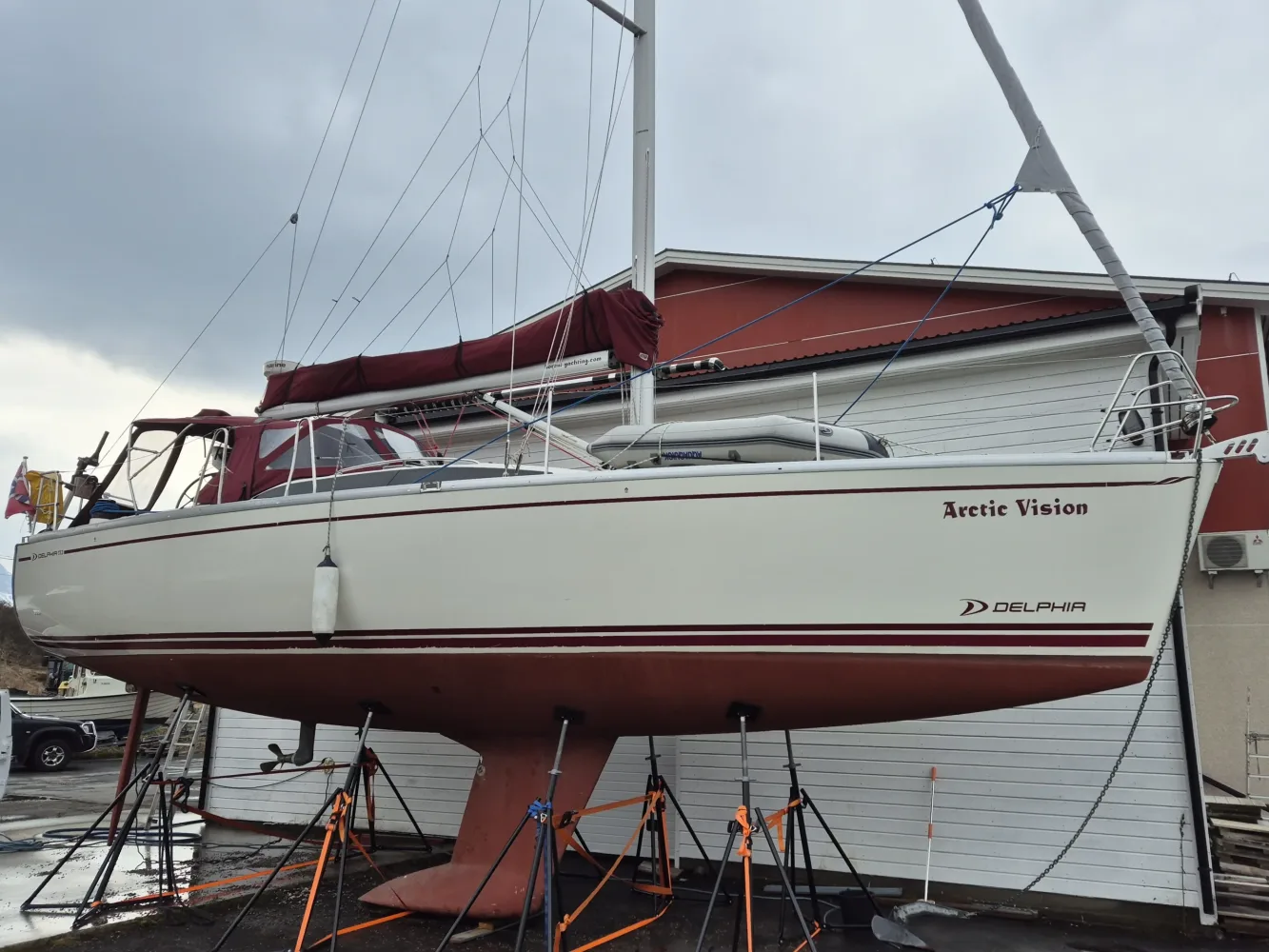
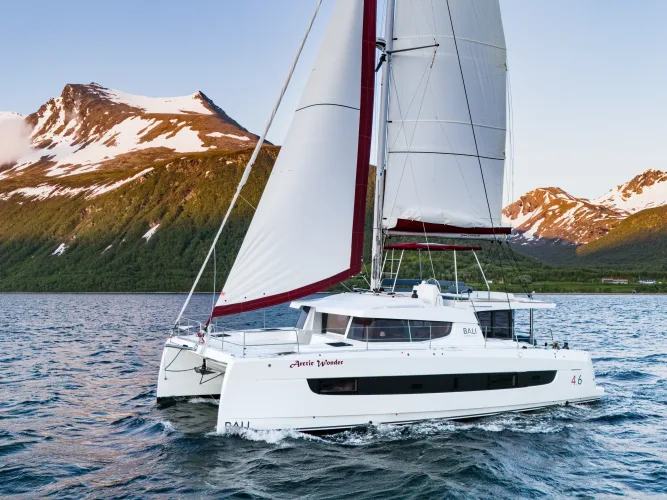
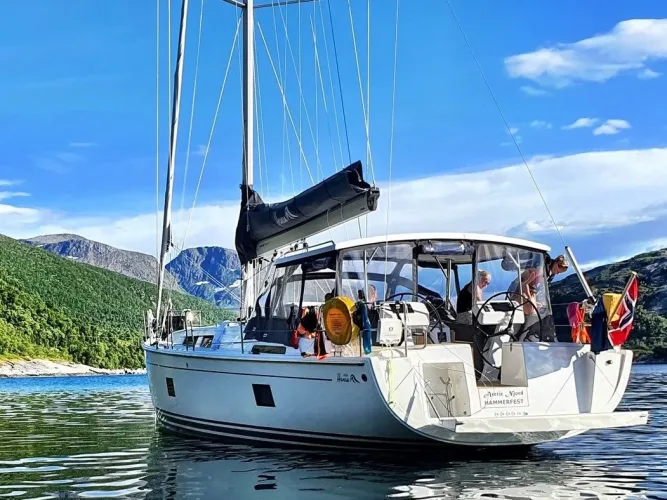
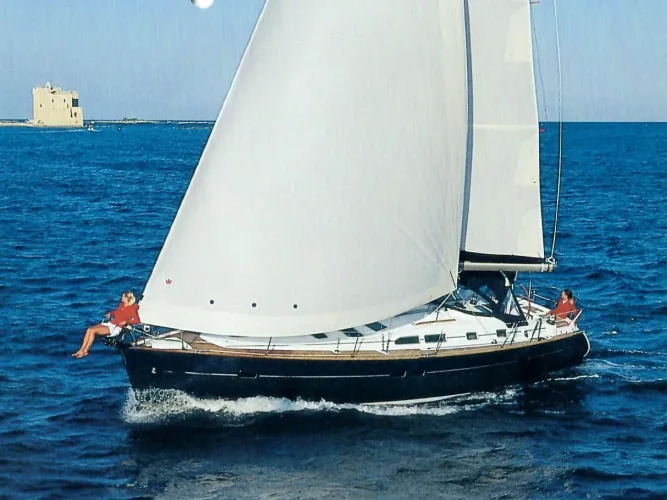
Fourteen boats above the Arctic Circle, thirteen of them monohulls, based at Tromsø, Harstad and — in one case — Longyearbyen on Svalbard at 78° north.
The reason to come is the light. At Tromsø the midnight sun holds above the horizon from late May to mid-July, which means a week with no night in it. That changes how you sail: there is no reason not to move the boat at two in the morning if the wind suits, and crews routinely do. The practical season is June to August, with air temperatures generally between about 7 and 15 °C — you dress for it, and in exchange the water is almost always sheltered because this coast is an archipelago for most of its length.
The cruising is better than the latitude suggests. East of Tromsø the Lyngen peninsula rises straight out of the water to nearly 1,800 metres, and the fjord arms behind it hold glaciers and anchorages with nobody in them. South-west, Senja is a large island with a jagged outer coast and deep quiet fjords on the inside — less visited than Lofoten and closer to both bases. Lofoten itself is within reach from Harstad if the weather cooperates and you commit to it early.
Prices here are noticeably higher than southern Norway — €7,413 to €15,390 against a €2,220 floor around Bergen — which reflects a short season, long logistics and boats equipped for cold.
One scheduling note worth having: 12 of the 14 boats hand over on a Friday rather than a Saturday. That is the source of the mixed pattern you see on the Norway country page.
And one hard boundary: the Longyearbyen listing is not a bareboat week. Svalbard requires the operator to notify the Governor at least eight weeks in advance, register the transit, carry insurance or a bank guarantee covering search and rescue, and — outside Management Area 10 around the settlement — carry means of deterring polar bears. It is crewed for those reasons.