
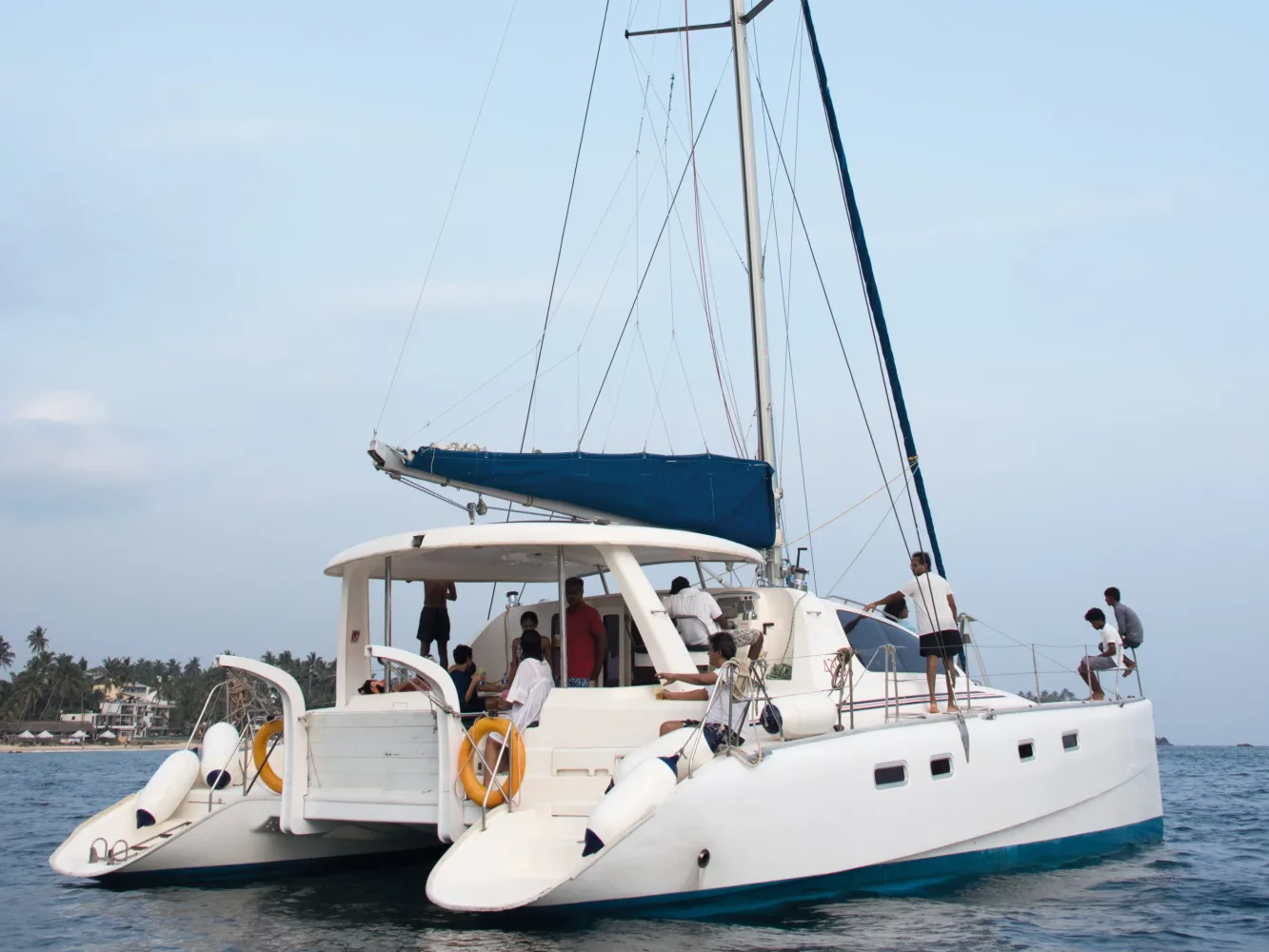
Indian Ocean
Yacht charter in Sri Lanka
Choose from 22 yachts across Sri Lanka. Spread over 1 sailing regions.
-
22Yachts available
-
1Charter regions
-
2Marinas
Why this country
Sailing in Sri Lanka
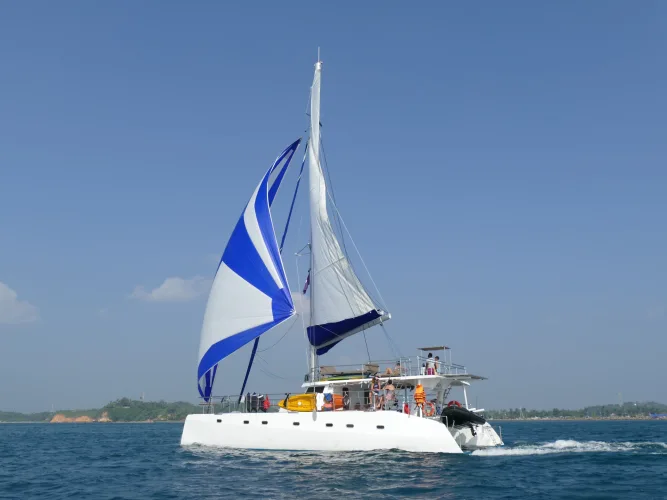
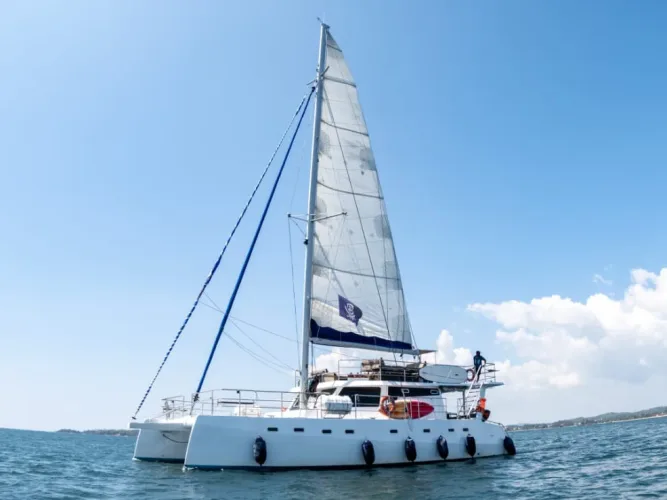
Sri Lanka is not a charter week, and it would be misleading to present it as one. Every one of our 22 boats here is a crewed catamaran, every one is skippered only, and none of them carries a weekly rate — because none of them is sold by the week. They average 19 metres but only 1.2 cabins, which tells you plainly what they are: large day boats, not floating accommodation.
What you are booking is a half-day or full-day expedition, and almost always for one reason. Nineteen of the 22 boats operate out of Mirissa on the south coast, and the water a few miles offshore there holds one of the highest concentrations of blue whales anywhere on the planet. Sperm whales, Bryde's whales, the occasional orca and large pods of spinner and bottlenose dolphins use the same stretch. In the peak months of January to March, sighting rates reported by operators run above 90 per cent.
The season is firm: November to April. Outside those months the south-west monsoon makes the coast uncomfortable and the boats stop running. The three remaining boats are at Colombo, which is a city harbour rather than a cruising base — think a sunset sail or a corporate day out rather than a route.
If you want a week aboard in the Indian Ocean, the honest answer is the Maldives or Seychelles, where our fleets are built for it. If you want to be out at dawn in the right few miles of ocean with a skipper who knows where the whales were yesterday, that is what Sri Lanka is for, and it does it better than almost anywhere.
On the water
Sailing conditions in Sri Lanka
- What you are actually booking
- A crewed day charter
- Season
- November – April
- Peak months
- January – March
- Where the fleet is
- Mirissa and Colombo
- What you will see
- Blue whales, and more
All 22 boats are skippered only and none is priced by the week. They average 19 m but 1.2 cabins — day boats, not a week aboard.
Whale-watching expeditions depart Mirissa daily through these months. Outside them the south-west monsoon shuts the south coast down.
Operators report sighting rates above 90% in this window. December and April still work but are less certain.
19 boats at Mirissa on the south coast — the whale-watching harbour — and 3 at Colombo, which is a city harbour rather than a cruising base.
Blue and sperm whales, Bryde's whales, occasionally orca, and large pods of spinner and bottlenose dolphins. The continental shelf drops away close to shore here, which is why.
Worth the detour
Where to drop anchor in Sri Lanka
-
1
Mirissa — the whale grounds
The boats leave early and run a few miles south to where the shelf falls away. One of the few places in the world where a blue whale is a realistic expectation rather than a lucky break.
-
2
A day aboard rather than a tour boat
The difference between these catamarans and the standard whale trip is space and numbers: a shaded deck, a small group, breakfast and lunch aboard, and time in the water once the whales have moved on.
-
3
Swimming and paddleboarding stops
Most full-day charters include time at anchor off the coast with snorkelling gear and paddleboards. It is the half of the day the whale listings tend not to mention.
-
4
Mirissa and Weligama bays
The two bays either side of the harbour — Weligama is the surf bay, Mirissa the quieter one with the headland and the small island at its eastern end.
-
5
Galle
Half an hour west along the coast: a Dutch-built walled fort on a peninsula, a UNESCO World Heritage Site, and the obvious place to stay either side of a charter.
-
6
Dondra Head
The southernmost point of Sri Lanka, east of Mirissa. The lighthouse marks the corner where the migration route bends — the reason this stretch of coast works at all.
-
7
Colombo harbour
The three city boats sail from here. Sunset and evening charters along the waterfront rather than an expedition; useful if you are in the capital rather than on the coast.
-
8
Combining it with a land trip
A day on the water fits naturally into a Sri Lankan itinerary — the hill country and the cultural triangle are a few hours inland. Treat the boat as one day of a holiday, not the holiday.
Before you book
Local rules and paperwork in Sri Lanka
- No bareboat option
- Every boat here comes with a crew. All 22 listings are skippered only, so no licence or sailing resume is needed from you. The skipper and crew are included in the price rather than an extra.
- Pricing
- By the day or half-day, per person or per boat. There is no weekly rate on any of these boats. Shared departures are usually priced per person; a private charter prices the whole boat. Confirm which you are buying.
- Start time
- Early. Whale-watching departures leave at or before dawn, because the sea is calmest and the sightings best in the first hours. Plan to be in Mirissa or Galle the night before, not travelling that morning.
- Responsible viewing
- Approach distances matter. Mirissa gets busy in peak season and crowding around animals is a known problem. The larger crewed catamarans generally keep their distance better than the small fast boats; it is worth asking an operator directly what their approach policy is.
- Sightings are not guaranteed
- Above 90% in peak season is still not 100%. Operators quote high rates for January to March, but a blank day is possible. Ask what happens if nothing is seen before you book — policies differ.
- If you want a week afloat
- Look at the Maldives or Seychelles. Both have fleets in our catalogue built and priced for liveaboard weeks in the Indian Ocean. Sri Lanka is a day on the water done exceptionally well, and it is better described that way.
Checked October 2026. Rules change — confirm the detail that matters for your trip when you book.
What is here
The Sri Lanka fleet at a glance
The fleet in Sri Lanka is made up of 22 catamarans.
Most boats here are catamarans, averaging 19 metres.
Boats sleep between 2 and 4 guests, with cabins up to 3.
The most common size band is 13 – 16 m, with 10 boats.
22 boats can be chartered with a skipper; 0 are available bareboat.
Space on board
Boat sizes
Sleeping 2–4 guests
- 10 – 13 m 2
- 13 – 16 m 10
- over 20 m 10
Most common models in Sri Lanka
Counted from our live catalogue.
The fleet
Yachts in Sri Lanka
22 yachts available
Where to sail
The one sailing region in Sri Lanka
Every region we have boats in, largest fleet first — with the number of departure bases so you can see where a week actually starts.
Good to know
Frequently asked questions
Our Sri Lanka catalogue currently lists 22 catamarans.
0 of the 22 boats we list in Sri Lanka are available bareboat, meaning you sail them yourself. A recognised licence is required; the listing states which. 22 boats can be chartered with a skipper.
Boats in Sri Lanka sleep from 2 up to 4 guests, with the largest offering 3 cabins. Most groups book a boat in the 13 – 16 m size band.
Ready to explore Sri Lanka by sea?
22 verified yachts across 1 regions.