Galley Up vs Galley Down: Which Layout Suits Your One-Week Charter?
Compare galley‑up and galley‑down catamaran layouts for a one‑week charter and choose the option that matches your crew’s comfort, provisioning needs and social style.

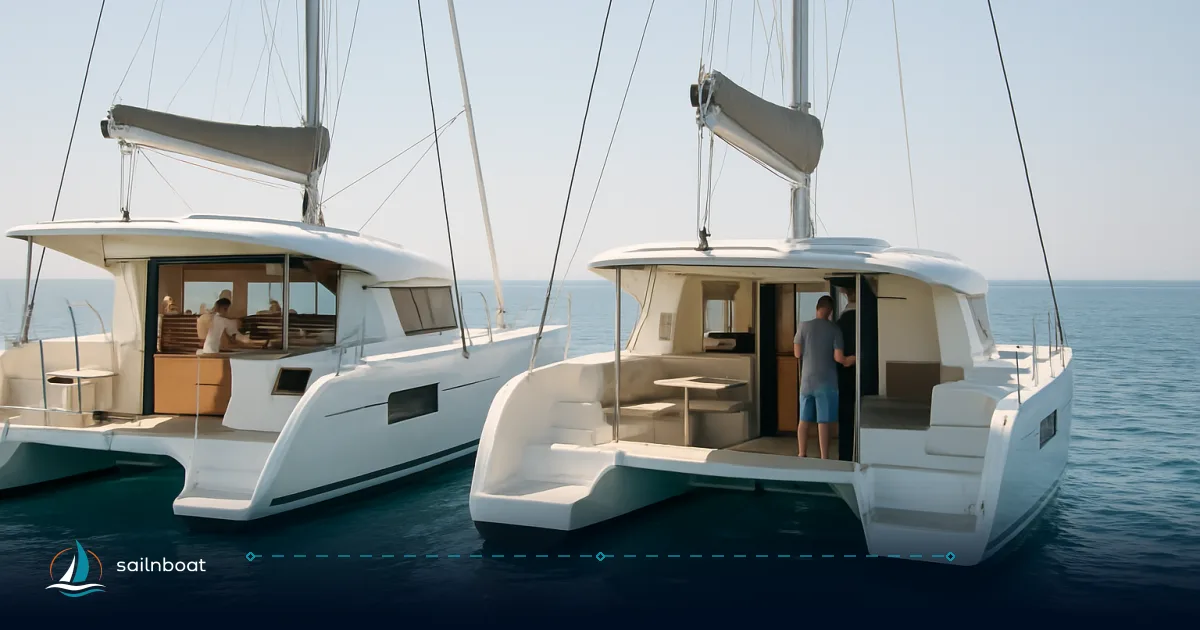
For a one‑week charter the practical choice depends on your crew: galley‑up wins for sociability and fast service, while galley‑down wins when motion sensitivity, a dedicated cook, or extra storage matter more. The charter market in the 40–60ft band is overwhelmingly galley‑up, but several builders now offer both options — ask for the exact inventory layout before you book.
Understanding Galley Layouts in Catamarans
Galley‑Up Layout
A galley‑up sits on the main (bridgedeck) level and is usually part of the saloon or immediately adjacent to it. That layout makes the cook part of the social area: handing plates to the cockpit, pouring drinks through a sliding hatch, or keeping an eye on children in the cockpit are all simple flows. In the charter market this layout is very common because it maximises usable social volume on the main deck and simplifies meal service.
Typical attributes
- Location: main deck/saloon, often L‑ or U‑shaped.
- Social: cook faces or has direct access to the cockpit/saloon.
- Storage: adequate but often less than hull‑mounted galleys because saloon volume is shared.
Galley‑Down Layout
A galley‑down is positioned below the saloon, usually in one of the hulls or in a lower passage. It isolates cooking noise, hides meal prep, and frequently delivers more vertical locker space at eye height and larger dedicated refrigeration/freeze capacity. Designers often prefer galley‑down for boats aimed at long‑distance cruising or owner‑operators who value a “kitchen” feel rather than an integrated saloon galley.
Typical attributes
- Location: hull level beneath the bridgedeck.
- Privacy: chef works out of sight; mess is contained.
- Storage: better locker and bench volume; easier to fit larger fridges/freezers.
Service Flow and Social Interaction
Impact on Meal Service
On a one‑week charter service speed and simplicity matter: galley‑up keeps plates within a step of the table or cockpit and reduces tray‑carrying between levels. That saves time when you’re serving breakfast before a quick snorkel or moving drinks during sundowners. Galley‑down requires either a dedicated hand to shuttle food or a pass‑through hatch — it works, but it’s slower and requires choreography when you have six to ten guests aboard.
Trade‑off: speed vs clutter
- If your group is social and wants the cook present during meals, pick galley‑up.
- If you prefer the saloon to stay tidy and the cook to have a proper workspace, accept the extra steps and choose galley‑down.
Social Dynamics
Galley‑up encourages interaction — guests can chat with the cook, kids are easier to watch, and appetizers can be handed straight to the cockpit. Galley‑down tends to create a service‑style separation: the cook is focused and insulated, which many professional crews prefer but casual holidaymakers may miss. If one or two passengers plan to entertain or act as host/hostess, galley‑up reduces friction; if you’ll hire a cook, galley‑down gives them their own domain.
Motion Sensitivity and Safety Considerations
Stability and Safety
A galley‑down sits closer to the boat’s centre of gravity and typically experiences less vertical and roll motion than the bridgedeck. That makes pot‑handling and working at the stove easier in a sea state, and it reduces the chance of items sliding off counters. For guests prone to seasickness, galley‑down is often more comfortable during passages.
Practical safety points
- Regardless of layout, secure stowage, gimballed trays/ranges (or locking stove covers) and solid grab rails are essential under way.
- If you expect any overnight passages or rough conditions, choose the layout that keeps the cook nearest to the boat’s motion centre (often galley‑down) and confirm the boat’s seagoing fixtures before departure.
Chef’s Safety and Comfort
For a cook working solo, a narrow hull galley lets them brace against both sides while preparing food — a real advantage underway. Galley‑up can be more exposed: the cook may have only one grab point and must navigate an active social space while juggling hot pans. If your charter includes inexperienced helm/watch teams or you plan to cook underway often, prefer galley‑down.
Chef Privacy and Efficiency
Privacy for the Chef
Galley‑down offers deliberate separation: smells, dirty dishes and prep mess remain out of the saloon. That matters if you want the lounge to stay guest‑ready or if a professional chef needs uninterrupted workspace and larger stores. Galley‑up is inherently more exposed, so it’s better suited to short‑term casual meal prep rather than long multi‑course cooking sessions.
Efficiency in Meal Preparation
Efficiency follows space. Galley‑down often yields longer continuous bench runs, taller lockers and better fridge/freezer capacity — attributes that speed provisioning and cooking for a week‑long group. Galley‑up trades off some of those gains for proximity to diners and fewer vertical transitions during service. On charter weeks, that proximity often beats raw kitchen capacity for guest satisfaction; for a cook preparing concentrated meals every day, the storage and workspace of a galley‑down matter more.
Provisioning Logistics: Access and Storage
Access to Provisions
If your plan includes lots of snacks, beer runs, or family style serving, galley‑up keeps the fridge and cupboards a step from the cockpit and table — that reduces movement and keeps the social flow uninterrupted. Galley‑down requires a bit more planning: label crates, stage plates before service, and consider appointing a server to clear and deliver. For a one‑week charter you can work around either layout with sensible provisioning, but the labour pattern differs.
Storage Options
Across many modern designs, galley‑down layouts commonly provide larger, taller lockers and more built‑in refrigeration capacity; galley‑up designs optimise circulating social area at the expense of volume. If you intend heavy provisioning — lots of chilled items, meat, or wine — galley‑down often gives you the usable refrigeration you need without consuming saloon real estate. Builders increasingly offer alternate configurations on larger models so you can choose the storage profile you want.
Recommended Catamaran Models for Your Charter
Below is a compact comparison of representative models and how their typical layouts map to charter use. Always check the exact inventory layout before you book — manufacturers and bases offer multiple versions.
| Model / Builder | Typical layout (charter market) | Best for (one‑week charter) | Why (one line) |
|---|---|---|---|
| Lagoon (e.g., Lagoon 46/50) | Galley‑up (saloon) | Families, party groups | Open saloon → quick service and big social area. |
| Fountaine Pajot (larger models) | Options: galley‑up or galley‑down on bigger yachts | Owner/charter hybrids, cooks | Builder offers both options on flagship models to suit owner vs charter programs. |
| Antares (44/46) | Galley‑down available; confirm layout with builder or charter operator | Long‑range crews, people valuing storage | Antares positions galley‑down for liveaboard comfort; 46 can be ordered galley‑up. |
| Seawind (e.g., 1260) | Galley‑down available on some smaller to mid sizes; confirm with operator | Motion‑sensitive groups, cooks | Seawind highlights galley‑down as practical and safer underway. |
| Windelo (50–58) | Galley‑up or integrated saloon possible; confirm with builder or charter listing | Social groups who want a living‑space galley | Windelo markets an open main deck galley that centres social life. |
| Leopard (45/50) | Galley‑up available in many charter configurations; confirm with charter base | Charter groups, mixed crews | Leopard’s charter variants prioritise saloon volume and easy service. |
| Aventura (44/45) | Galley‑up and U‑shaped layouts possible; confirm with builder or charter documentation | Couples/families who want direct cockpit access | U‑shaped aft‑facing galley opens to cockpit for easy serving. |
Practical note: even on a boat with a galley‑down option, many designs include a pass‑through or sliding hatch so service to the saloon/cockpit is straightforward — the extra steps are mitigated by layout features on modern boats.
Which Layout Should You Pick for a One‑Week Charter?
- Families with kids, groups focused on social time and short hops between anchorages: choose galley‑up. You’ll spend less time ferrying plates and more time in the cockpit.
- Groups with one or two keen cooks, guests who prefer a tidy saloon, or parties including motion‑sensitive people: lean galley‑down for the steadier workspace and larger fridge/locker volume.
- Mixed groups that want both: on larger catamarans where the builder offers both options, pick the layout that prioritises what you do most — sociability (galley‑up) or provisioning and underway cooking (galley‑down).
- Crewed charters where you hire a chef: galley‑down is usually the head chef’s preference; confirm cook workflow and service plan with your charter company before you book.
Checklist before you book
- Ask the base for the exact layout and where the main refrigeration/freezer is located.
- If anyone is motion‑sensitive, ask about the galley’s proximity to the boat’s centre of gravity and presence of grab rails and gimbal appliances.
- Confirm whether the boat has a pass‑through hatch or a cockpit fridge to simplify service from a galley‑down layout.
- If you plan heavy provisioning, request fridge/freezer capacities or a picture of locker arrangements.
Final recommendation
For a typical one‑week charter where meals are casual and your group wants to socialise, go galley‑up. If your week includes longer passages, a professional cook, or a guest with motion issues, pick galley‑down. Wherever you land, check the exact inventory layout and refrigeration specs on the specific boat you’ll charter — builders and charter bases often list multiple versions of the same model.
Consider your crew’s needs and choose the best galley layout for your next charter.
Frequently Asked Questions
Galley‑up sits on the main deck integrated with the saloon/cockpit for social cooking and quick serving; galley‑down is below in a hull or passage for more privacy, storage and a steadier workspace.
Galley‑up minimizes steps and keeps the cook in view of the dining areas; galley‑down requires passing meals up or using a service hatch, which isolates the cook but reduces saloon clutter.
Galley‑down generally feels more stable underway because it sits nearer the boat’s centre of gravity and hull motion is reduced; it’s the better pick if any guest is prone to seasickness.
Galley‑down gives a dedicated workspace and often more bench and locker space, improving efficiency for a chef; galley‑up increases social contact but typically sacrifices some storage and counter area.
Galley‑up makes quick access to the cockpit and serving simple but can limit high‑volume storage; galley‑down often has bigger fridges/freezers and lockers but needs better planning to avoid trips up and down during service.
Smaller and charter‑oriented models are usually galley‑up (examples: many Lagoon and Leopard layouts); Seawind and Antares are known for galley‑down or offering both options; Windelo and Aventura favour open saloon/galley arrangements—always check the exact inventory layout.
Written by
Sailnboat Editorial
The Sailnboat editorial desk covers yacht and boat chartering worldwide — routes, bases, seasons, boat types, paperwork and the practical costs that decide a trip. We are a charter marketplace, not a boat owner or a local agency: what we sell is judgement and support, so our guides are written to help you make a decision, not to sell you a specific boat. Every guide is checked against live operator and marina data before it goes out.
Fact-checked against live operator and marina data, and published under our editorial standards. Last reviewed: .