Best Time to Sail Les Saintes: A Month-by-Month Guide
Month-by-month timing for Les Saintes: trade‑wind windows, where day‑trip ferries crowd the anchorage, key festival dates, and practical steps to secure a mooring.

Les Saintes is easiest to sail from December through April when the northeast trade winds are most reliable; expect steady ENE/NE trades commonly in the mid‑teens of knots, with January–February often the strongest. If your priority is quieter anchorages rather than the absolute windiest days, aim for November–early December or late April–May to avoid the Christmas/Carnival and high‑summer crowds.
Understanding Wind Patterns in Les Saintes
The archipelago sits in the Leeward Islands’ trade‑wind stream; wind direction is dominantly ENE–NE and strength varies seasonally. December–April is the trade‑wind window: winds are most reliable and useful for steady passages and inter‑island hops. Hurricane season runs 1 June–30 November, when winds are more variable with a higher chance of squalls and tropical systems.
Monthly Wind Conditions
Below is a month‑by‑month practical summary for a skipper planning passages and anchorage choices. Numbers are typical seasonal ranges and describe what you should expect operationally (gusts and local acceleration are common near headlands — adjust sail and sea‑state plans accordingly).
- January — Reliable trades, frequently 15–20 kt; many reinforcement days push gusts higher. Good sailing but expect choppy channels.
- February — Often the peak of the trade‑wind season; steady 15–20+ kt and Carnival brings extra people ashore. If you want wind with company, this is it.
- March — Still solid trades (often 12–20 kt); visibility and sea state are usually favourable for coastal legs.
- April — Trades begin to moderate; local regattas and sailing events may take place in spring, sometimes increasing mooring demand on race weekends.
- May — Typical winds drop into the low teens (10–15 kt) at times; good for relaxed coastal runs and longer day sails. Visitor numbers begin to increase near holiday weekends.
- June — Transition to the wet/hurricane season; winds can be variable and squalls more frequent — plan conservative passages and check long‑range tropical outlooks.
- July — Trade strengths vary; afternoon thunder‑showers and squalls are more common. Summer holiday crowds increase demand for moorings.
- August — Peak visitor season ashore; winds can be lighter and sea state choppier; 15 August (Assumption) is a major local festival that affects berthing.
- September — Statistically the most active hurricane month across the basin; avoid committing to exposed anchorages during peak Atlantic activity.
- October — Still within hurricane season; winds can be unstable and ferry services may reduce frequency in unsettled periods.
- November — Trades often start to re‑establish late in the month; quieter than the winter high season and a good shoulder option.
- December — Trades re‑intensify into the winter window; holiday travel increases ferry and marina traffic around Christmas/New Year.
Table: Month-by-month at-a-glance (typical wind in knots / day‑trip traffic / ferry frequency / events)
| Month | Typical wind (kt) | Day‑trip traffic | Ferry frequency (Trois‑Riv./P‑à‑Pitre) | Notable local pressure |
|---|---|---|---|---|
| Jan | 15–20 | High (holiday after New Year lower than Christmas) | High / Medium | Peak trade winds. |
| Feb | 15–20+ | Very high (Carnival weeks) | High / Medium | Carnival increases day visitors. |
| Mar | 12–20 | High | High / Medium | Good sailing; spring events start. |
| Apr | 12–18 | Medium–High | High (Easter) / Medium | Regattas and holiday weekends. |
| May | 10–15 | Medium | Medium | Shoulder season — calmer winds. |
| Jun | Variable | Medium | Medium–Low | Start of hurricane season; local festivals may raise activity. |
| Jul | 10–16 | High (summer holidays) | Medium | Summer tourists; more ferry rotations at weekends. |
| Aug | 10–16 | Very high | Medium | Assumption (15 Aug) — large gatherings and a sailing race. |
| Sep | Variable, often unstable | Medium | Reduced/variable | Peak hurricane climatology risk. |
| Oct | Variable | Medium | Reduced | Hurricane season remains the operational constraint. |
| Nov | 10–16 | Low–Medium | Medium | Trades rebuild late month; quieter anchorages. |
| Dec | 12–20 | High (holiday season) | High / Medium | Reestablished trades; Christmas/New Year crowds. |
(These ranges are typical for the Guadeloupe/Les Saintes area and reflect regional trade‑wind behaviour; local gusts and lee‑effects around high islands can significantly change conditions in channels.)
Day‑Trip Traffic and Anchorage Availability
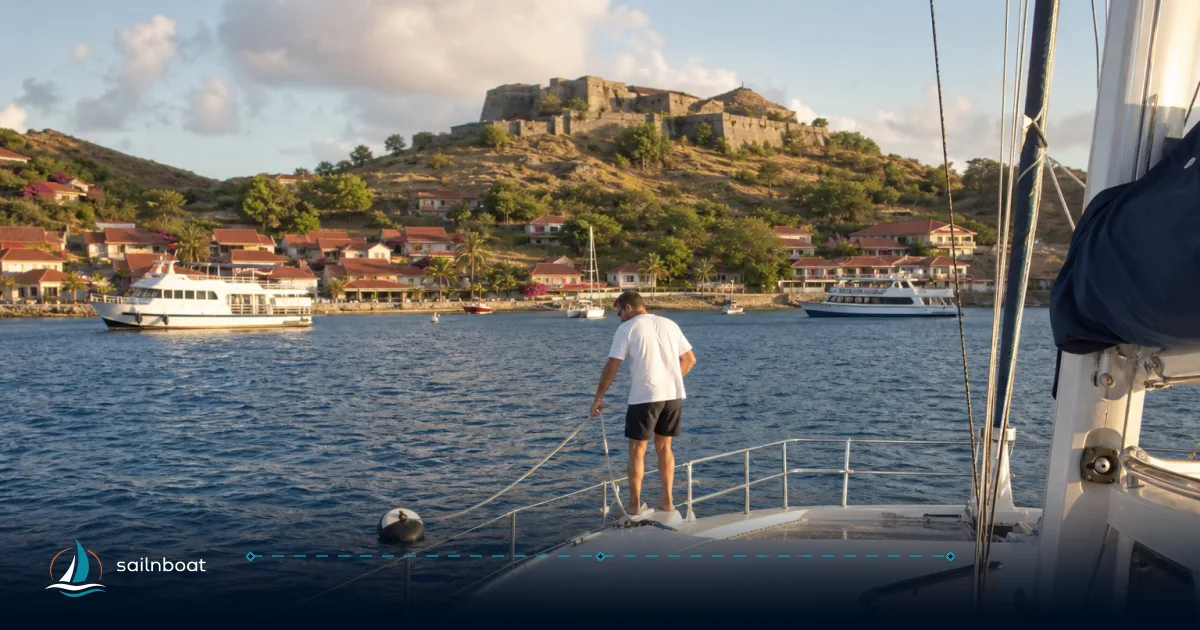
Trois‑Rivières and Pointe‑à‑Pitre are the main ferry gateways; high‑capacity day‑trip services bring a steady pulse of people to Terre‑de‑Haut during the high season. The short Trois‑Rivières crossing concentrates arrivals and departures into discrete morning and late‑afternoon peaks — on weekends and holiday weeks that pulse can fill public moorings and pontoons by mid‑morning. Expect the biggest crowd pressure on Saturday and Sunday mornings and on public‑holiday dates.
Operational implications for you and your crew:
- Arrive early to secure a buoy or marina berth on high‑traffic days. Weekends and Carnival weeks often fill by mid-morning.
- If the harbour is full, have a fallback plan: short hop to a quieter bay on Terre‑de‑Bas or use an outer anchor with stern‑to the beach — but be prepared for wakes from fast ferries.
- Night berthing in the main village is convenient for provisioning and crew shore time, but expect loud evening activity during festivals and holidays.
Ferry Schedules and Logistics
Operators: FRS Express des Îles and CTM Deher are the primary high‑frequency services between Trois‑Rivières and Les Saintes; smaller operators (Comadile/Val Ferry) provide additional seasonal and Marie‑Galante links. Crossing times and the number of daily rotations differ by route: Trois‑Rivières → Terre‑de‑Haut is a short hop (roughly 25–35 minutes) and runs multiple times per day; Pointe‑à‑Pitre → Les Saintes is a longer crossing (around 50 minutes) with fewer rotations daily. Schedules expand in peak season and on public holidays.
Practical notes for crew changes and provisioning:
- For same‑day crew transfers or provisioning, Trois‑Rivières is usually quicker and more reliable because crossings are shorter and more frequent. Block at least an hour for a crew change (embarkation + transit + transit time back to the boat).
- Ferry capacity can be large (some fast ferries carry hundreds of passengers), so ticketing and early reservations matter on busy dates. Operators publish timetables but routes and times change by season — always check operator timetables within 72 hours of travel.
- Off‑peak departures (late morning or mid‑afternoon) are less crowded and easier for a quick provisioning run.
Local Events Impacting Mooring Options
Several recurring events push demand ashore and on the water. These are the ones that most directly affect mooring and anchoring:
- Carnival (late January–February, peak on Mardi Gras): attracts large street processions and day visitors — moorings in Terre‑de‑Haut fill early on parade days.
- Fête de la Pêche (around 11 June): a local fishing festival with boats and shore activity that can increase waterfront activity and demand for moorings.
- Assumption (15 August) and the related local sailing race: a national holiday with island‑wide celebrations and a traditional sailing event that swells anchorage demand and launches many small craft. Expect limited berthing and higher noise levels.
- Spring regattas and regional races: when entries visit Les Saintes the harbour and buoys can be reserved; organisers may coordinate temporary race mooring zones. Confirm event dates locally.
Calendar advice: festival dates shift and organisers update annually — if you plan to be in port for one of these celebrations, reserve marina space well in advance and expect to pay a premium for berthing.
Best Months to Sail and Avoid Crowds
Decision rule: if you prioritise reliable sailing conditions, choose the trade‑wind window (December–April). If you prioritise quiet anchorages with decent sailing, pick the shoulder windows around November–early December or late April–May.
- Best for steady sailing (but expect more people): mid‑December through March; January–February are the windiest and most reliable for passage planning. Carnival and the Christmas/New Year weeks increase ashore crowds — plan around those dates if quiet is important.
- Best for fewer crowds with workable winds: November–early December and late April–May. Winds are often good enough for enjoyable passages and anchorages are quieter than the winter peak.
- Months to avoid for safety and operational unpredictability: September (and peak hurricane months broadly August–October) due to elevated basin‑wide tropical risk; if you do cruise then, keep flexible exit plans and monitor official forecasts.
Trade‑off summary: winter months = best winds + more visitors; shoulder months = quieter + slightly lighter winds; hurricane season = avoid unless you have a specific, well‑supported operational reason and contingency plan.
Practical Tips for Your Sailing Adventure
- Moorings and arrival timing: To improve your chance of securing a buoy or berth on a busy day, arrive before 09:00. Weekends and festival days fill fast. Bring extra stern lines and fenders for close‑quarters raftings.
- Crew changes and provisioning: Use Trois‑Rivières for short runs and Pointe‑à‑Pitre for larger provisioning trips — allow time for island transit and the ferry timetable. Reserve ferry tickets on busy dates.
- Weather monitoring: During the trade‑wind season watch both synoptic charts and local squall lines; during hurricane season (June 1–Nov 30) monitor NOAA/NHC updates and local maritime advisories daily.
- Festival planning: If your itinerary overlaps Carnival, early June, or 15 August, book berthing early and expect busy local services — plan a quiet alternative anchorage nearby.
- Safety and insurance: Many charterers reduce exposure by avoiding September and by keeping open options to move to more protected anchorages or a mainland base should a tropical system threaten. Confirm your insurance policy’s terms for trips during hurricane season.
Final operational checklist before you go:
- Confirm ferry timetables with FRS/CTM/Comadile within 72 hours of the planned transfer.
- Book marina berths for festival dates and weekends during December–March.
- Run a pre‑departure weather brief for the channel between Guadeloupe and Les Saintes and file a float plan if you will be offshore for multiple legs.
Plan your sailing itinerary to Les Saintes with the wind‑window and local events in mind: pick December–April for the most reliable sail, reserve moorings ahead for any holiday or festival, and treat June–November as a season that requires active weather contingency planning.
Frequently Asked Questions
East‑northeasterly trade winds dominate. The most reliable, steady trades are December–April (typically mid‑teens knots, with January–February often strongest); winds usually ease through late spring and can become variable during hurricane season (June–November).
High‑capacity ferry services bring large day‑trip numbers, especially on weekends and holiday weeks; Terre‑de‑Haut harbour and mooring buoys fill early — arriving before mid‑morning gives the best chance of a tourist‑free buoy.
Operators such as FRS Express des Îles and CTM Deher run multiple daily crossings from Trois‑Rivières (short—roughly 25–35 minutes) and a few rotations from Pointe‑à‑Pitre (longer—about 50 minutes); frequency increases during peak season and school holidays.
Carnival in February, the Fête de la Pêche in June (around 11 June) and the Assumption (15 August) all draw locals and visitors and can severely limit mooring and anchorage options.
For a balance of steady wind and lower visitor numbers choose November–early December or late April–May; December–March offers the best winds but includes holiday and Carnival crowd spikes.
Written by
Sailnboat Editorial
The Sailnboat editorial desk covers yacht and boat chartering worldwide — routes, bases, seasons, boat types, paperwork and the practical costs that decide a trip. We are a charter marketplace, not a boat owner or a local agency: what we sell is judgement and support, so our guides are written to help you make a decision, not to sell you a specific boat. Every guide is checked against live operator and marina data before it goes out.
Fact-checked against live operator and marina data, and published under our editorial standards. Last reviewed: .