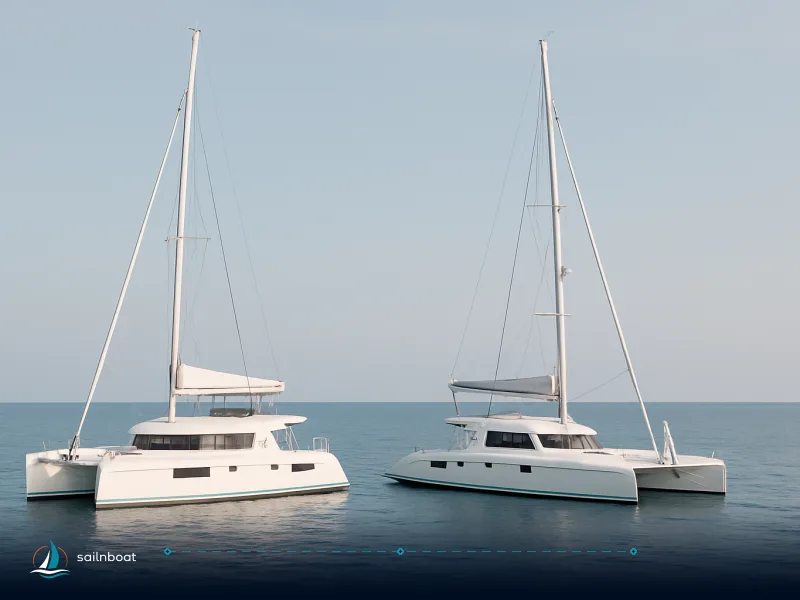
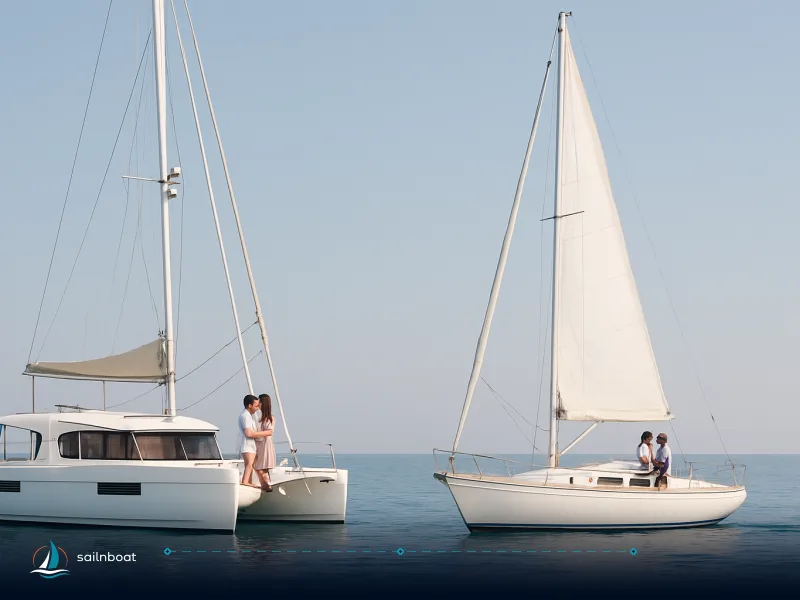
Catamaran vs Monohull: Space and Comfort for Chartering
If you prioritise usable living space and a low-heel platform, catamarans usually deliver; if you want an engaging sail and lower charter and berth costs, monohulls often win. This guide compares space and comfort, draft, layouts and costs so you can choose the right charter for your crew.

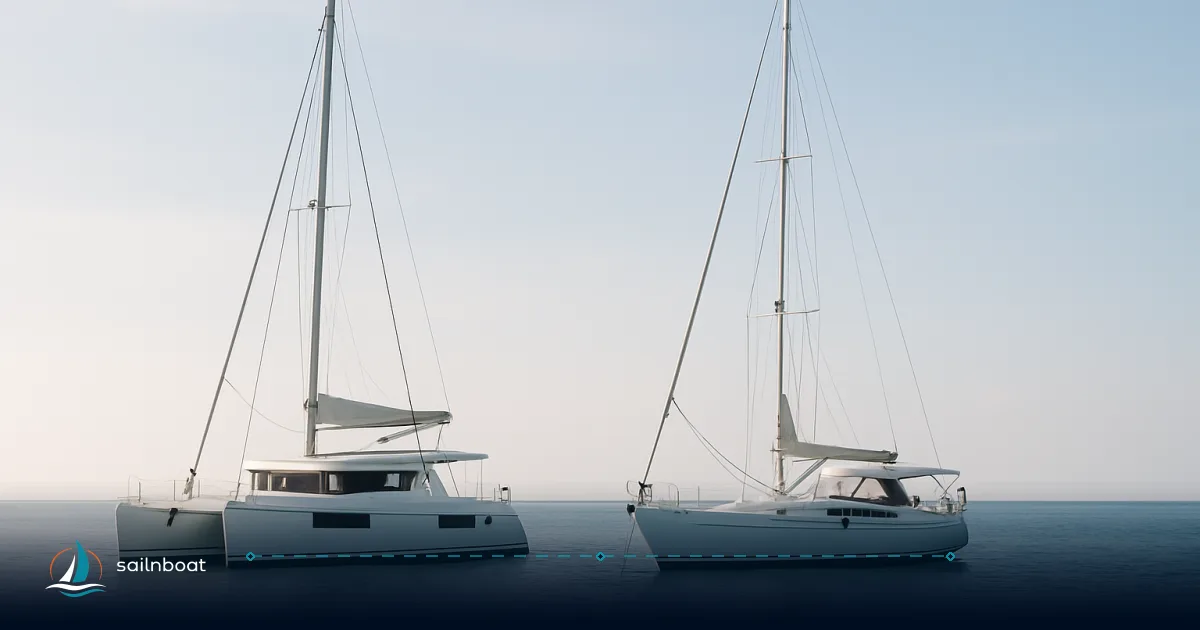
If space and comfort are the decisive factors for your next bareboat or skippered charter, a catamaran will usually give you more usable living area and a flatter, less nauseating ride; a monohull will give you a more traditional heeling sail, generally lower hire and berth costs, and simpler systems to maintain. Below I compare stability, interior layouts, draft and the real cost trade-offs so you can choose the right boat for your crew.
Stability and Heeling: How Catamarans and Monohulls Differ
Stability in Rough Seas
Catamarans get their stability from two widely spaced hulls and buoyancy rather than a deep ballast keel. That means a cruising cat will sail nearly upright in most conditions and resists sustained heel; capsize requires exceptional conditions. This high initial stability is what charterers notice first—there’s little sideways tilt when you stand in the saloon or move across deck. Practical effect: guests can walk about, cook and move between cockpit and saloon with far less need to brace for a heel.
Monohulls rely on ballast and hull shape for righting moment. They heel under sail, which changes the distribution of forces and motion patterns: monohulls typically point higher to windward than most charter cats because their deeper, more efficient foils generate more lift with less leeway; optimal pointing is with moderate heel, as excessive heel increases leeway and reduces performance. Any tendency for a monohull to pitch more gently in a head sea is mainly due to hull form, displacement and weight distribution, not the keel 'coupling' with the hull. Experienced sailors prize the feedback and “connected” sensation of a mono under sail; it is a trade-off, not a defect.
Impact on Comfort
Less heel equals two clear comfort wins for cats: reduced risk of seasickness for sensitive guests, and more continuously usable floor and deck space (furniture and tables stay level). Many charter operators and builders explicitly market catamarans for queasy crews and family holidays because of that predictable, upright ride. That said, cats can have a quicker, lateral “jerk” in steep confused seas—some people describe this as a different, less familiar motion than a mono’s slow pendulum. If your party values minimal heeling and easy movement, the cat is usually the better choice.
Interior Space: Comparing Living Areas and Cabin Layouts
Living Areas
The headline reason people choose a cat for charter is space. A cat’s beam on production 35–45ft models commonly runs around 6–7.5 m, versus roughly 3.8–4.5 m for a same‑length monohull — that extra width converts directly to usable salon, cockpit and foredeck living area. Designers exploit that by pushing the saloon coachroof wider, adding large sliding doors and connecting cockpit and saloon into one continuous indoor/outdoor living room on many modern cats. Expect larger windows, more headroom and a less compartmented feel than most monohulls of the same LOA.
A concrete example: a Lagoon 40 (a common 40ft charter cat) has a saloon and cockpit flow that effectively doubles the communal living area compared with many 40ft monohull saloons, and producers routinely fit these cats with large cockpit tables and lounge zones that become the social centre.
Cabin Configurations
Charter catamarans are typically offered in 3–4 cabin charter layouts where each hull contains double cabins — many charter cats in the 40–46ft range ship in 3‑ or 4‑cabin layouts, and 4‑head versions (one head per cabin) are common in the charter fleet. That gives groups more private en-suite heads and fewer compromises over who uses the day-head.
Monohulls of similar LOA commonly come as 2–3 cabin designs with 1–2 heads. A 40–41ft monohull such as the Oceanis 41 frequently appears in charter listings as a 3‑cabin / 2‑head boat — useful and comfortable, but not the equal in per‑person private space you’ll see on a 40ft cat configured for charter. If your party needs equal-en‑suite cabins and private bathrooms for each couple, a cat will often deliver that without jumping to a much larger LOA.
Draft and Accessibility: Impact on Mooring and Anchoring Options
Draft Measurements
A practical advantage of most charter cats is shallower draft. Common production cruising cats in the 40–46ft bracket typically draw in the region of ~1.1–1.4 m (3.6–4.6 ft), while many production monohulls of similar length more often draw around ~1.8–2.2 m (6–7.2 ft) depending on keel type. That difference is enough to let a cat approach sandbars, beach anchorages and shallow coves that would exclude a typical mono. Examples: Lagoon models list drafts near 1.25–1.35 m; popular Beneteau Oceanis monohulls list drafts around 1.95–2.17 m in standard configurations. Always check the specific boat’s spec sheet before you plan an anchorage.
Mooring and Docking Considerations
Shallow draft on a cat stretches your itinerary: you can anchor closer to shore, use sand beaches for dinghy access, and enter shallow coves where monohulls must stand off. On the flip side, a cat’s beam can complicate marina berthing — some older harbours have narrow slips and either charge a beam surcharge or require an end-tie. Many marinas apply a catamaran multiplier or premium for wide berths; plan accordingly when budgeting and when selecting bases. Monohulls generally slip into existing finger berths more easily and may not attract the same berth premium.
Charter Costs: Evaluating the Financial Implications of Each Option
Charter Fees
Market surveys and major charter brokers repeatedly show a clear premium to hire a catamaran versus a comparable‑length monohull. Typical headline figures reported across the charter market indicate a significant premium to hire a catamaran versus a comparable LOA monohull, though the exact percentage varies by region, season, boat age, and how you compare guest spaces. For groups, the per‑person cost can narrow if you fill a larger cat, but the absolute weekly hull fee is usually higher.
Expect the higher charter fee to reflect three economics: (1) higher purchase price for new cats, (2) higher demand from comfort‑focused holidaymakers, and (3) operationally higher berth and servicing costs that owners pass along. Typical add-ons — provisioning, port taxes, fuel, and an APA or refundable security deposit — remain similar in structure but scale with the boat’s size and systems.
Value for Money
The trade-off is straightforward. If your priority is usable communal space, private en‑suites for a multi‑couple group, and a stable platform that reduces seasickness, a cat will often be better value per person for larger parties. If your party values sailing performance, lower charter and berth costs, or you’ll be sailing windward‑heavy passages, a monohull is often a wiser, cheaper option. When comparing offers, compare both total weekly cost and cost per guest for the realistic party size you expect to carry.
Comparison table — pick the decisive metrics at a glance
| Metric | Typical catamaran (40–45ft) | Typical monohull (40–45ft) |
|---|---|---|
| Beam | ~6.0–7.5 m (much wider usable living area). | ~3.8–4.5 m (narrower salon/cockpit). |
| Draft | ~1.1–1.4 m (shallow; better access to coves). | ~1.8–2.2 m (deeper; better windward pointing in many designs). |
| Typical charter premium | Often significantly higher than equivalent LOA mono; exact percentage varies by region and season. | Baseline (lower headline weekly rate). |
| Cabins / Heads (charter layout) | Often 3–4 cabins with 3–4 heads (one‑per‑cabin common). | Typically 2–3 cabins with 1–2 heads on many 40ft models. |
| Berthing & maintenance | Higher: twin engines, more hull area to antifoul, possible cat surcharge on berths. | Lower: single engine, narrower berth needs; fewer service items. |
| Motion at anchor/sea | Less heel, easier aboard for non-sailors; different lateral motion possible. | Heels under sail, pitching/rolling patterns familiar to sailors. |
Suitability for Families and Groups Seeking Comfort
Family-Friendly Features
Cats are optimised for family charters. The combination of stable platform, more deck space and multiple en‑suite cabins means children and older relatives have safer movement and privacy. Many charter cats also offer large swim platforms and easy water access from either hull. If your crew includes anyone who’s prone to seasickness, a cat is often the most practical option and reduces the need for medication across the group.
Monohulls suit smaller family groups or crews that want a more traditional sailing feel. They are often easier to single‑hand or short‑crew because systems and deck layouts prioritise all‑around sail control and lower windage. For families who want active sailing and don’t require four equal cabins, a mono can be more economical and satisfy the sailing itch.
Group Comfort
For social life—meal times, lounging and moving between sunbathing, dining and cooking—a cat typically wins: the salon‑cockpit flow and larger foredeck make it easier to host a group without bumping into each other. For eight guests split into couples, a cat with four cabins and private heads changes the dynamic from “who takes the day-head” to “everyone has their own space.” That alone can tip the value calculus even with a higher headline charter fee.
Final Thoughts on Space and Comfort
Making Your Choice
Decide on two things first: (1) how many equal‑size cabins and private heads you actually need, and (2) how much of your week you’ll spend under sail versus anchored and socialising. If private space and a flat, easy platform top the list, favour a catamaran and budget for the charter premium and possible marina surcharges. If you prefer a more sailing‑centric experience, tighter budgets, or marina availability is a concern, choose a monohull. Either way, compare the specific model’s specs (draft, beam, cabins/heads), the charter contract’s inclusions (fuel, insurance waiver, skipper), and the base’s berth policy before you sign.
If you want a quick next step: shortlist two models at the same base (one cat, one mono), compare the total all‑in week cost for your actual party size, and check the exact draft and cabin configuration for each — that single check will reveal which trade-offs matter most for your charter.
Evaluate your needs and choose the best charter option for your crew.
Frequently Asked Questions
Catamarans resist heeling and stay much flatter under sail because stability comes from hull spacing and buoyancy; monohulls heel and rely on ballast for righting, which changes the motion and feel of the boat.
On the same LOA, catamarans usually offer a wider beam and more continuous indoor/outdoor living area; that translates into more cabins, more heads and larger communal salons than a comparable-length monohull.
Cats’ shallower drafts let you anchor closer to shore and visit shallow bays that are off-limits to many monohulls with deeper keels; this widens itinerary choices in shallow cruising grounds.
Charter rates for cats are generally higher (commonly 40–75% more); ownership and running costs are also higher due to twin engines, larger wetted surface and wider-berth premiums charged by many marinas.
For families or larger groups prioritising space, separate cabins and a stable platform, catamarans usually offer better comfort; if budget or deeper-water sailing performance matters more, a monohull can fit the brief.
Written by
Sailnboat Editorial
The Sailnboat editorial desk covers yacht and boat chartering worldwide — routes, bases, seasons, boat types, paperwork and the practical costs that decide a trip. We are a charter marketplace, not a boat owner or a local agency: what we sell is judgement and support, so our guides are written to help you make a decision, not to sell you a specific boat. Every guide is checked against live operator and marina data before it goes out.
Fact-checked against live operator and marina data, and published under our editorial standards. Last reviewed: .