How to Verify Yacht Ownership Before You Book: A Broker‑Level Checklist
A practical, broker-level workflow to verify yacht ownership before you commit: which documents to demand, registries to check, how to use photos and AIS, red flags, and when to call in experts.

You can and should verify yacht ownership before you book — it’s the single best way to avoid title disputes, hidden liens, and last‑minute cancellations. To verify yacht ownership quickly and reliably, request the right documents, cross‑check registries (NVDC for U.S. documented vessels; Equasis for IMO‑listed ships), and corroborate identifiers with photos and AIS; escalate to an Abstract of Title, a surveyor or escrow when anything looks inconsistent.
Essential Documents for Yacht Ownership Verification
Start here: documents are the primary evidence of ownership and the keys to registry searches.
Key Documents to Request
- Certificate of Documentation (U.S. documented vessels) or the relevant state title/registration. These are the documents authorities accept as proof of who is listed as owner.
- Bill of Sale or sale contract (signed, dated, notarised where appropriate). The bill of sale records the transfer and the parties.
- Hull Identification Number (HIN). In the U.S. the HIN follows a defined 12‑character format; it’s a permanent identifier you’ll match across paperwork and photos.
- Official number / IMO number / MMSI / radio call sign. Different registries use different identifiers; collect whatever applies to the vessel.
- Proof of identity and address for the registered owner (passport, corporate documents if the owner is a company). For complex ownership structures you’ll also want company registration documents and powers of attorney.
- Proof of lien release or mortgage satisfaction (if the seller claims the vessel is unencumbered). For U.S. documented vessels, an Abstract of Title from NVDC shows recorded mortgages and notices of claim of lien.
Practical handling: always ask the seller to provide certified copies where available (NVDC certified copy, notarised bills of sale). Keep all timestamps and file names when the seller sends PDFs — edit history, scan quality and inconsistent fonts are useful clues for later checks.
Table — Documents, where to verify, and what to watch for
| Document | Where to verify | What it proves | Typical red flags |
|---|---|---|---|
| Certificate of Documentation / state title | USCG NVDC eStorefront / state DMV | Registered owner and official number | Different owner name than seller, altered dates |
| Bill of Sale | Seller, notarisation office | Evidence of transfer | Missing signatures, handwritten amounts changed |
| HIN | Registry entry / transom photo | Unique hull identifier | HIN mismatches, scratched/obscured HIN on hull |
| IMO / Official number / MMSI | Equasis / NVDC / AIS databases | International identifier for cross-referencing | Different IMO/MMSI between registry and AIS records |
| Abstract of Title | NVDC (US) or equivalent | Chain of title, mortgages, liens | Recorded liens, multiple mortgages |
(Use the table to prioritise what you request before moving money.)
Consulting Public Registries and Databases
Registries convert the paperwork you collect into independently verifiable facts.
Accessing Public Registries
- USCG NVDC (National Vessel Documentation Center): for U.S. documented vessels the NVDC is the authoritative resource. You can order certified copies of the Certificate of Documentation and request an Abstract of Title (CG‑1332) that shows recorded mortgages and claims of lien; NVDC provides an eStorefront for these products. Requesting an Abstract is a standard next step when title or liens are in question.
- Equasis: a free service focused on commercial and IMO‑numbered ships. New users must register; Equasis allows searches by IMO number, call sign or ship name and provides company and registry information useful for cross‑checking ownership claims on larger yachts and commercial vessels.
- Commercial databases and AIS aggregators (MarineTraffic, VesselFinder): use these to gather MMSI/IMO/callsign history and recent positions — they are widely used for corroboration but are not typically accepted as legal proof of title.
How to interpret registry data
- Match identifiers: owner name, official number/IMO, HIN, and callsign/MMSI. If two of these fields line up but one doesn’t, the mismatch is meaningful and must be reconciled.
- Look at recorded instruments: Abstracts of Title list mortgages, bills of sale and liens; a recorded lien means the lender’s consent or payoff will be required on transfer. NVDC allows anyone to request an Abstract; this is how many buyers confirm encumbrances on U.S. documented vessels.
Practical steps
- Collect the vessel’s HIN, official number, IMO (if present), MMSI and full vessel name.
- Run searches: NVDC for U.S. documentation/Abstracts; Equasis for IMO/corporate history; commercial aggregators for AIS and ownership metadata.
- Reconcile names, dates and numbers — don’t assume a registry is up‑to‑date; use it as the authoritative baseline for formal checks.
Using Photographic Evidence and AIS Data
Documents tell you “who”; photos and AIS help confirm “which boat”.
Corroborating Ownership Claims
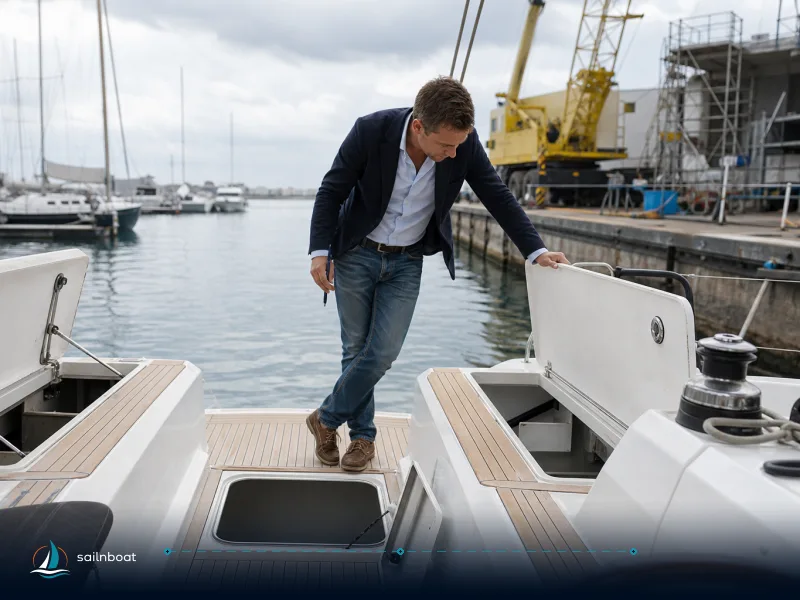
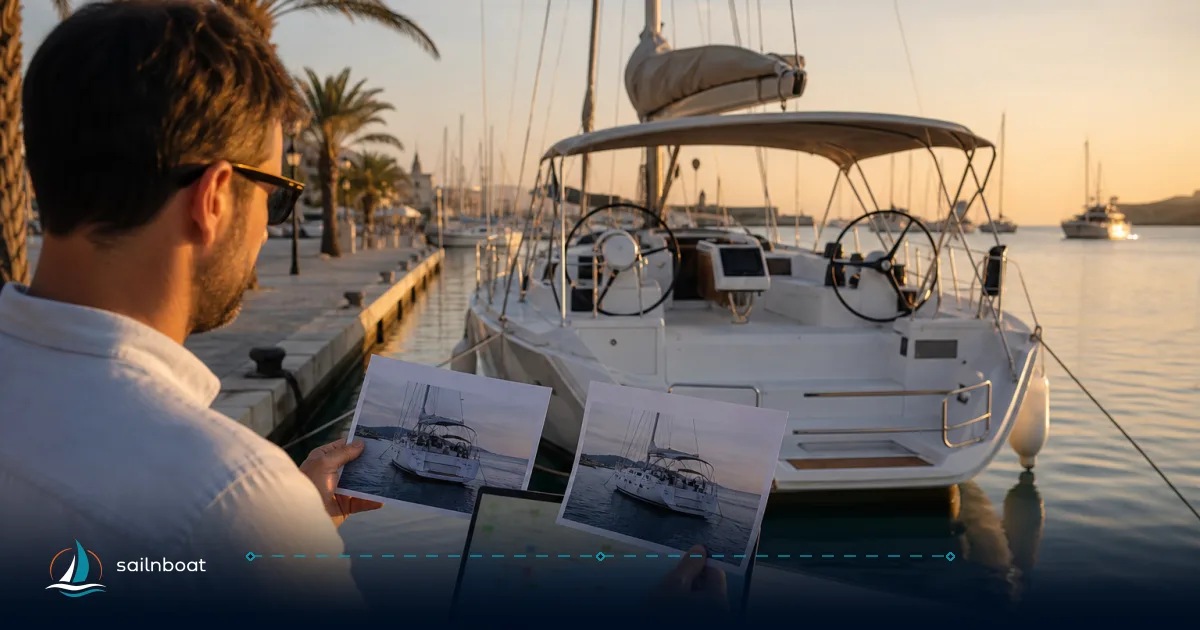
- Photographs: request high‑resolution photos of the transom (where the HIN is normally stamped or plate‑mounted), the stern showing the name and hailing port, hull sides showing official number, steering station instruments (where serials live) and engine plates. Match serials and the HIN placement against the documented HIN format. If the HIN is obscured, insist on an in‑person inspection or survey. US guidance prescribes where and how HINs are formatted and displayed.
- AIS/MMSI/IMO: use AIS to check recent movements and whether the vessel’s MMSI/callsign agrees with registry entries. AIS is excellent for corroborating that a named vessel was at the advertised berth or cruising area recently, but AIS can be misconfigured or spoofed; treat it as supporting evidence, not a sole proof of ownership.
Practical checks
- Match three identifiers across sources: one visual (transom/HIN), one registry (official number/IMO), and one live trace (AIS/MMSI). If all three match, you have strong corroboration.
- If the seller provides only phone photos or cropped scans, ask for raw images (EXIF timestamps) or an arranged inspection — poor photo provenance is a common evasion tactic.
Identifying Common Red Flags
Verify the facts — and be prepared to walk away.
Common Issues to Watch For
- Identifier mismatches: owner name differs between bill of sale, registry and the person you meet. Mismatched HIN, official number or IMO are a primary red flag.
- Edited or inconsistent documents: differing fonts, pixel artefacts in scanned PDFs, missing notarisation where one is expected, or documents that look retyped. The NVDC warns against false statements on documentation and treats fraudulent submissions seriously.
- Evidence of tampering on the hull: HIN plates scratched, repainted transoms with sloppy repainting around the registration, or serial plates on engines inconsistent with paperwork. HIN validation guidance clarifies what constitutes a valid HIN.
- Pressure to move fast or requests to wire deposits to personal accounts: these behavioural red flags frequently accompany title or lien issues. Brokers usually use licensed escrow or trust accounts for deposits.
What to do when you see red flags
- Stop. Do not send money. Ask for an Abstract of Title (or equivalent), independent survey, and a short, written chain‑of‑title showing how the seller obtained the vessel. If the seller refuses, you should treat the sale as high risk.
When to Seek Independent Verification or Escrow Services
Escalate when complexity or risk increases.
Scenarios Requiring Extra Caution
- Complex ownership (companies, trusts, nominee owners). Company documents, powers of attorney and proof that signatories are authorised should be independently checked by a maritime lawyer.
- Foreign‑flagged vessels where local registries are opaque. Different flags and jurisdictions have different recording practices — get legal advice and a registry search in the flag state. Equasis and commercial databases help for IMO vessels, but legal title work may need local counsel.
- Unresolved liens, mortgages or notices of claim. For U.S. documented vessels, order an Abstract of Title from NVDC and resolve any recorded lien before funds change hands. If a lien appears, the lender’s payoff letter and discharge should be handled through escrow.
Recommended safeguards
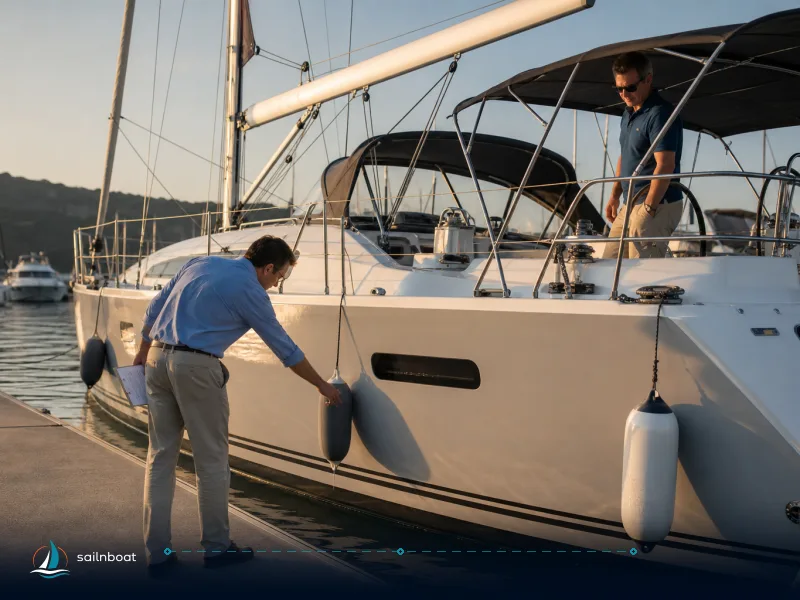
- Independent surveyor: hire a qualified marine surveyor (membership in NAMS, SAMS, IIMS or similar is a good sign) to perform a condition and title‑check survey and to inspect HIN/serials in person. Surveyors also confirm whether hull or engine serials have been altered.
- Escrow / trust account: insist deposits and final payments go into a licensed escrow or broker trust account governed by a written escrow agreement. Broker associations and professional codes of ethics describe how trust funds should be handled. Escrow protects you if title does not transfer as promised.
- Legal/title review: for high‑value transactions or complex flags, use a maritime lawyer to run corporate checks, verify powers of attorney and draft the sale documents.
Final checklist you can use now
- Ask the seller for: Certificate of Documentation or title, bill of sale, HIN, official/IMO/MMSI numbers, ID for the registered owner.
- Search NVDC and Equasis and order an Abstract of Title if the vessel is documented or a U.S. sale is involved.
- Match HIN/official number across photos, registry entries and AIS traces.
- If anything mismatches, pause and escalate: get an independent surveyor, legal review and use escrow for any deposit.
You can reduce most title and ownership surprises by following this checklist. When in doubt, spend a few percent of the purchase price on independent checks — it’s small compared with the cost and hassle of a contested title or an unexpected lien.
Frequently Asked Questions
Request the Certificate of Documentation (or state title/registration), the Hull Identification Number (HIN), the vessel's official number, the bill of sale, and proof of address/ID for the registered owner; these let you confirm identity in public registries and trace encumbrances.
Search Equasis (free account) by IMO, call sign or name for international ships; for U.S.-documented vessels use the USCG NVDC eStorefront to request certified copies and an Abstract of Title to reveal liens and chain of title.
Photos let you match visual identifiers (name on hull, hailing port, official number, HIN placement); AIS/MMSI/IMO tracks recent movements and whether the MMSI/callsign matches registry entries, but AIS can be misconfigured or spoofed so use it alongside documents.
Discrepant or missing HIN/official number, different owner names across docs/registries, documents that appear edited, sellers pressuring for a quick deposit, and records of claims/lien notices are all warning signs.
Use independent legal/title checks, a professional surveyor, and a licensed escrow if the vessel has complex ownership, is foreign-flagged, has unresolved liens, or if you are sending a sizeable deposit before transfer of papers.
Written by
Sailnboat Editorial
The Sailnboat editorial desk covers yacht and boat chartering worldwide — routes, bases, seasons, boat types, paperwork and the practical costs that decide a trip. We are a charter marketplace, not a boat owner or a local agency: what we sell is judgement and support, so our guides are written to help you make a decision, not to sell you a specific boat. Every guide is checked against live operator and marina data before it goes out.
Fact-checked against live operator and marina data, and published under our editorial standards. Last reviewed: .