Catamaran vs Monohull: Cost-Effectiveness for Chartering
Catamarans usually carry a clear price premium (weekly charter and ownership), but their extra space and per‑person economics can make them the better value for groups. This guide breaks down weekly rates, maintenance, fuel and the trade‑offs you need to decide.

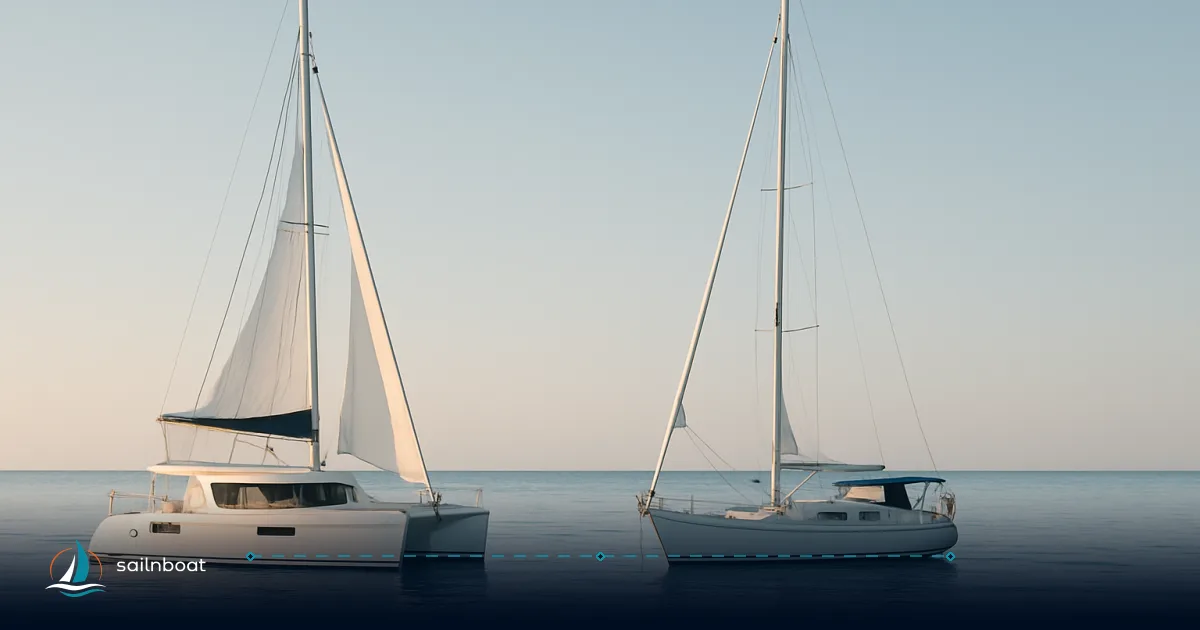
Catamaran vs Monohull: Which is More Cost-Effective for Chartering?
Expect to pay a clear premium to charter a catamaran: market surveys show that catamarans typically carry a 40–80% weekly price premium over an equivalent monohull, but that gap can narrow on a per-person basis for larger groups, since cats accommodate more guests and let you split fixed costs. Here’s what you need to match your hull choice to your budget and sailing plans—real numbers, a worked example, regional differences, and the operational detail that actually affects your total spend.
Understanding Charter Costs: Catamarans vs Monohulls
Average Weekly Charter Costs
The headline weekly rate is the most visible metric. Catamarans command higher base weekly fees than monohulls of comparable length and finish. The premium generally falls in the 40–80% range, but the spread depends on destination, season, age, and model.
Typical ranges for Mediterranean and Caribbean charters:
- Catamarans (40–50 ft): €3,500–€8,000 per week for charter-standard models; higher for new/luxury models or larger sizes.
- Monohulls (35–45 ft): €1,500–€4,500 per week for basic, well-maintained bareboats; higher for new or premium models.
Season and region matter. July–August in Croatia or Greece can push rates to double those of May or October. The Caribbean high season (December–April) commands a premium, especially around holidays.
| Item | Typical Catamaran (40–50 ft) | Typical Monohull (35–45 ft) |
|---|---|---|
| Base weekly bareboat (shoulder) | €3,500–€6,500 | €1,500–€3,500 |
| Base weekly bareboat (peak) | €6,000–€12,000+ | €3,000–€7,000 |
| APA (Advance Provisioning Allowance) | 25–35% of base* | 20–30% of base* |
| Skipper (if not bareboat) | €180–€250/day | €180–€250/day |
| Typical guest capacity | 8–12 | 4–8 |
*APA and skipper rates are typical; always confirm current season rates with your operator.
Regional and Seasonal Price Differences
- Croatia: Highly competitive, large fleets. Expect peak summer rates, and marina fees can be significant, especially for catamarans (often 1.5–2x monohull rate due to beam).
- Greece: Similar to Croatia, but with more variation in marina infrastructure. Some smaller harbours may not accommodate wider cats, or charge a premium.
- Caribbean: Rates are generally higher than the Med, especially in winter. Mooring buoys are common, and marina costs can be steep for cats in popular anchorages.
Seasonality: In all regions, July–August (Med) and December–April (Caribbean) are peak, with rates often 50–100% higher than shoulder season. Shoulder and low season can deliver substantial savings, but weather and availability vary.
Marina and Mooring Fee Examples
Marina fees are a major factor, especially for catamarans. Here’s a regional snapshot:
| Region | Monohull (40–45 ft) | Catamaran (45–50 ft) | Notes |
|---|---|---|---|
| Croatia (peak) | €60–€90/night | €110–€180/night | Catamarans often charged 1.5–2x monohull |
| Greece (peak) | €30–€60/night | €50–€120/night | Some small harbours may not accommodate cats |
| Caribbean | US$60–$100/night | US$100–$200/night | Mooring buoys common; marinas limited |
Actual fees depend on marina, location, and season. Always check with your base for current rates.
Worked Cost Example: Catamaran vs Monohull (All-In Costs)
Let’s run a real scenario: a group of 8 on a 45-foot catamaran vs 6 on a 41-foot monohull, both in Croatia, one week in July (peak season), bareboat but with paid skipper.
| Cost Item | Catamaran (45 ft, 8 guests) | Monohull (41 ft, 6 guests) |
|---|---|---|
| Base charter fee | €8,500 | €4,500 |
| Skipper (7 days) | €1,400 | €1,400 |
| Cleaning | €250 | €180 |
| Transit log | €200 | €180 |
| Outboard/dinghy | €120 | €100 |
| Linens/towels | €80 | €60 |
| Fuel (estimate) | €250 | €180 |
| Marina/mooring fees (2 nights in marina, 5 at anchor) | €500 | €330 |
| Security deposit* | €3,000 (refundable/insurance available) | €2,000 |
| Total (excl. deposit) | €11,300 | €6,830 |
| Per person | €1,413 | €1,138 |
*Security deposits are typically blocked on a card or paid as cash; insurance buy-down is available for an extra fee (see below).
Notes:
- APA (if required for crewed charters) would be higher and covers fuel, food, marina fees, etc.
- Many extras (outboard, linens, towels) are not always included in the advertised base rate.
- Crew gratuity (customary in some regions, typically 5–15% of charter fee) is not included above.
Hidden and Optional Fees: What to Watch For
Charter quotes almost never include every cost. The table below outlines common extras. Always ask for a full cost breakdown before booking.
| Fee Type | Typical Range | Catamaran vs Monohull | Notes |
|---|---|---|---|
| Final cleaning | €150–€300 | Slightly higher for cats | Usually mandatory |
| Transit log/admin | €100–€250 | Similar | Covers local paperwork, taxes |
| Outboard engine | €80–€150/week | Similar | Sometimes included |
| Bed linens/towels | €10–€20/person | Similar | Sometimes included |
| Wi-Fi | €30–€60/week | Similar | Not always included |
| Early check-in | €100–€200 | Similar | Optional, not always available |
| Security deposit | €1,500–€3,500+ | Higher for cats | Refundable or insurance buy-down |
| Insurance buy-down | €150–€400+ | Higher for cats | Reduces deposit; check terms |
| Marina fees | €60–€200/night | 1.5–2x for cats | Payable when not at anchor/mooring |
| Fuel | €100–€400/week | Slightly higher for cats (twin engines) | Depends on motoring hours |
Maintenance and Operating Costs
Annual Maintenance Costs
Catamarans generally cost more to operate annually than comparable monohulls, due to:
- Dual engines and systems: More service points and potential repairs.
- Wider beam: Higher marina and haul-out fees; some marinas charge cats as two berths.
- More deck/hull area: More antifouling, more fittings to inspect.
For charterers, most of these costs are built into the weekly fee and security deposit. If you are considering ownership or long-term charter, request a full breakdown from your operator—costs vary by region and vessel age.
Insurance and Security Deposit Differences
- Security deposit: Catamarans typically require a higher deposit (€2,500–€4,000) vs monohulls (€1,500–€2,500) due to higher repair and replacement costs.
- Insurance buy-down: Many operators offer optional insurance to reduce the deposit. For example, paying €250–€400 (non-refundable) may reduce your deposit from €3,000 to €500. Terms vary: some policies cover only damage above a set threshold, while others exclude certain incidents (grounding, negligence, tender loss). Always review the operator’s policy wording and ask them to clarify what’s included and excluded.
- Liability: Missing required qualifications (see below) can impact insurance claims. Make sure your paperwork matches operator and country requirements.
APA (Advance Provisioning Allowance): What It Is and When It Applies
The APA is a pre-paid onboard spending account, most commonly required for fully crewed charters (yachts with a professional crew). For bareboat charters, APA is not usually collected; you pay for food, fuel, and marina fees as you go.
- When APA applies: On crewed charters (catamaran or monohull) with a chef, hostess, or full crew.
- What APA covers: Fuel, food, beverages, docking fees, local taxes, sometimes gratuities.
- How much: Typically 20–35% of the base charter fee, collected before departure and settled at the end of the trip.
- Example: For a €10,000 crewed charter, expect to prepay €2,000–€3,500 as APA.
Unused APA is refunded; overages are settled at the end. For bareboat charters, you’ll pay these costs directly as they arise.
Fuel Efficiency and Charter Expenses
Fuel is rarely the largest line item on a sailing charter, but differences exist:
- Catamarans: Typically have twin engines, which can increase consumption under power compared to a single-engine monohull. Actual fuel use depends on engine size, speed, and generator use (for air-con), but expect a higher bill for motoring-intensive itineraries.
- Monohulls: Usually one engine; generally more fuel-efficient under power for the same length.
For a week with mostly sailing and moderate motoring, budget €150–€350 for fuel. If your group wants air-con running overnight, or you expect long passages under power, ask for recent engine-hour data from your charter base. Actual consumption can vary widely by vessel and usage pattern.
Factors Contributing to Higher Catamaran Costs
- Purchase price and depreciation: Catamarans are sold at a premium, and that carries through to charter rates.
- Duplicate systems: Two engines, two saildrives, more anodes, and more routine service.
- Marina and haul-out: Wider beam means higher berth and yard fees, and some small harbours cannot accommodate cats.
- Charter demand: Catamarans are popular for families and groups, so operators set rates to capture this market.
- What you get for the premium: More private cabins and heads, larger saloon and cockpit, level living at anchor, higher deck space and stability.
These features matter most for family or multi-group charters, or for guests prioritising comfort over pure sailing performance.
Value Considerations: Catamaran vs Monohull
Per-Person Economics
If you fill all cabins, a catamaran’s per-person cost can be competitive with a monohull, especially when you need four cabins and four heads. Fixed costs (skipper, cleaning, transit log) are split more ways.
Experience and Guest Satisfaction
- Catamaran: More space, no heeling, easier movement, stable swim platform. If your crew values comfort and shared spaces, this is a clear advantage.
- Monohull: Better upwind sailing, more “classic” sailing feel, often easier to find berths in busy marinas.
Match your priorities: If your week is about relaxed island-hopping and group social time, catamarans deliver value. If you want to sail longer legs, enjoy close-quarters manoeuvring, or keep costs down, a monohull usually wins.
Decision Matrix: Which Hull for Which Priorities?
| Priority | Catamaran | Monohull |
|---|---|---|
| Space and stability | ✓ | |
| Lower per-head cost (big group) | ✓ | |
| Headline cost | ✓ | |
| Performance sailing | ✓ | |
| Easier marina logistics | ✓ |
Qualifications, Licence Requirements, and Cost Impact
- Bareboat charter: Most Mediterranean countries (Croatia, Greece, Italy, Spain) require at least an ICC (International Certificate of Competence) or national equivalent, plus a VHF/SRC certificate for the skipper. Some operators will accept an RYA Day Skipper or ASA 104.
- Skippered charter: No licence required for guests, but you pay for a professional skipper (see rates above).
- Insurance and liability: Missing or insufficient qualifications can affect your charter contract and insurance. Always confirm with your operator what documents are required for your itinerary.
If you or your group don’t have the required licence, factor in skipper fees and consider the impact on privacy and cost.
Cost-Saving Tips and Common Booking Pitfalls
- Travel outside peak weeks: Rates in May, early June, September, and October can be 30–50% lower than high season.
- Book early or late: Early booking discounts are common in the Med. Last-minute deals exist but you risk limited choice.
- Fill the boat: Catamarans only deliver per-person value if you fill most cabins. For small groups, a monohull is often more cost-effective.
- Ask for an all-in quote: Insist on a full breakdown including cleaning, transit log, linens, outboard, Wi-Fi, and marina fees. Don’t compare headline rates alone.
- Check what is included: Some bases include dinghy fuel, snorkel gear, or Wi-Fi; others charge extra.
- Understand the insurance: Read the buy-down terms and clarify what is and isn’t covered before you sign.
- Confirm berth availability: In peak weeks, some marinas require advance booking, and catamarans may not fit in all slips.
Final Takeaway: How to Decide
Start with your group size, privacy needs, and comfort priorities. If you need space, stability, and all cabins filled, a catamaran can deliver solid per-person value even with a higher base rate. For smaller groups, classic sailing feel, or lower upfront costs, a monohull is usually more cost-effective.
Action steps:
- Get a full, all-in quote (base fee, extras, likely fuel, skipper, marina fees).
- Run the per-person numbers for your group size.
- Confirm your qualifications or factor in skipper fees.
- Match the hull to your route, group, and comfort needs—not just the headline rate.
This approach puts you in control of the real cost and experience—no surprises, just the right charter for your budget and crew.
Frequently Asked Questions
Typical bareboat weekly rates vary by length, season and destination: many catamarans rent from roughly €3,500–€8,000/week (median figures are higher), while comparable monohulls commonly fall in the €1,500–€4,500/week band; prices spike in peak summer. Exact rates depend on boat age, number of cabins and country.
Annual running and maintenance for a catamaran is generally higher—surveys and ownership guides put the premium in the 25–50% range (and sometimes higher when you include dockage and specialized haul-out fees) because of dual engines, larger surface area and wider berthing costs.
Under sail, fuel is a small line item; when motoring, catamarans can have lower drag per hull but most sailing cats have two engines so combined consumption can match or exceed a mono; expect large variance by engine horsepower and cruising style.
Higher purchase price, two engines and duplicated systems, wider berth fees (often 1.5× the mono rate), and sometimes higher insurance and specialized maintenance facilities.
Catamarans often deliver better charter experiences for groups—more cabins, generous deck and saloon space and flat behaviour at anchor—so the higher weekly fee can be justified by lower per‑person costs and higher guest satisfaction when space and stability matter.
Written by
Sailnboat Editorial
The Sailnboat editorial desk covers yacht and boat chartering worldwide — routes, bases, seasons, boat types, paperwork and the practical costs that decide a trip. We are a charter marketplace, not a boat owner or a local agency: what we sell is judgement and support, so our guides are written to help you make a decision, not to sell you a specific boat. Every guide is checked against live operator and marina data before it goes out.
Fact-checked against live operator and marina data, and published under our editorial standards. Last reviewed: .