Yacht Inventory List: A Broker’s Template and Negotiation Playbook
A practical yacht inventory list template for brokers and captains plus a negotiation playbook to avoid and resolve check‑in/check‑out disputes quickly.


A good yacht inventory list answers the single question guests and operators fight over: what was onboard and in what condition when the charter began. Use the inventory and the signed Condition Report as your primary defence — itemised, evidence-backed, and incorporated into the charter agreement — and you reduce 80% of routine disputes at check‑out.
Essential Items for Your Yacht Inventory List
A complete yacht inventory list records every item that could reasonably be disputed at return: locations, counts, serials, condition and who checked it. Start by dividing the list into high-level categories so nothing is missed; the table below is the one we use in briefs and handovers.
| Category | Typical line items (examples) | Who records it | Evidence to capture |
|---|---|---|---|
| Rooms & Furnishings | Berths (by cabin), mattress protectors, pillows, towels, curtains, cabin lights | Captain / lead crew | Photos of each cabin (wide + close), bed linen counts |
| Equipment & Deck Gear | Main & jib sails, spare halyards, anchor(s), chain length, fenders, winches | Captain + base tech | Serial numbers, photos of sail numbers and anchor chain markings |
| Consumables & Provisions | Galley staples, bottled water, alcoholic/non‑alcoholic drinks (by bottle), gas cylinder(s) | Chef / provisioning list | Provisioning invoice, photographed stock, labelled containers |
| Safety Gear | Lifejackets (count & type), liferaft capacity, flares (expiry), fire extinguishers | Captain + safety officer | Serial/ID stamps, expiry dates visible in photos; lifejacket counts |
| Electronics & Navigation | Chartplotter, AIS, radar, VHF handhelds, chargers | Captain | Photos showing software/firmware screens, serial numbers |
| Tender & Outboard | Tender make/model, engine hours, prop condition | Captain + tech staff | VIN/serial photo, engine hour reading photo |
| Papers & Manuals | Insurance certificate, yacht papers, licence, crew list | Broker/Captain | Scanned PDFs, original signatures or stamped copies |
| Consumable meters | Fuel, freshwater, generator hours | Captain | Photo of gauges/totaliser at handover (with timestamp) |
Key principle: every inventory line must have a measurable attribute (count, serial, expiry or photo). Without that attribute the line becomes an opinion at check‑out.
Documenting Yacht Condition During Check-In/Check-Out
Start the check‑in with an unambiguous Condition Report and finish check‑out by reconciling it item‑by‑item. The first sentence of the report should state who completed the inspection and the exact date/time.
Step-by-step documentation process
- Pre‑arrival: populate the inventory attachment (Attachment A) with the yacht’s model-specific items and known serials; circulate it to the client and the base 48–72 hours before embarkation.
- Joint walkthrough at handover: captain, lead crew and a base representative walk every area together; read each line item aloud and tick “OK”, “Noted” or “Damaged”.
- Photograph protocol: for each cabin/area take a wide shot and 2–3 close shots of notable items (serials, odometer, damage). Use the phone’s native timestamp and keep originals; export a PDF log of photos for the charter file.
- Meter readings and consumables: photograph fuel and water gauges, fridge/freezer temperatures (if digital), gas cylinder weight/label and tender engine hours with clear display numbers.
- Signatures: the Condition Report is signed by the captain and base rep at handover; if guests arrive later have the lead charterer countersign within 24 hours — this creates a narrow dispute window.
- File and distribute: save the Condition Report and photo set to a shared folder (PDF) and email it to the broker and client within 12 hours of handover.
Practical tips that reduce noise
- Use a standard filename convention: YYYYMMDD_Base_CharterID_Photos.pdf.
- Mark consumable quantities (e.g., 12 x 0.5L water, 6 x red wine) on both the provisioning invoice and the inventory.
- For high‑value items (EPIRB, liferaft, TOYS): record serials and expiry/battery dates; add these lines to the “high‑value” page of Attachment A.
- If anything is “Not Ready”, note an agreed repair timeline and whether the item is replaced or credited in APA (advance provisioning allowance) reconciliation.
Common Causes of Disputes in Yacht Check-Ins
Most disputes are not caused by malicious behaviour but by missing evidence or ambiguous expectations. Common triggers are easy to prevent.
Frequent dispute triggers
- Vague inventory lines such as “assorted kitchenware” — that invites disagreement; break it down (pots, pans, set of 12 plates).
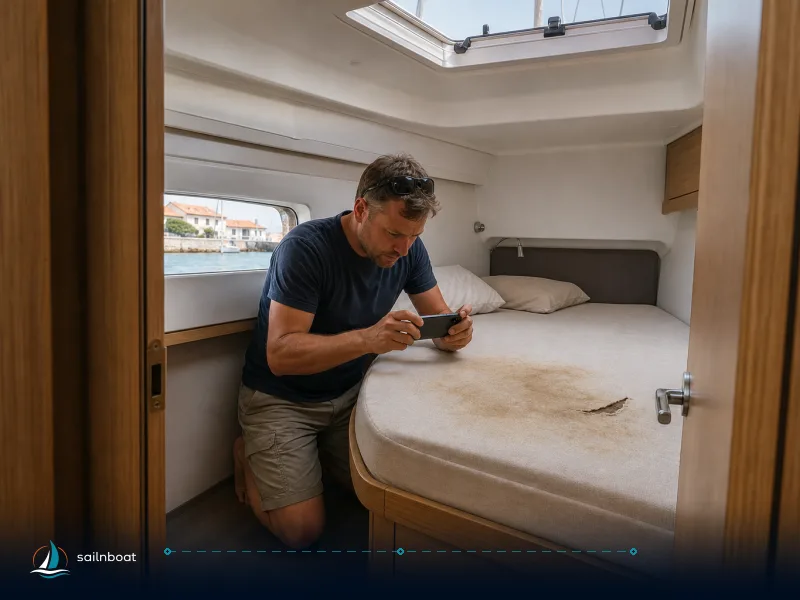
- Missing pre‑existing damage records — small scratches or upholstery stains listed only in the base’s notes become contested if there are no photos or signatures.
- Unclear return expectations for consumables (fuel policy, water, gas) — guests assume reasonable use; operators apply the contract’s refill rules.
- Late crew/guest changes not updated on the crew list — port authorities or additional provisioning fees then appear as unexpected charges.
- Deposit and waiver misunderstandings — guests who think the damage waiver covers “all” costs are surprised when wear/tear exclusions apply.
Documenting the specifics above, and keeping the Condition Report visible to everyone during the charter, prevents most of these disputes.
(Operational note: routine charter handover times at many Mediterranean bases are late afternoon and check‑out windows are typically a morning return; this is common practice and varies by operator and country).
Standardizing Inventories to Prevent Disputes
A single standard inventory template adopted across your listings removes subjective differences between yachts and speeds inspections.
Benefits of standardization
- Consistency: crews and bases know the format and where to look; clients learn what to expect before arrival.
- Faster inspections: a predictable checklist reduces handover time from hours to 30–60 minutes in many cases.
- Objective comparison: brokers can compare like-for-like items across yachts without parsing custom lists.
- Streamlined claims: when an item is absent or damaged, the contract references a clearly numbered line and the agreed remedy.
How to roll out a standard template
- Create Attachment A as a living spreadsheet with fixed sections and unique line numbers.
- Make the template mandatory for all new listings; retrofit high‑risk or high‑value yachts first.
- Train base staff and captains on three photographic standards: wide, detail, serial/expiry.
- Use a digital signing tool for Condition Reports so signatures and timestamps are immutable.
Standardization is not bureaucracy — it's the friction reduction you need when a late checkout collides with a ferry schedule.
Contract Clauses for Efficient Dispute Resolution
Include short, operational contract clauses that define what happens on day one and how disagreements are resolved, keeping legal escalation as a last resort.
Sample clauses to include
- Inventory Attachment: "Attachment A (Inventory & Condition Report) forms part of this Agreement; the charterer accepts the Attachment when the lead charterer signs the Condition Report at handover."
- Reporting window: "Charterer must notify the owner/operator in writing of any undisclosed damage or missing items within 24 hours of embarkation; failure to notify within this period constitutes acceptance of the Condition Report for routine items."
- Inspection & reconciliation: "Check‑out inspection will be performed by the operator with the lead charterer present; operator will return held deposit within X working days less agreed deductions supported by invoices and photographs."
- Mediation first: "Parties agree to attempt negotiation, assisted by a mutually agreeable mediator, before commencing arbitration or court proceedings for claims under €Y (threshold negotiable)."
- Minor damage threshold: "Damages under €Z (a defined small-claims threshold) shall be settled by a fixed schedule of repair/replacement costs set in Appendix B without further charge."
- Surveyor clause: "For disputed damage over €W, the parties will appoint an independent marine surveyor from a pre‑agreed list; the surveyor's factual report is binding on quantum (not on legal liability)."
Language to keep clear: who holds the deposit, how quickly it is released, the reporting window after embarkation, and a simple escalation ladder (captain/base → broker → mediator → surveyor → claim).
(Design the numeric thresholds to reflect yacht value and local practice; they are negotiation points, not universal law.)
Negotiation Strategies for Brokers and Captains
Negotiation in this context means preventing escalation by making disputes simple to verify and cheap to resolve.
Best practices for negotiation
- Pre‑empt with clarity: send Attachment A and the base’s check‑in/out desk procedure to the client at time of booking and again 7 days before embarkation.
- Lead the walkthrough: brokers and captains should insist on a joint handover with a base rep; verbal “notes” alone are weak evidence.
- Use objective triggers: settle small losses by fixed repair rates in the contract so the captain can settle without calling the broker or insurer.
- Keep receipts and a running APA ledger: for crewed charters reconcile APA with receipts in real time; this prevents surprises at checkout.
- Offer pragmatic compensation: when clients find minor damage after sailing, offer a proportionate partial refund or voucher instead of taking the full deposit — it preserves relationships and avoids a claims process.
- If disagreement persists: escalate to the pre‑agreed independent surveyor named in the contract; avoid threats of litigation in initial communications.
How to handle a disputed item at check‑out — short playbook
- Stop the clock: take photos immediately and isolate the item if possible.
- Reconstruct evidence: pull the handover photo for the specific line number and compare timestamps/angles.
- Apply the contract: consult Attachment A, the reporting window and minor damage schedule.
- Remedy quickly: for small, clear losses use the repair schedule and invoice the agreed sum from the deposit.
- If material disagreement: appoint the pre‑agreed surveyor and freeze further deductions until the surveyor’s factual report is issued.
These steps reduce emotion and make the process repeatable—exactly what a broker wants when they’re juggling multiple bookings.
Appendix — Practical Inventory Template (condensed)
Use this as Attachment A and expand per yacht.
- Document header: Charter ID / Yacht name / Handover date & time / Base / Lead charterer name & passport / Base rep name & ID
- Section 1 — Cabins (lines 1–20): cabin name, berth count, linens (count), towel sets (count), light functioning (Y/N), notes/photo ref
- Section 2 — Deck & Sailing gear (lines 21–60): mainsail serial, genoa serial, spare halyards, anchor & chain length (m), fender count/condition
- Section 3 — Tender & Outboard (lines 61–75): tender make/model, outboard serial, engine hours photo
- Section 4 — Safety (lines 76–100): lifejacket count & type, liferaft capacity & serial, EPIRB serial & battery expiry, flares list with expiry dates
- Section 5 — Electronics (lines 101–130): chartplotter model & serial, VHF fixed & handheld serials, AIS, radar
- Section 6 — Consumables & meters (lines 131–160): fuel (litres at handover photo), water level (% or litres), propane cylinders (weight/label)
- Signature block: signed name / role / date / digital signature hash
Safety-critical items called out: lifejacket counts and flare expiry dates should be recorded with photographed stamps. Regulatory guidance commonly requires one adult lifejacket per person on board plus spare lifejackets at least equal to 10% of persons onboard or two, whichever is greater.
Flares and pyrotechnics must be within their stamped expiry or replaced; in many practical jurisdictions pyrotechnic signals are treated as expired three years from manufacture unless a later expiry is printed on the device. Record expiry dates and photograph them during handover.
Advance Provisioning Allowance (APA) and security deposit: state expected APA percentage on the quote and the deposit amount/holding method in the contract; industry practice sets APA commonly in the 20–40% range depending on yacht type (sailing yachts typically lower, motor yachts higher). Security deposits vary widely by yacht size and operator — common bareboat holds range from roughly €1,000 to €5,000 in many bases, and larger yachts may carry higher holds. Put the exact numbers in the booking papers.
Closing practical note — day of handover Show the lead charterer how to find Attachment A on the yacht (a printed copy inside the owner’s folder and a labelled PDF on the onboard tablet). Explain the reporting window and who the captain should call with any urgent discrepancies. Doing this 15 minutes before you sign any check‑in paperwork removes most later complaints.
Use this template to standardise Attachment A for each listing, add photo evidence at handover, and include the short dispute ladder in your charter contract — you’ll reduce time lost to debates and protect deposits without going to claims.
Frequently Asked Questions
Include categories for rooms (beds, linens, furniture), equipment (anchors, sails, tools), consumables (provisioned food and drinks), safety gear (lifejackets, flares, first aid) and electronics (plotter, VHF, chargers).
Do a joint walkthrough, create a signed Condition Report, take timestamped photos of every cabin and critical item, record serial numbers and log odometer/fuel readings.
Disputes commonly come from missing or unclear inventory lists, undocumented pre‑existing damage, vague return conditions, and surprise deposit withholdings.
Standard inventories set consistent expectations across yachts, make discrepancies obvious at check‑in, shorten inspections and reduce subjective decisions at check‑out.
Include an Inventory Attachment, a short reporting window (e.g., 24 hours), a mediation step before claims, defined thresholds for minor damage and an agreed surveyor selection process.
Written by
Sailnboat Editorial
The Sailnboat editorial desk covers yacht and boat chartering worldwide — routes, bases, seasons, boat types, paperwork and the practical costs that decide a trip. We are a charter marketplace, not a boat owner or a local agency: what we sell is judgement and support, so our guides are written to help you make a decision, not to sell you a specific boat. Every guide is checked against live operator and marina data before it goes out.
Fact-checked against live operator and marina data, and published under our editorial standards. Last reviewed: .