20 Practical Sailing Tips and Tricks for Enhanced Safety
Twenty concise, actionable seamanship tips that reduce risk on short charters — covering winches, sail trim, helming, fenders, pre-departure checks and crew briefings.


Your crew will be safer if you change three habits: handle winches with purpose, trim to stop sudden overloads, and brief roles before cast-off — those are the fastest gains from practical sailing tips and tricks. Below are 20 concise, decision-focused techniques you can implement on a charter tomorrow to reduce injuries, equipment damage and emergency response time.
Winch Operation Techniques
Proper Winch Handling
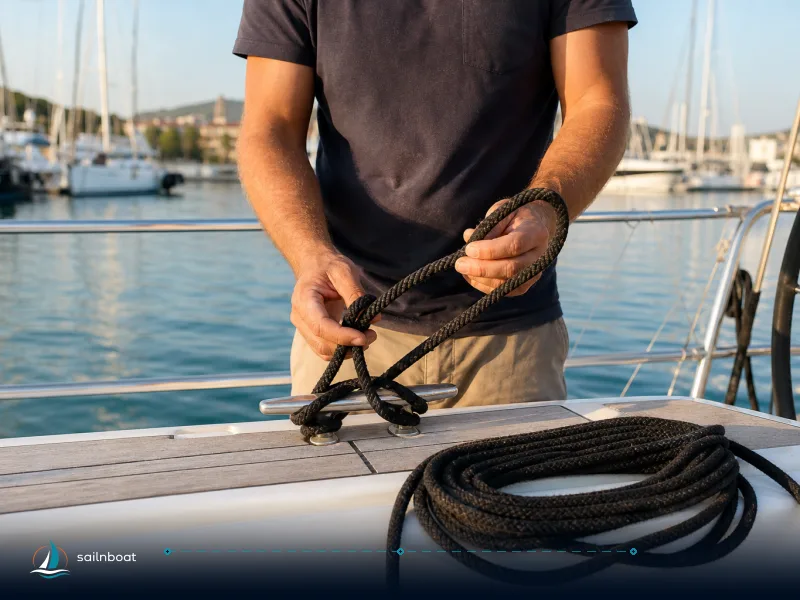
- Use two hands for control: one on the winch handle, the other tailing the free end. That combination keeps tension predictable and reduces the chance of fingers being drawn into the drum.
- Remove the winch handle between turns and whenever the winch is unattended — a loose handle can spin and injure someone.
Practical routine: before you insert a handle, call out the action ("Main on winch, three turns, tailing ready") so everyone knows who is responsible for the tail. In bigger crews assign named trimmers so roles don’t switch mid-manoeuvre.
Preventing Equipment Damage
- Avoid “riding turns”: if a line stacks on the drum under load, stop, ease, clear the wraps and re-tension—shock loads and uneven layering wear gears and rope.
- Inspect winch pawls, teeth and handles during the pre-departure walkaround; replace or report any rough engagement or missing spring tension. While general equipment inspection is standard, specific winch checks may not always be listed in every training syllabus—confirm with your operator or follow the boat’s manual.
Tip: keep a small winch-cleaning kit (brush, light grease approved by manufacturer) on board and note lubrication intervals in the boat’s log — regular minor maintenance prevents sudden failures.
Effective Sail Trimming Methods
Trimming for Wind Conditions
- Use telltales as your primary feedback: if windward telltales stall, ease the sheet; if leeward telltales stream and windward flutters, trim in. Teaching the crew to “steer to the telltales” removes guesswork and reduces sudden over-trims.
- Trim to balance helm: when weather helm increases, reduce mainsail area (traveller down, ease mainsheet) or reef early — correcting helm keeps the rudder effective and saves fuel/time when motoring in tight water.
Maintaining Stability
- Balance sail area between main and jib: in gusty or choppy seas, a smaller headsail with a well-sheeted main gives more control than a full genoa that suddenly blanks the rudder.
- Reef early rather than late: there is no universal wind speed for every boat; however many guides suggest a first reef is sensible when gusts become frequent and the boat heels more than comfortable or weather helm grows — reefing reduces heel and the risk of broaching.
Practical check: when you find yourself asking “should I reef?”, reef — this rule of thumb removes hesitation and prevents the helm from being overloaded.
Helming Practices to Avoid Accidents
Preventing Broaching
- Keep the hull under the sailplan: steer to keep the boat moving with balanced flow across the rudder; if the stern starts surfing, ease sheets immediately to depower.
- Avoid abrupt course changes in strong winds: slow, deliberate adjustments give trimmers time to depower the sails and avoid sudden loss of rudder authority (a common cause of broach).
Practical drill: practice an “ease-first” immediate response to gusts — helm keeps heading while trimmers ease the affected sail, then the skipper decides whether to bear away, luff up slightly or reef.
Capsizing Prevention
- Monitor crew weight distribution: move weight to windward in a knockdown-prone moment; conversely, keep cockpits clear of people standing on the lee deck during gusty squalls.
- Use the right sail for the conditions: a well-cut, partially-reefed main or a smaller working jib keeps centre-of-effort lower and closer to the hull, reducing the knockdown risk.
Safety trade-off: reefing early reduces speed but increases margin for error — for charter skippers, choose stability and predictable handling over marginal VMG gains.
Fender Management Strategies
Optimal Fender Placement
- Rig fenders before you enter the marina: place them at the hull’s widest points and at any expected contact points (piles, whalers, neighbouring boats). Set the fender centre roughly at the dock edge height — adjust for tidal range.
- Use multiple fenders spaced along the probable contact length; more contact points spread the load and reduce chafe or concentrated dents. For a typical 10–12 m cruiser, guides commonly recommend at least three fenders along each side when alongside.
Fender Maintenance
- Check valves, UV degradation and chafe before each season and carry spare fender lines — a flat or knotted fender is useless in a tight approach. Keep inexpensive fender covers to reduce scuffing on varnish and canvas.
Docking protocol: brief the “roving fender” role — a crew member ready to deploy or re-position a fender while the helm focuses on the approach.
Pre-Departure Safety Checks
Essential Safety Checks
- Inventory safety kit every trip: one correctly sized lifejacket per person, throwable buoy, charged handheld and fixed VHF, EPIRB/PLB where carried, serviceable flares and accessible fire extinguishers. Use a written checklist — organisations like RYA and USPS include these items as standard.
- Quick systems walk: fuel and oil levels, bilge pump operation, battery state, steering free movement, engine cooling-water flow and instrument power — run this as a short circuit before casting off.
Practical tempo: a complete pre-departure routine should be scripted and repeatable — doing the same checks every time reduces missed items under time pressure.
Emergency Equipment Locations
- Show, don’t tell: physically point out lifejackets, MOB equipment, fire extinguishers, first-aid kit and how to arm and reset the EPIRB/PLB; let one crew member demonstrate each device to confirm understanding. This short physical demo speeds emergency response.
Conducting Effective Crew Briefings
Safety Procedures Overview
- Run a five-minute, standardised briefing before cast-off: roles for leaving the berth, who handles which lines and fenders, simple MOB recovery method (who points, who throws the life ring, who drives the boat back). Get verbal acknowledgment from every crew member. Practical Boat Owner and other training centres recommend this discipline as a primary means to reduce mistakes.
Checklist item to read aloud: helm intentions, abort criteria (e.g., “if we’re not lined up by one boat length out, we go around”), and VHF channel for marina comms.
Equipment Usage Training
- Short hands-on drills make the difference: practice putting on a lifejacket, clipping a harness to a jackline, deploying a danbuoy and making a Mayday on VHF — the timing and sequence of these drills may vary, but early practice helps the crew become comfortable and reduces fumbling in an emergency.
Run a simple MOB simulation at the dock (float a throwable, recover it with the planned method) so everyone knows their position and the timing under calm conditions.
Quick-reference table — 20 tips at a glance
| # | Tip (short) | When to use | Primary safety gain |
|---|---|---|---|
| 1 | Two-hand winch technique | All winch operations | Prevents finger entrapment, keeps tension predictable |
| 2 | Remove winch handle when idle | Between trims | Stops accidental spinning injuries |
| 3 | Clear riding turns | Under load | Protects winch gears and rope |
| 4 | Telltales-to-trim | Continuous trim checks | Maintain efficient lift and balanced helm |
| 5 | Trim to balance helm | After sail changes/gusts | Keeps rudder effective |
| 6 | Reef early | When helm/heeling increases | Reduces heel and broach risk |
| 7 | Balance main and jib | Changing wind/sea state | Predictable handling |
| 8 | Ease-first response to gusts | Gusts/overpowering | Immediate depower, avoids knockdown |
| 9 | Steer to keep hull under sailplan | Downwind surfing risk | Prevents broaching |
| 10 | Avoid abrupt course changes | Heavy conditions | Prevents loss of rudder authority |
| 11 | Control crew weight | Knockdown risk | Reduces capsize chance |
| 12 | Use correct sail for conditions | Strong wind/sea | Lower centre of effort |
| 13 | Rig fenders before arrival | Approaches | Prevents hull impact |
| 14 | Multiple, spaced fenders | Alongside docking | Distributes contact loads |
| 15 | Maintain fenders & lines | Season-start & before each docking | Ensures protection when needed |
| 16 | Written pre-departure checklist | Every departure | Reduces missed safety items |
| 17 | Quick systems walk | Before cast-off | Avoids mechanical surprises |
| 18 | Show emergency kit locations | Pre-departure brief | Faster emergency response |
| 19 | Five-minute crew brief | Before moving | Clear roles and abort criteria |
| 20 | Short hands-on safety drills | First morning | Speeds competent emergency action |
(Each table row corresponds to the numbered tips above.)
Implement these measures progressively: pick three to practise on your next charter (two-hand winch technique, a scripted pre-departure brief, and an “ease-first” gust response) and add one more the following day — the compounding effect is immediate.
Final note: these sailing tips and tricks focus on behaviour and crew organisation more than gear. Small changes in how you handle lines, talk with the crew and trim the sails produce the largest safety gains on short charters. Implement them, make them routine, and your margin for error — and the time you stay smiling — increases substantially. Implement these tips on your next charter to enhance safety.
Frequently Asked Questions
Use two hands (one tailing, one on the handle), remove the winch handle when not in use, keep fingers clear of the drum, and brief the tailer and trimmer before every winch movement.
Watch telltales and balance sheet tension between main and headsail; reef early when heel or weather helm increases rather than chasing speed.
Steer proactively to keep the hull under the sailplan, ease sheets to depower immediately in gusts and avoid abrupt course changes downwind.
Put fenders out before you enter the marina, place them at the hull’s widest points and adjust height so the fender centre meets the expected contact point of dock or piling.
Confirm one correctly sized lifejacket per person, check handheld and fixed VHF, ensure flares/EPIRB are serviceable, verify bilge pumps and fire extinguishers, and run a short systems check (engine, battery, instruments).
Keep the briefing short, assign roles (helm, fender, lines, MOB), show equipment locations, run a simple MOB drill and get verbal acknowledgment from each crew member.
Written by
Sailnboat Editorial
The Sailnboat editorial desk covers yacht and boat chartering worldwide — routes, bases, seasons, boat types, paperwork and the practical costs that decide a trip. We are a charter marketplace, not a boat owner or a local agency: what we sell is judgement and support, so our guides are written to help you make a decision, not to sell you a specific boat. Every guide is checked against live operator and marina data before it goes out.
Fact-checked against live operator and marina data, and published under our editorial standards. Last reviewed: .