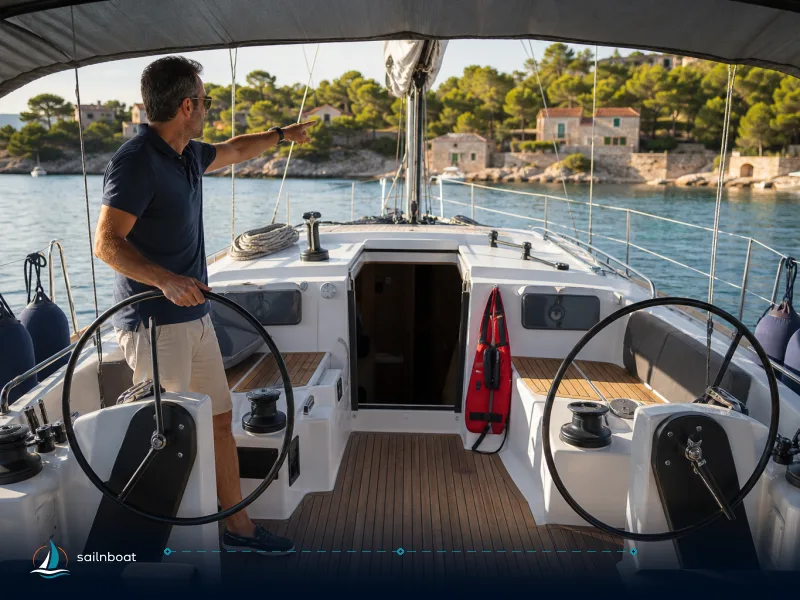
Understanding Yacht Tipping Over: Causes and Prevention
A practical guide to how yacht tipping over happens, how professional crews stop it, and exactly what charterers should do before and during a trip to reduce risk.


Yacht tipping over is not a mysterious failure—it's a predictable loss of righting moment when hull form, ballast and human factors combine or when a sudden influx of water reduces buoyancy.
Mechanical Factors Leading to Yacht Capsizing
Hull Design and Stability
The hull shape sets the baseline for how a vessel reacts to heel. Wide, flat-bottomed hulls (many catamarans and planing motorboats) have large initial stability—they resist small angles of heel—but when they pass a critical angle they can lose righting lever rapidly and invert. Narrower, deeper-displacement monohulls present a gentler righting curve: they heel more easily but gain substantial righting moment as they do, provided ballast and hull integrity are maintained.
Two technical points matter for you:
- Initial stability (often expressed by metacentric height, GM) governs how the boat feels for small heels: a larger GM feels “stiff” and returns upright quickly; a small GM feels “tender.” The GM concept underpins practical checks and is used by naval architects and operators as a first stability indicator.
- The GZ (righting-arm) curve determines whether the vessel will right itself at larger angles; a design with a small or negative area under the GZ curve can capsize when heeled far enough.
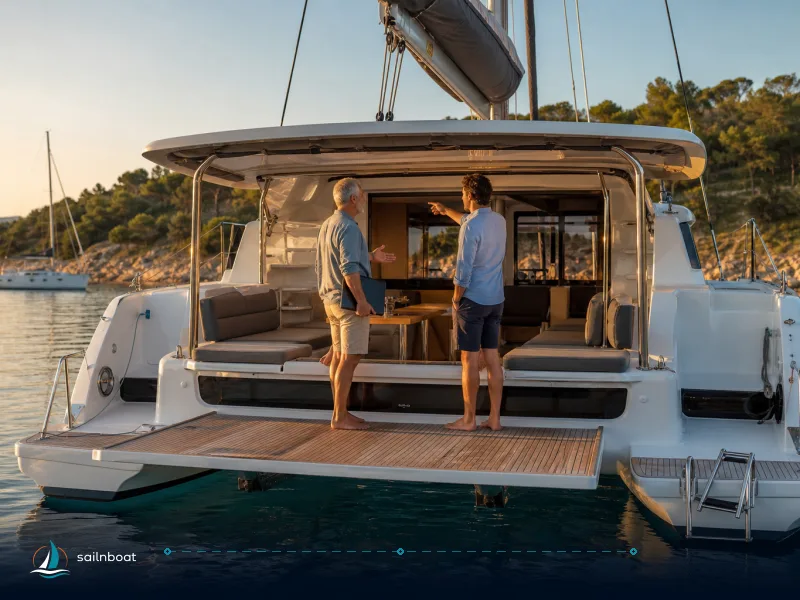
If you want to know how your charter boat will behave, ask for the stability booklet or design summary at handover—it will show the righting-arm information or at least say whether the boat is a light-displacement racer, a heavy cruiser, or a catamaran, and what to expect behaviorally.
Ballast and Weight Distribution
Ballast—fixed (keel bulb, ballast tanks) or movable (water in tanks, fuel, passengers)—lowers the centre of gravity and increases righting moment. For monohulls, a deep ballast keel or bulb significantly increases resistance to tipping; lifting the centre of gravity (heavy gear in lockers above decks, loosely stowed luggage on settees) reduces safety margins.
Practical rules you can act on:
- Keep heavy items (water containers, spare fuel, suitcases) low and close to the boat’s centreline.
- Avoid stacking heavy bags aft or forward where they change trim and reduce bilge immersion margins.
- Remember that passenger movement can be a dynamic ballast change—if several people rush to one rail, the temporary heel can be large on lighter boats.
Because ballast effects vary by vessel type, treat specific numbers (how many kilos where) as operator-dependent. Ask the skipper what the operator’s loading limits are for that specific boat.
Human Factors in Yacht Capsizing Incidents
Crew Training and Preparedness
Most serious capsize events trace to combinations of mechanical vulnerability and human error—failure to reduce sail in time, leaving openings (hatches/bilge scuppers) unsecured, or poor decision-making about weather and sea room. A well-drilled crew runs through predictable checks as wind increases: reef early, secure hatches, brief passengers, position people for leverage, and confirm pumps and alarms are functioning.
Training focus areas that reduce risk:
- Sail-handling under pressure (reefing or dropping sails quickly).
- Flood-control drills: identify the path of water from deck to bilge and how to isolate it.
- Clear communications: short commands, roles for handling sheets, helm, and emergency pumps.
Routine drills shorten reaction time and reduce the chance of the sort of complacency that has caused major ferry disasters historically.
Passenger Movement and Behavior
Passengers are often the variable that converts an uncomfortable heel into an incident. Sudden lateral movements (everyone to starboard to see a sight) or standing on transoms in rough conditions shifts the centre of gravity and can reduce the righting moment enough to create an uncontrollable heel on light boats.
Practical passenger guidelines to enforce:
- Keep passengers low and amidships in rough conditions.
- Give clear instructions about where to go and when to wait for crew assistance on deck.
- Stow loose gear so it cannot move and become a shifting load.
Make these briefing points part of your pre-departure routine: a three-minute safety brief prevents risky behaviour later.
Crew Responses to Prevent Tipping
Monitoring Weather Conditions
Skippers and watch leaders monitor forecasted wind, rapidly updated local observations (wind shifts and gusts), and sea state. When models or real-time observations show increasing wind or steepening seas, the timely decisions are: reef, change course to reduce exposure, head for shelter or heave-to.
Modern crews use forecast GRIBs, official meteorological sources and local observations together; the practical rule is to act sooner than feels necessary—reef early rather than late. RYA guidance explicitly recommends reefing before the boat becomes difficult to handle rather than when you are already fighting it.
Utilizing Stabilization Equipment
Active and passive stabilizers reduce roll but are not replacements for seamanship. The two common systems are fin stabilizers (hydrodynamic fins) and gyroscopic stabilizers (flywheel-based).
Comparison at a glance:
| Stabilizer type | When effective | Practical effect | Limitations |
|---|---|---|---|
| Fin stabilizers | Underway at speed | Reduce roll significantly when moving; useful for comfort and reducing amplitude | Less effective at low speed or at anchor; installation/maintenance required |
| Gyroscopic stabilizers | At speed and at rest (depending on model) | Provide roll-reduction without drag; useful at zero speed for comfort | Power/space requirements; varying effectiveness by model |
| Passive bilge keels / hull form | Always | Increase initial transverse stiffness | Limited effect on sudden flooding or large external moments |
Contemporary studies and trials show fin and gyro systems can substantially reduce roll in their effective envelope, but exact performance varies by hull and system design—consult the boat’s equipment list and the operator about which system is fitted and its recommended operating envelope.
Preventative Measures for Charterers
Proper Loading Techniques
Before you leave dock:
- Distribute heavy items low and close to the centreline; avoid high stowage.
- Secure all deck and saloon gear with lashings; loose objects can shift suddenly.
- Ask the base for the boat’s maximum capacities and whether any tanks should be full/empty for recommended trim.
Onboard practices:
- Make a crew briefing that defines where passengers may move in rough conditions.
- Pre-plan for where to move people in an emergency (windward bench, sheltered cockpit).
Regular Equipment Maintenance
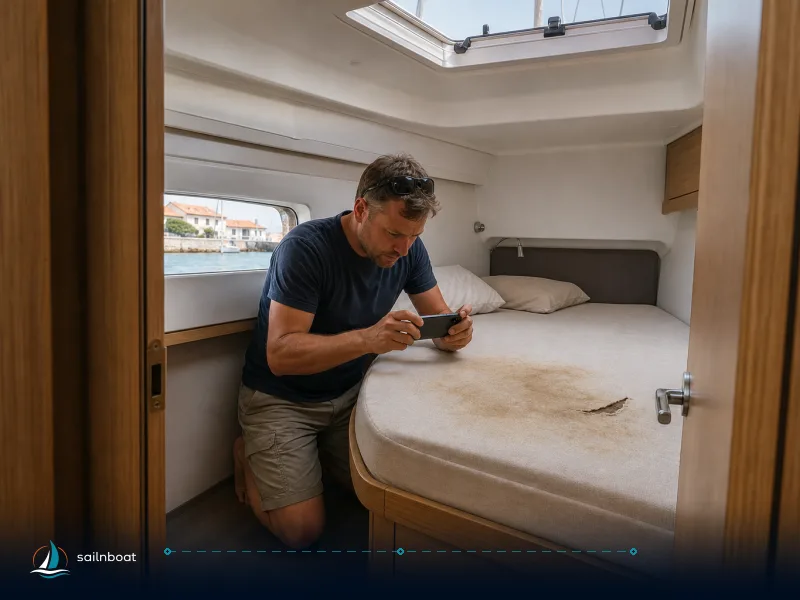
A poorly maintained drain, non-working bilge pump or jammed hatch turns a manageable heel into a flooding event. At handover ask the base to demonstrate:
- How to operate the bilge pump (automatic and manual modes, if fitted).
- Location and operation of portable pumps and how to connect them.
- Which deck and below-deck openings must remain closed in rough weather.
If the operator cannot demonstrate these systems promptly, treat it as a red flag—either postpone or choose a different boat.
Understanding the Role of Weather Conditions
Wind and Wave Effects
Wind over a sail plan produces heeling moment; waves can both lift and slam on decks. Gusts increase instantaneous heeling force and can create broaching or rounding-up behaviours. Confused short-period seas (where wave length is similar to boat length) can amplify roll and transmit violent impacts to the hull; these states increase the likelihood of water on deck and subsequent flooding.
When weather combines with an open deck fitting or unsecured hatch, the result can be rapid loss of stability—this mechanism has been central to ferry and ro-ro disasters where water entered vehicle decks through openings.
Avoiding Adverse Weather
Practical steps:
- Check a reputable forecast before departure and again during the day.
- Plan a weather window with conservative margins—expect winds to build faster than modelled in coastal gust-prone zones.
- When the forecast or real-time observations show gusty, building conditions, reef early, shorten passages and consider sheltered alternatives.
Use a combination of forecast products and local knowledge; do not treat modern forecasts as perfect—treat them as an input that must be matched to how the boat is performing.
Key Statistics and Case Studies
Capsizing Incident Statistics
Recreational boating statistics collected by national authorities point to a variety of causes for fatalities and accidents; while capsizes are a portion of incidents, the dominant issues in many regions remain open-boat swamping, falls overboard and collisions. For context, the U.S. Coast Guard’s recreational boating summary reports annual fatality totals and highlights common risk areas like lack of lifejacket use, but specifics vary year to year and by vessel type—consult the national boating statistics for current numbers and trends for your charter location.
Case study: Herald of Free Enterprise
The 1987 Zeebrugge ferry disaster (Herald of Free Enterprise) illustrates how an open vehicle deck and human error can produce a catastrophic capsize: the vessel sailed with bow doors open, water entered the car deck and stability was destroyed, resulting in the loss of many lives. The disaster prompted a major reappraisal of ro-ro safety, tighter procedures for securing openings and bridge indicators for doors—an example of why even well-known commercial designs must be managed with disciplined procedures.
Final checklist — what you must do before and during a charter
- At handover: see bilge pump(s) run, ask where the manual pump and spare lines are, confirm the location of all deck/hatch closures.
- Loading: place heavy items low and central; secure everything that can move.
- Passenger brief: explain where to sit/stand in rough weather and insist on lifejackets when ordered.
- Sailing: reef early, avoid over-canvassing, and prefer sheltered routes when conditions are marginal.
- If flooding begins: stop the source if possible, close off affected compartments, start bilge pumps, prepare lifejackets and don harnesses, and call for help if pumps cannot control ingress.
Implement these strategies and you reduce the chance that an adverse moment of heel or an unexpected inrush of water becomes a tipping event. Good seamanship is your first and best stabilizer: equipment helps, but decisions and preparation prevent most incidents.
Implement these strategies to enhance your sailing safety.
Frequently Asked Questions
Mechanical causes centre on stability: hull form and righting moment, insufficient ballast or a high centre of gravity, and uncontrolled flooding (open hatches or doors). A boat with low initial stability or a sudden loss of buoyancy will heel quickly and may capsize.
Crew actions are immediate: reduce sail area (reef or drop), alter course or heave-to, move people to the windward side to shift the centre of gravity, close watertight doors/hatches, and use pumps or portable bilge gear to control flooding.
Charterers should distribute heavy gear low and central, secure loose items, brief passengers about moving on deck, check the boat’s bilge and drain plug, monitor weather, and follow the skipper’s orders to reef early or return to shelter.
Raising the centre of gravity reduces initial stability; placing weight low and near the boat’s longitudinal centre increases the righting moment. Sudden lateral movement of crowds can provoke large heel on light displacement boats.
Wind gusts, steep confused seas and breaking waves multiply heel and water on deck risk; gust-driven overpowering and wave-driven flooding are frequent contributors to capsizes, so charting a weather window and reacting early are essential.
Written by
Sailnboat Editorial
The Sailnboat editorial desk covers yacht and boat chartering worldwide — routes, bases, seasons, boat types, paperwork and the practical costs that decide a trip. We are a charter marketplace, not a boat owner or a local agency: what we sell is judgement and support, so our guides are written to help you make a decision, not to sell you a specific boat. Every guide is checked against live operator and marina data before it goes out.
Fact-checked against live operator and marina data, and published under our editorial standards. Last reviewed: .