Calanques Anchoring Rules: Essential Guidelines for Skippers
A practical, regulation-focused guide to anchoring in the Parc national des Calanques: where anchoring is banned, where ecological buoys are installed, how enforcement works and workable alternatives for charter skippers.

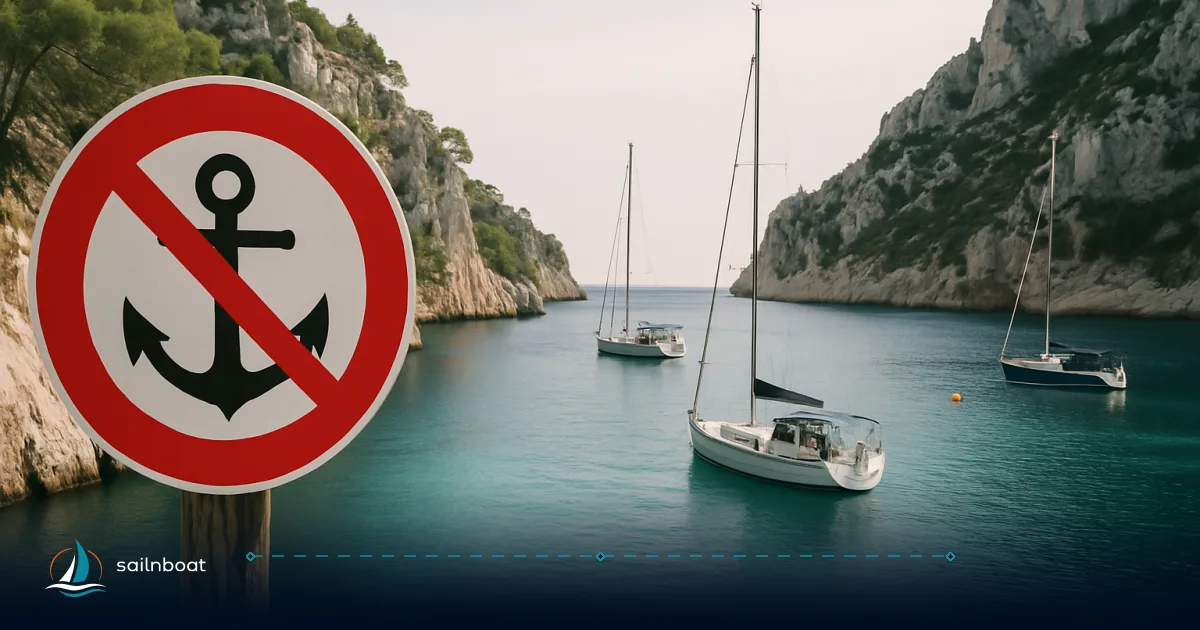
The Parc national des Calanques tightly restricts where you may drop the hook: in practice, an anchor on the seabed is allowed only in a handful of managed locations — otherwise you must use designated ecological moorings or ports, and the most famous bays (En‑Vau and Port‑Pin) are closed to any stopping or anchoring. Follow the park’s mooring scheme, reserve in high season, and treat posidonia‑covered bottoms as no‑go: the law and local arrêtés are actively enforced.
Overview of Calanques Anchoring Regulations
The park’s rules combine a national decree, préfectoral arrêtés and a local "schéma d’organisation des mouillages" that orders where boats may stop, where ecological moorings are installed and which areas are strictly protected. The objective is to remove anchor damage to posidonia meadows, reduce crowding in narrow calanques, and manage safety in a busy near‑shore channel.
Designated No-Anchoring Zones
- En‑Vau and Port‑Pin: permanent prohibition on anchoring, stopping or drifting inside the calanque mouths and inner basins; these restrictions were formalised by park regulations and préfectoral measures. Visiting is limited to transit and viewing from outside the prohibited area.
- Other protected sectors: several marine “Zone de Protection Renforcée” (ZPR) and “Zone de Non‑Prélèvement” (ZNP) are marked around archaeological or sensitive biological sites (for example, areas around Riou and some reef systems). These areas may prohibit anchoring, diving or collecting.
- Herbiers of Posidonia: dropping an anchor on posidonia meadows is prohibited where it would damage habitat — the park maps show the extents and the mouillage scheme moves moorings off those beds. The park expects skippers to avoid sandy patches identified on nautical charts and the park’s map layers.
Practical note: the park publishes the regulation map (interactive cartothèque) and the mouillage plan — check those on the Parc national des Calanques site and the local capitaineries before you plan to stop.
Enforcement Practices and Penalties
The regulatory framework combines maritime law and local arrêtés; enforcement is active and multi‑agency.
Regulatory Enforcement
Who enforces the rules
- Préfet maritime and the Préfecture’s maritime services (CROSS, maritime affairs) set and publish navigational arrêtés and safety measures.
- Agents of the Parc national des Calanques, local capitaineries (e.g., Cassis), the gendarmerie and gendarmerie maritime, customs and maritime police take part in controls, issue notices and can require a vessel to leave a protected area.
Typical enforcement actions and practice
- On‑site checks: park agents or maritime patrols will identify vessels on forbidden anchors or occupying a ZNP/ZPR and can order immediate departure, issue on‑the‑spot fines or summon the case to the public prosecutor.
- Removal of illegal moorings: authorities can require the removal of unauthorised buoys or bodies attached to the seabed; commercial or private installations without concession are not tolerated.
Penalties (legal calibration)
- National maritime/transport law provides for substantial sanctions where a skipper does not comply with navigation or mouillage interdictions: criminal and large monetary penalties appear in the legal texts that underpin préfectoral measures. In practice, fines and administrative sanctions are commonly applied; more serious or repeated breaches can elevate the case under the criminal provisions of the transport code. (See the Code of Transports articles governing non‑compliance with maritime regulatory orders.)
What this means for you
- Treat the rules as actively policed: expect random checks in summer, and assume that being found on an illegal anchor in a protected area will result in at minimum removal orders and fines — and potentially larger legal exposure if damage or repeat breaches are alleged.
Ecological Mooring Buoys: Usage and Locations
The park’s response to anchor damage has been to equip many high‑pressure calanques with ecological moorings (ZMEL / ZMO) — fixed buoys with appropriate anchoring hardware that avoid dragging on posidonia.
Where to Find Mooring Buoys
Key sites and how they are managed
- Port‑Miou (Cassis) — ZMEL with a dedicated field of visitor buoys and managed pontoon capacity; the commune operates the system and limits boats by length (commonly under ~17 m for visitor buoys). Bookings and long‑stay requests are handled by the Capitainerie of Cassis.
- Sormiou and Morgiou (Marseille side) — park ecological buoys in the calanques’ heads; capacity is small (dozens of visitor buoys across the park’s sites) and the park runs a reservation system for busy periods.
- Sugiton and other smaller pockets (Frioul/Riou area) — site‑specific moorings exist, with priority sometimes given to diving clubs; the park publishes location layers and guidance.
Reservation, size limits and fees
- High‑season reservations: many ZMEL/ZMO buoys require reservation and payment for overnight stays during the main summer window (commonly around mid‑June to mid‑September). Outside that window some buoys may be free or on a first‑come basis. Expect to reserve early for July–August.
- Fees and limits: typical visitor tariffs reported in local sources and port materials range in the order of roughly €15–€30 per night (varies by site, boat length and manager). Size limits are enforced on some fields (Port‑Miou commonly sets a 16.99 m visitor limit for buoys; other calanques often cap access for vessels above ~20 m). Always confirm current tariffs with the managing capitainerie or the park booking platform.
How to use an ecological buoy (practical steps)
- Reserve if the site requires it and arrive within your booked window.
- Approach slowly (≤5 knots within 300 m of shore as per park speed limits), identify the numbered buoy and follow any approach instructions from the capitainerie.
- Use the buoy’s knot or slings (not your anchor) and leave your anchor stowed; do not add additional permanent tackle.
- Respect diving priorities: many white buoys are prioritised for diving; check local signage and the park’s rules.
Seasonal Bans and Trip Planning
Seasonality is the single biggest operational constraint for Calanques cruising. The park applies time‑limited measures to limit summer pressure and manage fire risk ashore.
Impact of Seasonal Bans
Typical season windows and effects
- Visitor reservation windows: the park commonly uses focused summer reservation periods for constrained sites (for example, reservation systems for Sugiton and several ZMEL fields apply across specific weeks and the core summer — the park’s 2026 Sugiton calendar shows reservations for late June through August on specified dates). During those windows overnight availability on buoys becomes scarce and day‑visits swell.
- Fire‑season closures ashore: from 1 June to 30 September local prefectural rules can close terrestrial access and may also affect sea access or landing rights; the park and prefecture issue daily updates when risk changes. If the massif is closed for fire risk, landing and certain shore activities are prohibited — the day‑to‑day situation can change with weather.
How this changes planning
- Reserve buoys and marina berths well in advance for July–August (expect to need days to weeks’ notice in peak weekends).
- Build a fallback plan: if your reserved buoy is unavailable or the massif is closed on arrival, have pre‑identified ports (Cassis, La Ciotat, Marseille) and alternative anchorages outside the park plotted.
Operational checklist for high season
- Check park maps and reservation portal the morning you plan to transit; ZMEL booking slots often open at a fixed hour.
- Monitor Préfecture maritime and park bulletins for last‑minute closures or changes to speed/traffic measures (e.g., Croisette speed limits or new temporary exclusion zones).
Alternative Anchoring Options
If your primary target is closed or full, these alternatives keep your trip legal and enjoyable.
Recommended Itineraries
Short 2‑day sample (from Marseille Vieux‑Port) — respects park rules and gives workable anchor/berth choices:
- Day 1 (morning): Depart Vieux‑Port, cruise to Sormiou — pick a reserved ecological buoy or pass outside to view the cliffs; afternoon swim/snorkel. Night option A: Sormiou buoy (if reserved). Night option B: return to Pointe‑Rouge marinas or anchor legally outside the park (see note).
- Day 2 (morning): Early transit east to Cassis — visit Port‑Miou buoys or the Port of Cassis (reserve berth), short hike to Port‑Pin/En‑Vau viewpoints (note: En‑Vau & Port‑Pin anchoring is prohibited — visit by foot from Port‑Miou or by tender from outside). Return to Marseille late afternoon.
Anchor and berth alternatives (ranked by legal safety)
- Official ZMEL / park buoys (reserve in season).
- Marina berth (Cassis, La Ciotat, Marseille Pointe‑Rouge) — secure services and reliable overnight shelter.
- Managed moorings on the Frioul / Riou fringe — some buoys and marked zones exist; check the park map for permitted spots.
- Anchoring outside the park boundary on clearly sandy ground (only where charts/park layers permit): use this only if you can confirm the seabed is not posidonia, the area is outside marked ZNP/ZPR, and local arrêtés permit anchoring there. This is a contingency rather than a first choice.
Comparison table (quick reference)
| Calanque / zone | Anchor allowed? | Ecological buoys? | Reservation in season? | Typical notes |
|---|---|---|---|---|
| En‑Vau | No (stop/anchoring prohibited) | No | N/A | Transit/view from outside only; access by foot from Port‑Miou. |
| Port‑Pin | No | No | N/A | Closed to anchoring to protect posidonia. |
| Port‑Miou (Cassis) | An anchor is prohibited inside ZMEL; use buoys/pontoons | Yes — ZMEL (≈30 visitor buoys) | Yes in high season; berth requests handled by Cassis capitainerie | Visitor buoys normally limit length (~16.99 m) and charge nightly fees. |
| Sormiou | No anchor on seabed in the core; buoys present | Yes | Yes (mid‑June–mid‑Sept typical) | Limited capacity; book early. |
| Morgiou | No anchor on seabed in the core; buoys present | Yes | Yes (mid‑June–mid‑Sept typical) | Very limited visitor buoys; priority sometimes for divers. |
| Frioul / Riou fringe | Some managed moorings; watch ZNP | Some | Site dependent | Portions of Riou are highly protected (landings and mooring restricted). |
(Entries summarise park maps and local management practices; capacity and exact rules change by season and manager.)
Navigating the Calanques: Key Considerations
Best Practices for Skippers
- Plan and book: treat ZMEL/ZMO slots and marina berths as pre‑bookable services — in July/August think weeks in advance.
- Use the official park tools: the Parc national des Calanques publishes an interactive map, reservation portals and the Mes Calanques / Mouillages platforms — consult them the morning you sail.
- Respect speed limits and approach rules: 5 knots inside the 300 m coastal band is the commonly published limit and enforced for safety around swimmers and small craft. Approach buoys slowly.
- Never anchor on posidonia or within marked ZNP/ZPR: the seabed requires careful chart work — use electronic chart layers and the park’s cartothèque to identify safe sandy patches.
- Carry documentation: have charter paperwork, skipper qualifications and identification accessible; many charter operators and capitaineries will request them at check‑in.
- Communicate: call the relevant capitainerie on VHF (Port‑de‑Cassis VHF 9 is commonly listed for Port‑Miou/Cassis reception) before entering a ZMEL to confirm availability and approach instructions.
Final operational checklist before you leave the marina
- Latest park regulation map checked and saved ashore/ship’s tablet.
- Buoy reservation confirmed (if required) and a fallback berth identified.
- Charts checked for posidonia and ZNP/ZPR areas; routing reflects expected wind windows (mistral can close the calanques quickly).
Plan your charter with the assumption that the most iconic bays are the most restricted: you’ll get better results — and avoid penalties — by reserving official moorings, booking a marina night or scheduling daytime visits with a tender, rather than relying on ad hoc anchoring.
Acknowledgements and next steps
- Before finalising an itinerary, check the Parc national des Calanques site for the up‑to‑date mouillage plan and the préfet maritime bulletins for temporary or seasonal measures on the day of transit. Give yourself margin for weather and for the likely need to fall back to Cassis/La Ciotat or the Frioul perimeter.
Frequently Asked Questions
The park has permanent no‑anchoring / no‑stop zones for sensitive sites: most notably the calanques of En‑Vau and Port‑Pin where anchoring, stopping and drifting by any vessel is prohibited; additional restricted zones (ZPR/ZNP) and areas around archaeological or posidonia habitats are also closed to anchoring.
Enforcement is by the préfet maritime, maritime services, gendarmerie/gendarmerie maritime, park agents and local capitaineries; penalties range from administrative fines to criminal sanctions under transport and maritime law (the legal framework allows significant fines and, in serious cases, custodial sentences).
Ecological mooring buoys are installed at priority sites (Sormiou, Morgiou, Sugiton, Port‑Miou and several spots around the Frioul and Riou archipelagos); Port‑Miou is run by the commune of Cassis (ZMEL) and offers a defined number of visitor buoys for boats under a length limit.
High‑season reservation windows commonly run roughly from mid‑June to mid‑September at many ZMEL/ZMO sites (dates and exact windows can vary annually); during peak summer the number of overnight stays on buoys is tightly limited and availability can be nil without advance booking.
Plan to use official buoys (reserve early), book berths at Cassis or La Ciotat marinas, anchor legally outside the park’s regulated area on sandy ground (with careful chart checks) or shift nights to the Frioul/Riou perimeter where managed moorings exist; sample 2‑day itineraries and timings are provided in the article.
Written by
Sailnboat Editorial
The Sailnboat editorial desk covers yacht and boat chartering worldwide — routes, bases, seasons, boat types, paperwork and the practical costs that decide a trip. We are a charter marketplace, not a boat owner or a local agency: what we sell is judgement and support, so our guides are written to help you make a decision, not to sell you a specific boat. Every guide is checked against live operator and marina data before it goes out.
Fact-checked against live operator and marina data, and published under our editorial standards. Last reviewed: .