Port‑Cros Anchoring: Zones, Seasonal Bans & Responsible Visits
Clear, operational guidance for skippers: where you may anchor around Port‑Cros and Porquerolles, which areas are closed when, how the park’s mooring fields work and how to land your tender with minimal impact.

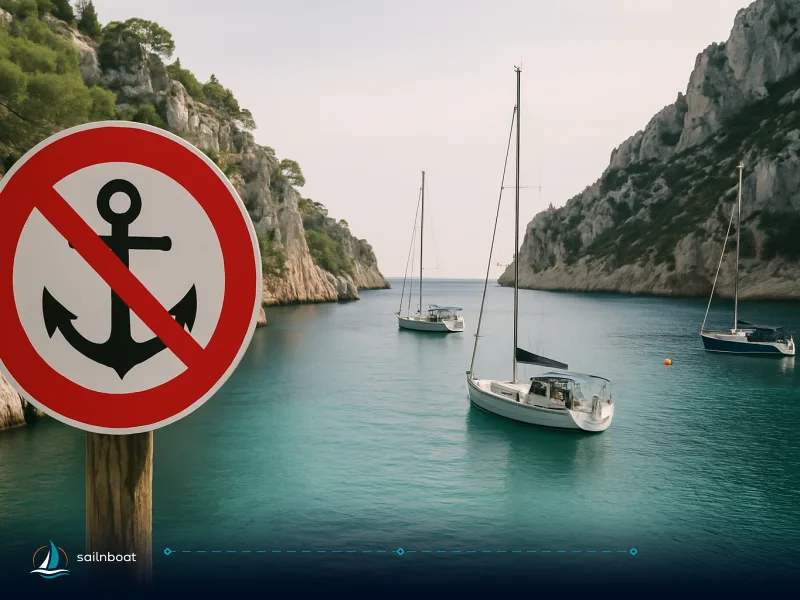
Port‑Cros anchoring is tightly managed: much of the archipelago’s “heart” either bans anchoring on Posidonia or requires you to use park buoys (the Passe de Bagaud ZMEL has 68 ecological buoys and is active 15 April–15 October; hook anchoring there is prohibited year‑round). Read the zones before you arrive — Port‑Cros and Porquerolles use lettered regulatory sectors (C, D, E, G, H, I, J, etc.) with different year‑round and seasonal rules.
Understanding Anchoring Zones in Port‑Cros
Port‑Cros and Porquerolles sit inside a legally mapped “coeur marin” and set of adjacent regulatory sectors; those maps are the single source of truth for where you may anchor, where you may not, and where only mooring devices (bouées) are authorised.
Designated Anchoring Areas
- Passe de Bagaud (Port‑Cros): the Parc national operates a ZMEL here (176 ha) with 68 ecological buoys distributed in four sub‑zones (Nord Bagaud, Sud Bagaud, Anse Saint‑Pierre and Anse Fausse Monnaie). Hook anchoring is forbidden in the ZMEL at all times; the buoys are the legal mooring option.
- Port‑Cros — Port and Baie: the park manages the small port (pontoons and corps‑morts). Daytime access and local buoys are available; many buoys are sized for 10–15 m boats and deeper‑draft quillards are warned about shallow approaches. Port depths alongside pontoons vary roughly between ~1.3 m and ~3.0 m (charted sondes are published by the park).
- Porquerolles — north coast beaches (Notre‑Dame, la Courtade, l’Argent): large sandy areas remain the principal free, forain (anchoring on hook) spots where local maps show sand bottoms and typical depths in the mid‑single to low double metres offshore; however many sectors adjacent to reefs and Posidonia are closed or reserved. The park is implementing a large ZMEL project around Porquerolles (projected ~350 buoys across the main beaches) to move traffic off the Posidonia.
Practical navigation note — the park publishes precise, lettered maps (Porquerolles: zones C, D, E, G, H, I, J, R; Port‑Cros: detailed ZMEL and cordoned areas). Always consult the park map for the exact polygon before you commit to a hook.
Seasonal Bans on Anchoring and Mooring
There are two layers of timing you must track: (A) year‑round prohibitions in sensitive sectors and (B) seasonal closures and time windows that restrict landing, mooring or diving.
Key Dates and Areas Affected
- ZMEL de Bagaud (Port‑Cros): accessible 15 April–15 October; day use 08:00–18:00 (free), night use 18:00–08:00 is paid and requires reservation; anchoring by hook inside the ZMEL is illegal at any time.
- Porquerolles: the park’s arrêté sets numerous lettered zones. Notably, Zone J (east of Pointe Prime) is reported to forbid mouillage all year, and several other zones (C, D, E, G, I) either prohibit anchoring year‑round or limit it to designated devices; confirm the exact boundaries and restrictions on the current park map. and several other zones (C, D, E, G, I) either prohibit anchoring year‑round or limit it to designated devices; parts of the coast also prohibit accostage/amarrage/debarquement seasonally between 15 June–30 September.
- Rade and coeur marin limits: since 15 December 2020 mouillage by vessels above a certain large length (the park’s documentation and préfectoral measures currently prohibit mouillage by vessels >24 m in the coeur marin and much of the rade d’Hyères). That rule is enforced by maritime authorities and may be policed at approach.
How this affects your schedule: if you plan a July/August cruise you cannot rely on free, unrestricted hook anchoring in many of the archipelago’s best coves; instead either reserve a ZMEL buoy in advance for overnight or plan to transit to mainland marinas. The park’s seasonal dates have been consistent in recent years but do vary with administrative updates — check the park website or the ZMEL booking portal before you set sail.
Park‑Managed Mooring Fields: What You Need to Know
The park now uses ZMELs and ecological moorings as the primary tool to protect Posidonia and control overnight pressure.
Mooring Field Details
- ZMEL de Bagaud (Port‑Cros)
- Total buoys: 68 (60 for 0–15 m; 5 for 15–30 m; 3 reserved for island residents). Day use 08:00–18:00 is free; night 18:00–08:00 is paid and requires online reservation. Anchor hook is banned in the ZMEL year‑round. Limited to 5 consecutive night stays per vessel; tariffs are charged per m² (park publishes the current price schedule).
- Port de plaisance de Port‑Cros
- Capacity: pontoons + corps‑morts managed by the park (many visitor buoys sized for craft ≤15 m; specific bouée numbering indicates 10 m and 15 m maxima on groups of bouées). The port enforces a night tax and closes seasonally.
- Porquerolles (projected ZMEL)
- The park’s official project pages show a planned re‑organization with a capacity on the order of ~650 units total overnight capacity and roughly 343–354 buoys planned at full delivery (the scheme stages in over several years; daytime use will be free, nights reservable). This is a park project and rollout timing remains subject to technical and administrative steps.
Reservation, fees and practical steps
- Bagaud bookings currently run via the park’s Smartwaters portal (the site is publicised on the park pages). You must reserve night stays in advance; day use is “first come, first served.” The Bagaud night tariff example published by the park uses a per‑m² basis (the park’s page quotes €0.58 TTC × boat m × beam for the first two nights, with higher rates after). Cancellations are non‑refundable under the current T&Cs.
Vessel size limits and safety
- The park sets explicit maxima: many Port‑Cros bouées are for up to 15 m; port access for vessels >15 m is limited to the stone quay and requires reservation (the port warns about exposure to Mistral and closures above force 6/7); mouillage of vessels >24 m is prohibited in coeur marin / rade. Check the park’s harbour PDF for pontoon sondes and per‑buoy length limits before committing.
Tendering and Shore Access Protocols
Landing a tender or coming ashore places the same pressure on beaches and trails as a landed tourist: the park regulates where and when you can go ashore.
Designated Landing Areas
- Port‑Cros:
- Official tender/ponton access is concentrated at the port pontoons, Plage de la Palud and the plage du Sud; the park expressly forbids beaching or tying off on the littoral outside these points (and forbids hauling a tender ashore on islets). A person must remain aboard during busy periods as required by the park.
- Porquerolles:
- The island’s port has visitor pontoons and scheduled ferry services; many beaches (notably in the central/north sector) are accessible only where the map allows — accostage, amarrage and disembarkation are banned in specified places from 15 June–30 September to protect nesting birds and fragile dune vegetation. Consult the Porquerolles regulation map for exact permitted landings.
Tendering best practice (operational checklist)
- Approach slowly under oars or low‑throttle (5 knots or less in the 300 m band; the park’s speed bands are 5 kn in the 300 m zone, 3 kn in ports and 3 kn within 100 m of diving sites).
- Use the official ponton or the small, signed beach access points only; do not beach the tender on dunes or scrub.
- Leave no waste ashore — the park requires you to take all waste back to the mainland; there are few collection points.
Low‑Impact Alternatives When Anchoring Is Prohibited
If the area you intended to anchor is closed, take one of these practical alternatives rather than forcing an anchor on a Posidonia bed.
- Use a ZMEL buoy: ecological, legally permitted, less risk of hook dragging or fines; book nights early in high season.
- Book a pontoon at Porquerolles or a berth on the mainland (Hyères/La Londe/Le Lavandou) — in July/August this is often the reliable option.
- Plan to anchor on recognised sandy grounds well outside the coeur marin (consult charts and park maps); set a conservative scope and back‑up anchor and avoid any visible Posidonia fronds when recovering.
- If you must tender ashore, pick official landing points and reduce shore visits during breeding season and peak summer closures; stagger group landings to reduce trampling.
Environmental rules that affect your choice
- Discharging blackwater in the park is forbidden. The Préfet Maritime requires vessels to be equipped with holding tanks for blackwater where applicable (this affects whether some vessels may be allowed to anchor in certain park waters). Use the park’s “bateaux propres” guidance and avoid any discharge.
Planning Your Visit to Port‑Cros and Porquerolles
A practical checklist so you arrive with the right bookings, kit and expectations.
- Paperwork and radio
- Carry your boat papers, skipper’s licence where applicable, and an operational VHF. Most park notices advise monitoring VHF (canal 9/16 for Port‑Cros) for harbour info. The park’s capitainerie contact details are published on its site.
- Check the park map and restricted sectors
- Download or view the park’s regulatory map before you leave: the lettered zones and the exclusion polygons are the legal reference for where you may anchor, dive or land. The park provides printable PDFs and an interactive cartothèque.
- Reserve ZMEL buoys if you plan to stay overnight
- If your plan includes an overnight in Bagaud (Port‑Cros) or in the future around Porquerolles, reserve via the park’s online booking portal (Smartwaters for Bagaud). Book nights early in July/August; cancellations on the park portal are typically non‑refundable.
- Check vessel suitability
- Take note of per‑buoy and port size limits (many park buoys are for ≤15 m). If you are a quillart with deep draft, favour pontoons and book the stone quay if you exceed 15 m. The park posts pontoon sondes and length limits.
- Weather and safety margin
- The Port‑Cros port is exposed to mistral; the park closes or limits moorings above specified wind thresholds (closures above Beaufort 6–7). Plan a weather buffer and do not rely on sheltered coves when a mistral window is forecast.
- Onboard conduct
- No blackwater or sewage discharges, no engines idling in the 300 m band, no lighting underwater at night, and keep noise low; the park enforces these rules and fines can be applied.
Table — quick comparison of managed options
| Site / Field | Buoys (published) | Vessel limits | When active | Reservation / Fees |
|---|---|---|---|---|
| ZMEL — Passe de Bagaud (Port‑Cros) | 68 (60 × 0–15 m; 5 × 15–30 m; 3 resident) | Day use for small craft; larger boats cautioned near shore | ZMEL open 15 Apr–15 Oct; hook anchoring banned year‑round in zone | Day 08:00–18:00 free; night 18:00–08:00 paid & reservable via Smartwaters; tariff example €0.58 × m² first two nights. |
| Port de plaisance de Port‑Cros | Pontoons + corps‑morts (park‑managed) | Many buoys 10–15 m; stone quay for >15 m (booked) | Year‑round operations but capitainerie seasonal; port closes in severe weather | Night tax payable at capitainerie; reserve for quay; limited services (no fuel). |
| Porquerolles — ZMEL project (planned) | Projected ~343–354 buoys (phase rollout) | Designed to host a mix of small/medium craft; details per site | Projected scheme staged (park planning horizon through 2028); day free, nights reservable | Nightly tariffs proposed to align with nearby ZMELs; booking portal to be used. |
(Ensure your planned boat length matches the field’s published per‑bouée maxima before committing.)
Final operational tips for flotilla leaders and bareboat skippers
- Include the park map and ZMEL booking instructions in your pre‑charter briefing; assign one person to handle the reservation and show them how to operate the bouée interaction safely.
- If you lead a group, stagger arrivals: the park enforces presence‑of‑person‑onboard rules during busy hours and does not permit leaving a boat unattended on a ZMEL buoy at night without the live‑aboard condition satisfied.
- Brief the crew on Posidonia recognition (green, grass‑like beds) and have stern‑line/snubber practice to avoid chain rubbing; chains dragging through Posidonia are a common damage cause.
- Always carry a secondary plan: if the nearest ZMEL is full, head for the port (if space) or mainland marinas rather than essaying an anchor in a red‑shaded no‑mouillage zone.
Plan the visit to Port‑Cros and Porquerolles around the park rules: reserve early for nights, use ecological buoys rather than hooks where required, land only at official points and leave the islands cleaner than you found them.
Frequently Asked Questions
The Park uses lettered zones. Port‑Cros includes the Passe de Bagaud ZMEL (Bagaud North/South, Anse St‑Pierre, Anse Fausse Monnaie). Around Porquerolles the map shows zones C, D, E, F, G, H, I, J and R; several of those (C, D, E, G, I and J) prohibit mouillage except on designated devices.
ZMEL fields and several park protections run seasonally: Bagaud ZMEL operates 15 April–15 October (day free 08:00–18:00; night 18:00–08:00 paid and reserved); around Porquerolles some landing and amarrage activities are restricted between 15 June–30 September and specific dive/anchoring bans run 1 April–30 September for parts of the park.
ZMEL buoys are ecological fixed moorings. Day use is generally free; night use requires online reservation and payment (the park currently uses a Smartwaters booking portal for Bagaud). Capacity and distribution vary by field (Bagaud: 68 buoys; Porquerolles project: ~350 buoys planned).
Mooring buoys at Port‑Cros are primarily for 0–15 m craft (specific bouée ranges give 10 m or 15 m maxima on many positions) and the port limits >15 m except on the stone quay (reservable up to about 30 m). In the park’s coeur marin and the rade, mouillage is generally prohibited for vessels over 24 m.
At Port‑Cros use the official pontons (Plage de la Palud, plage du Sud and the port pontoons). At Porquerolles use the port ponton and the beaches where landing is allowed (many beaches and some coves are off‑limits for landing between mid‑June and end‑September). Always use the park’s maps to identify permitted landing spots.
Use an ecological park buoy (ZMEL), book a pontoon, overnight in a managed marina on Porquerolles or the mainland, or plan to night‑run to an allowed sandy anchorage further from fragile habitats; always avoid Posidonia beds and carry your waste ashore.
Written by
Sailnboat Editorial
The Sailnboat editorial desk covers yacht and boat chartering worldwide — routes, bases, seasons, boat types, paperwork and the practical costs that decide a trip. We are a charter marketplace, not a boat owner or a local agency: what we sell is judgement and support, so our guides are written to help you make a decision, not to sell you a specific boat. Every guide is checked against live operator and marina data before it goes out.
Fact-checked against live operator and marina data, and published under our editorial standards. Last reviewed: .