Medical Evacuation from a Yacht: Planning and Insurance Guide
Practical steps to plan a medical evacuation from a yacht, compare evacuation memberships and travel insurance, and understand who pays in an emergency at sea.

Plan for a medical evacuation from a yacht by treating it like a high-cost contingency: the evacuation logistics (who moves the patient), the clinical bill (who pays for treatment), and the policy cover (what you bought) are three separate risks you must manage before you step aboard. This guide shows the exact steps crews follow in an evacuation, how membership services differ from travel insurance, the questions to ask your operator, realistic cost ranges to budget, and who usually pays. Read these parts and you’ll leave port with a practical, actionable plan.
Understanding Medical Evacuation Logistics
A medical evacuation from a yacht is a chain of decisions and actions: on‑board assessment → contact & coordination → extraction → handover ashore. Each step has operational consequences you should understand before you charter.
Typical procedures for medical evacuations
- Immediate on‑board action: the skipper and crew perform a primary assessment (ABC — airway, breathing, circulation), apply first aid, start oxygen and IVs if trained, and prepare the casualty for movement. The master makes the safety/weather call — whether to alter course, seek shelter, head for the nearest port, or stand by for an aerial pickup.
- Notification and coordination: the crew calls the operator/base and, if needed, the national maritime Rescue Coordination Centre (MRCC) or coast guard. If you have a membership (Medjet/Global Rescue/Ripcord) or travel insurer with an assistance line, contact them promptly — they take over coordination and can mobilise aircraft or specialist teams.
- Extraction options and constraints:
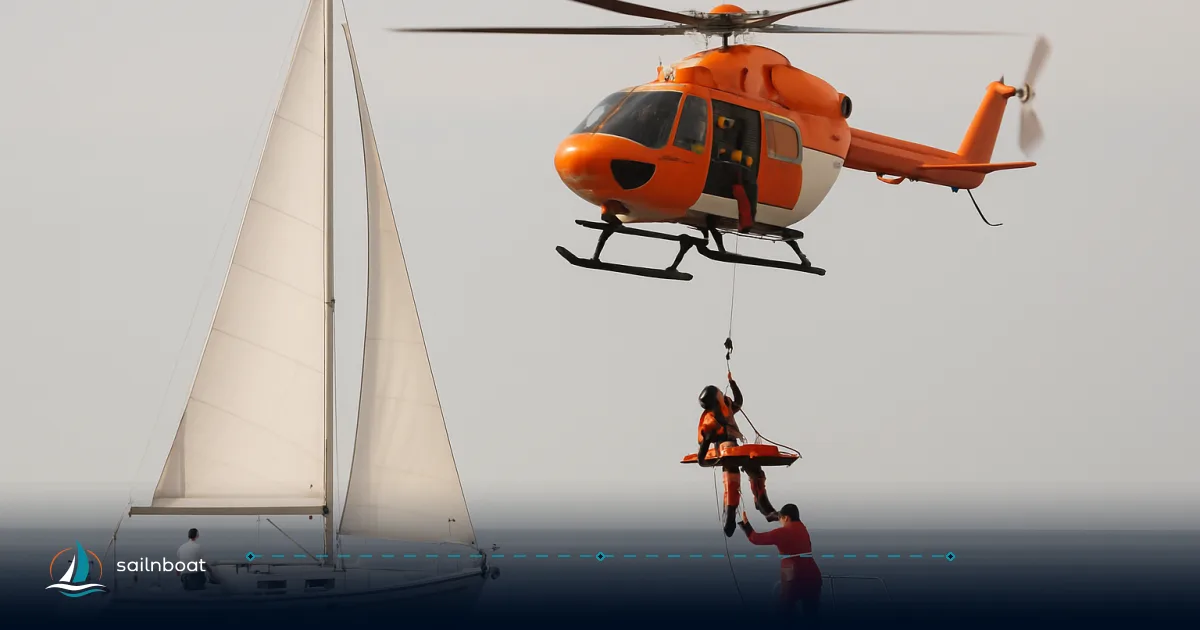
- Helicopter hoist or ship‑to‑shore winch where weather, sea state and distance permit; helicopters are fast but expensive and have limitations in bad weather or at night.
- Fast rescue boat transfer if land or a sheltered port is reachable within safe transit time.
- Fixed‑wing air ambulance or scheduled commercial jet stretcher transfer for long‑range repatriation once the patient is stable; these require an airstrip and medical escort.
- Handover ashore: local ambulance or hospital accepts the patient; the assistance provider coordinates paperwork, visas or customs clearance if international transportation is needed. Memberships will often arrange and pay for the transport portion to a chosen hospital; travel insurers manage medical treatment costs within policy limits.
Practical point: extraction choice is a clinical and safety decision; the captain, assisted by medical advice from the assistance provider, decides the safest option. Confirm at pre‑charter briefing how your skipper will make that call and how you will be informed.
Insurance Options for Medical Evacuations
There are two distinct but complementary products: evacuation/membership services (organisers/payment for transport) and travel/medical insurance (medical treatment, reimbursement, trip interruption). Buying both is common for remote cruising.
Subscription‑based services
Membership programmes (examples: MedjetAssist, Global Rescue, Ripcord-style integrated programs) specialise in search, rescue coordination and medical transport to a hospital of choice or home‑country facility. Memberships typically:
- Mobilise aircraft, arrange medical escorts and manage logistics.
- Often require activation before departure and have defined trip-duration rules.
- Frequently cover the transport cost itself (subject to membership terms); they do not replace travel insurance for medical bills, cancellation or baggage loss.
Typical membership price signals (market examples): Medjet annual plans commonly start in the low hundreds USD for individuals and ~USD 300–500 is a common annual figure for broader plans; short‑term trip options also exist. Members and travel writers cite similar ranges for Global Rescue / Ripcord offerings depending on duration and benefits. These are pricing examples from public plan breakdowns and reseller quotes — check the provider for current rates.
Comprehensive travel insurance
A travel medical policy (Allianz, IMG/IMG‑branded plans, specialist expedition insurers such as Expedition Insure) typically:
- Covers local emergency medical treatment and may reimburse emergency medical transportation to the nearest appropriate facility.
- Offers limits for emergency medical evacuation and repatriation — these limits vary widely, so you must check the policy’s maximum for evacuation and whether it is primary or secondary to your home health plan.
- Includes related benefits (trip cancellation/interruption, baggage, AD&D) that memberships do not.
Table — quick comparison
| Product type | Primary function | Typical gap it fills | Typical price signal |
|---|---|---|---|
| Evacuation membership (Medjet, Global Rescue, Ripcord) | Organise & usually pay for transport / repatriation | Logistics & transport costs (not routine medical bills) | Annual: low hundreds USD (varies by plan and trip length). |
| Travel medical insurance (Allianz, IMG, specialist) | Pay medical bills, reimburse evacuation up to policy limit | Hospital bills, tests, ambulances, trip cancellation | Trip cost‑based premiums; evacuation limits vary from tens to hundreds of thousands EUR. |
| Integrated products (Ripcord Rescue Travel Insurance) | Combined assistance + insurance in one product | Single contact for rescue + claims handling | Varies; marketed to adventure travellers; price depends on territory and age. |
Why carry both: memberships guarantee fast, specialist logistics and often no‑out‑of‑pocket for transport; travel insurance handles the medical bill, hospital guarantees and trip finances. Expedition insurers will explicitly recommend carrying a membership plus a large SAR sublimit for remote operations.
Key Questions to Ask Your Yacht Operator
Before you book or at handover, get answers to these practical, decision‑grade questions — write them into the charter notes if needed.
Emergency protocols
- Who is the on‑board medical lead (captain, chief officer or crew member) and what are their qualifications? Ask for specific certificates (first aid, STCW medical training).
- What is the skipper’s chain of command for a medical diversion or evacuation? Confirm whether the captain can make a port diversion without prior owner approval.
- Which authority will the crew contact first — local coast guard / MRCC, the charter base, or a private assistance provider — in case of a serious incident?
Equipment and resources
- What medical kit is onboard? Request an inventory: oxygen, automated external defibrillator (AED), basic IV supplies, immobilisation kit and the crew’s training to use them. Some yachts carry advanced kits or a stretcher — ask specifically.
- What is the nearest hospital with emergency capability, and how long does it typically take to reach that port from your planned cruising area (give the distance and estimated transit time in hours under normal conditions)? Ask the captain to state the nearest SAR base or heliport by name.
- Does the yacht have a tender capable of fast transfers? If not, your options for sea retrieval may be limited.
Operationally important: ask whether the operator/owner will coordinate the evacuation and whether they require payment up front (some private providers or local services ask for payment guarantees; a membership or insurer contacting them directly avoids that). Confirm exactly how billing will be handled.
Budgeting for Medical Evacuation Costs
Put hard numbers into your cost planning. Two figures matter: likely extraction cost and the follow‑on repatriation/medical treatment cost.
Cost factors
- Helicopter (rotary‑wing) evacuations: analyses and government studies show median billed charges in many markets in the tens of thousands of dollars (example median figures published by GAO: roughly $36,400 for rotary‑wing and $40,600 for fixed‑wing in their 2017 dataset). These are billed charges and your out‑of‑pocket depends on policy and network status.
- International fixed‑wing repatriation: longer range air‑ambulance repatriations can exceed $100,000 and, in published cases, reach several hundred thousand dollars depending on escort, aircraft type and distance. Commercial sources and operators commonly warn that an international medevac without cover can be six‑figure.
- Variables: distance to home country, need for an intensive‑care escort, flight clearance and diplomatic/landing fees, night operations, and whether an in‑country provider is available. All of these push cost up quickly.
Preparing for unexpected expenses
- Budgeting approach: for ordinary Mediterranean or Caribbean day‑sailing, expect contingency of at least several tens of thousands EUR if an air evacuation might be required; for remote offshore, budget for the order of magnitude of 5‑figure to 6‑figure worst cases unless you carry a membership that explicitly covers transports. Use the GAO median figures as a baseline for helicopter retrievals and assume higher for international repatriation.
- Practical mitigations: purchase a travel policy with high evacuation limits, add an evacuation membership that removes transport‑cost risk, and keep a designated payment card with sufficient limit (bases sometimes require payment guarantees).
Financial Responsibilities During Emergencies
Who actually pays is contract and product dependent. Understand legal liability (charter contract) versus practical payment (who settles the bill on the spot).
Traveler responsibilities
- Your medical bills and evacuation costs are normally your financial responsibility unless your travel insurance or an evacuation membership covers them. Most owner H&M or yacht P&I insurance does not pay for guests’ personal medical treatment. Buy personal travel medical and evacuation cover; for remote cruising, plan a membership plus a policy with large evacuation limits.
- If you lack cover, you (or the lead charterer’s credit card) will often be asked to guarantee payment for private air ambulance crews or local hospitals before the transfer or treatment — that can be a practical barrier to timely care. Memberships that pay providers directly remove that friction.
Yacht operator responsibilities
- The charter contract sets the legal allocation of risks: in bareboat charters the charterer often steps into the owner’s shoes for vessel operation and certain liabilities; on crewed charters the owner/operator keeps operational control but will usually coordinate assistance and liaison with insurers and P&I clubs. The owner’s insurance typically covers owner liabilities, not guests’ personal medical bills. Read the charter agreement and the insurance clauses carefully.
- Practical help: most professional charter operators will coordinate an evacuation and communicate with your insurer or membership provider, and will assist with port procedures — but coordination is not the same as accepting financial responsibility for the patient’s costs. Confirm whether the operator expects you to use their local agents (and who pays those costs).
Final operational checklist to leave with your crew/guests
- Carry printed and digital copies of your travel insurance policy, membership ID and emergency contact numbers.
- Add the membership and insurer numbers to the yacht’s emergency board and confirm who will call them.
- Make the captain note nearest emergency facilities and the estimated transit time from planned anchorages.
- Nominate who will guarantee emergency payments (which card) if the insurer or membership cannot be reached immediately.
If you do one thing: buy a travel medical policy with generous evacuation/repatriation limits and add a medevac membership when you’ll be more than a short tender ride from shore. The membership removes the largest practical barrier — immediate access to a jet or helicopter — while the insurer protects you from the follow‑on medical bill and ancillary financial losses.
Review your insurance options and discuss emergency protocols with your yacht operator before your next charter.
Frequently Asked Questions
Crew stabilises the patient, contacts the operator/shore assistance and SAR/evac provider, and transfers the patient to the agreed extraction point (helicopter landing, rendezvous with fast rescue boat or port) for onward transfer to hospital.
Membership services focus on organising and covering medical transport and repatriation; travel insurance reimburses medical care, trip interruption and other losses — many travellers carry both.
Ask about crew medical training, the onboard medical kit and AED, nearest hospitals and SAR units, how they handle emergency billing, and the skipper’s authority on diversion or evacuation.
Expect rotary‑wing (helicopter) evacuations to be in the tens of thousands (median figures from recent analyses are around €30k–€40k) and international fixed‑wing repatriation to be substantially higher; plan for worst‑case six‑figure scenarios if remote or offshore.
Guests are usually financially responsible for their own medical care and evacuation unless the charter contract or operator explicitly states otherwise; owners/operators generally coordinate but do not usually absorb guests’ medical bills.
Written by
Sailnboat Editorial
The Sailnboat editorial desk covers yacht and boat chartering worldwide — routes, bases, seasons, boat types, paperwork and the practical costs that decide a trip. We are a charter marketplace, not a boat owner or a local agency: what we sell is judgement and support, so our guides are written to help you make a decision, not to sell you a specific boat. Every guide is checked against live operator and marina data before it goes out.
Fact-checked against live operator and marina data, and published under our editorial standards. Last reviewed: .