Electricity on a Yacht: A Practical User Guide
A concise, practical guide to managing electricity on a yacht: shore power connections, generators, inverters, safe device charging and the adaptors you should bring.

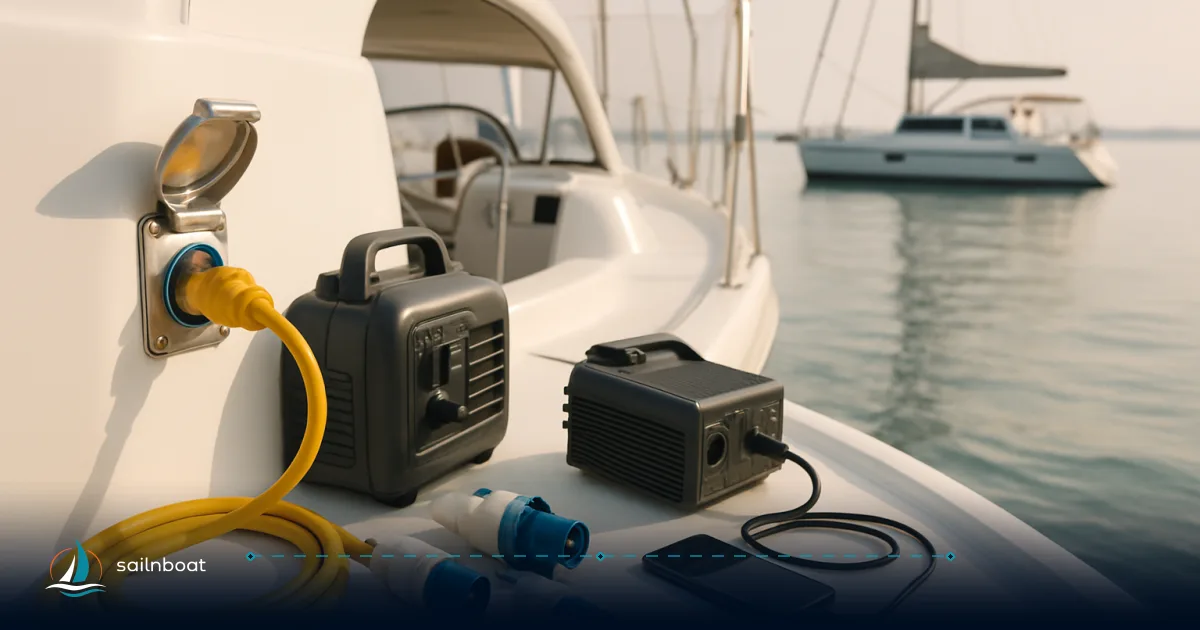
Electricity on a yacht comes from three practical sources: shore power at the dock, an onboard generator, and your boat’s DC battery bank feeding an inverter. Manage them by matching inlet amperage to the marina pedestal, limiting simultaneous high-wattage loads, and using the right adaptors and protection devices — that’s the shortest route to reliable power aboard your charter.
Understanding Shore Power Connections
Shore power is the main way most charter boats run air-conditioning, battery chargers and galley equipment while alongside. It’s simple in concept — a dedicated cable links the marina pedestal to the boat’s shore inlet — but the socket type, voltage and amperage differ by region and can affect what you can run.
What is Shore Power?
- Definition: shore power is AC electricity supplied by the marina through a pedestal or dock box. It feeds the boat’s AC distribution panel and battery charger when connected.
- Regional standards at a glance:
- Europe: IEC 60309 (“CEE”/blue red industrial sockets) at common ratings 16A, 32A and 63A, typically at ~230V single‑phase (and three‑phase options for larger pedestals).
- United States: marina pedestals commonly include a 30A/120V or a 50A/120/240V split‑phase pedestal; the 50A pedestal supplies two 120V legs for larger loads.
- Why it matters: plugging a boat inlet into a pedestal with a different voltage or wiring configuration can damage equipment or trip breakers — always confirm the boat’s inlet rating before connecting.
Connecting to Shore Power
Step-by-step safe connection (standard sequence):
- Inspect the pedestal and cord for corrosion, cracked insulation or loose pins; do not use visibly damaged equipment.
- Turn off the boat’s main shore‑power breaker or disconnect at the inlet.
- Plug the shore cord into the pedestal, then into the boat inlet — follow the pedestal’s recommended order (some pedestals have a switch). Lock or secure the connection where provided.
- Switch on the pedestal breaker (if present), then the boat’s shore breaker. If the pedestal trips, unplug and see if another boat is overloading the pedestal.
- Always use a marine‑grade shore cord rated for wet environments (EEL or equivalent) and the correct ampacity for your inlet.
Safety standards and protective devices:
- Many regions and manufacturers expect an ELCI or equivalent shore‑fault protection at the inlet; ABYC guidance includes requirements for leakage protection and shore power overcurrent protection. These devices reduce electrocution risk and detect shore‑side faults.
- In the U.S, regulations reference shore power requirements for vessels with electrical systems operating above 50 volts; compliance is part technical standard, part operator practice.
Onboard Generators and Inverters
When you’re away from the dock or need more AC than batteries alone can supply, generators and inverters are the two ways to create AC aboard.
Using Onboard Generators
- What they do: a marine generator burns diesel (or gasoline/propane on some units) to produce AC power continuously and run heavy loads (AC units, ovens, large battery charging). A typical charter catamaran or motor yacht will have a small genset sized to its expected loads.
- Fuel use and noise: small marine gensets (common ratings 4–8 kW) often consume between 1 and 3 L/hr at light to medium loads, but actual fuel use varies widely by model and load percentage — always check the manufacturer’s data for your specific generator. Sound levels and fuel use improve with newer low‑speed, supersilent models. Use the manufacturer’s data for precise numbers on your charter.
- Trade‑offs:
- Pros: reliable continuous AC, good for air‑con and heavy charging.
- Cons: fuel use, maintenance, and noise—run times and restrictions vary by marina (many marinas ban running gensets overnight or in narrow channels). Ask the base about limits before you plan to run it.
Inverter Functionality
- How inverters work: an inverter converts DC from the boat’s battery bank into AC that mimics mains power (preferably as a pure sine wave). This lets you run laptops, TVs, small microwaves and low‑power kitchen appliances without a generator.
- Typical sizes and what they handle: marine inverter/chargers commonly range from about 1,000W to 5,000W. A 1,500–3,000W unit will cover most electronic loads and modest appliances; boats that need to run air‑conditioning or large induction cookers normally have larger inverter/charger systems or rely on the generator. Size for continuous watts and allow extra capacity for motor start surges (fridges/AC compressors).
- Practical point: inverter efficiency and battery capacity determine how long you can run—expect efficiency in the high‑80s to low‑90s percent for modern units and plan battery amp‑hours accordingly.
Safe Charging Practices for Devices
Small electronics account for most guest electrical needs. Charging them correctly protects devices and the boat’s electrical system.
Charging from Shore Power
- Prefer direct USB/USB‑C PD chargers for phones, tablets and laptops where possible — they draw low, regulated power and are efficient. For laptops requiring AC, use the boat’s AC sockets but avoid daisy‑chaining adaptors.
- Avoid overloading: total continuous loads must not exceed the inlet/pedestal rating (30A/50A or 16A/32A etc.). Use an amp calculator (sum device wattages ÷ voltage) and remember inverters and chargers draw extra current during battery charging.
- Small surge protectors / EMS (electrical management systems) are a cheap insurance item between the pedestal and your cord; they protect against voltage spikes, reversed polarity and other pedestal issues.
Charging from Generators and Inverters
- If using the generator: run the generator for charger loads or heavy AC appliances; avoid operating the generator solely to charge a phone—use the battery charger when practical. Keep gen run windows short to limit fuel use and marina noise issues.
- If using an inverter: run higher‑efficiency devices (phone chargers, laptops) from DC‑to‑AC via the inverter only when shore power or generator is unavailable; large continuous AC draws quickly deplete batteries. For long laptop work sessions, a small USB‑PD power supply on DC via a 12V USB outlet is preferable.
- Device compatibility: modern laptops increasingly use USB‑C PD; check your laptop’s wattage (45W–100W typical) and size inverter accordingly if you plan to run multiple such devices from inverter power.
Required Adaptors for Yacht Power Outlets
Bring adaptors appropriate to the region and the boat’s inlet. Adaptor misuse is a common cause of shore‑power incidents.
Common Adaptor Types
| Region / Socket | Typical pedestal / inlet | What to bring |
|---|---|---|
| Europe | IEC 60309 CEE 16A / 32A (230V single‑phase) and larger CEE sockets | CEE 16A→32A pigtail or CEE 32→16 adapter, plus Schuko to CEE adaptor if you need to plug household chargers ashore. |
| United States | 30A (TT‑30/NEMA style) 120V and 50A 120/240V twist‑lock pedestals | Marine 30A or 50A shore cord as required; if your boat inlet is 30A and the pedestal is 50A, use a certified 30→50 adapter (not improvised). |
| United Kingdom | Type G (230V) onshore sockets; marinas often use CEE or dedicated marine pedestals | Bring plug adaptors for Type G and any CEE adapters you need. |
- USB options: bring one or two high‑quality multi‑port USB‑PD chargers (30–100W per port options) to efficiently charge devices and minimize reliance on AC outlets.
- Extension and cord length: request the shore cord length the base supplies; marina pedestals can be far from the inlet — a 10–15 m (30–50 ft) cord is common; bring a longer certified cable if you expect deep slips.
Confirming Adaptor Needs
- Always ask the base for the boat’s inlet type, whether a shore cord is supplied, and the exact pedestal type at your slip — adaptors that appear interchangeable can have different phase/wiring and safety requirements. Adaptor requirements vary by region and marina.
- Risks of incorrect adaptors: overheating, reversed polarity, tripped pedestals and, in the worst case, equipment damage or fire — use certified marine adaptors rated to the same ampacity and IP/wet‑location rating as your shore cord.
Inquiring About Power Availability at the Yacht Base
Before you arrive, a short checklist to get decision‑grade answers from the base will save time and avoid surprises.
Questions to Ask the Yacht Base
- What is the boat’s shore‑power inlet rating (voltage and amperage)? (E.g., 230V 16A inlet, 32A inlet, 120V 30A or 120/240V 50A.)
- Do you supply a shore power cable? If so: length, amp rating and connector type (CEE/Marinco/twist‑lock)?
- Does the marina pedestal at my berth have metering, and what amperage is available there? (Some pedestals are limited or shared.)
- Is an ELCI/GFCI fitted at the inlet or pedestal, and will you provide any surge protection?
- Any generator use restrictions (hours/noise rules) at the base or marina?
Understanding Regional Differences
- Standards vary: the IEC/CEE system in Europe is different from US marina pedestals; some boats are wired for 230V only and cannot accept US 120V without a transformer or rewiring. Ask for the boat’s owner’s manual or base tech sheet if you need to confirm.
- If you plan international legs, confirm whether the boat’s inverter/charger and chargers accept the local mains frequency (50 vs 60 Hz) and voltage—some sensitive equipment tolerates both, some do not.
Practical checklist before you board
- Ask the base for the inlet type, shore cord availability (length & rating), ELCI/GFCI presence and generator rules.
- Pack: 1–2 USB‑PD chargers, a small AC surge protector/EMS, CEE 16/32 adapters if sailing Europe, and a certified marine shore cord or adapter matching your inlet if the base cannot supply one.
- Onboard practice: switch off major loads when plugging/unplugging shore power, stagger high‑draw appliances, and prefer DC/USB charging for long sessions.
You should be able to run phones, tablets, laptops and small galley items without drama if you match inlets, use a correctly rated shore cord and don’t expect a small inverter to supply continuous heavy AC loads. If anything about the boat’s electrical layout is unclear, ask the base for the boat’s electrical diagram or for a short briefing at handover — that single conversation prevents most on‑charter electrical problems.
Call your yacht base and ask the five key questions above before you pack adaptors or buy equipment — the clarity will save time and money on the dock.
Frequently Asked Questions
Shore power is the AC supply provided by a marina pedestal that plugs into your boat’s shore inlet to power AC systems and charge batteries; pedestal types and voltages vary by region (Europe uses IEC/CEE sockets, the US commonly uses 30A/50A pedestals).
A generator produces AC power directly and can run heavy loads; an inverter converts the boat’s DC battery power to AC so you can run household devices away from the dock.
Use USB‑PD chargers where possible, avoid long-term charging from an inverter when batteries are low, limit simultaneous high‑draw devices, and carry a compact surge protector and power bank.
Bring a CEE (IEC 60309) 16A→32A adapter if sailing in Europe, a Schuko (Type F) to CEE adapter for shore-side charging, and a NEMA/TT‑30/14‑50 adapter if sailing in US waters; confirm with your base because marinas vary.
Call or email the base and ask for the boat’s inlet rating (voltage & amp), whether an ELCI/GFCI is fitted, what shore‑cord (length & type) they supply, and if the marina pedestal is metered or limited.
Written by
Sailnboat Editorial
The Sailnboat editorial desk covers yacht and boat chartering worldwide — routes, bases, seasons, boat types, paperwork and the practical costs that decide a trip. We are a charter marketplace, not a boat owner or a local agency: what we sell is judgement and support, so our guides are written to help you make a decision, not to sell you a specific boat. Every guide is checked against live operator and marina data before it goes out.
Fact-checked against live operator and marina data, and published under our editorial standards. Last reviewed: .