Trip Cancellation Insurance for Yacht Charters: Protect Your Investment
Trip cancellation insurance protects the non‑refundable portion of a yacht charter; adding CFAR and sufficient medevac limits is the most important decision for high‑value bookings.

Trip cancellation insurance protects the non‑refundable portion of your yacht charter — deposits, advance payments and often linked travel costs — so you don't lose the full charter sum when plans change. Buy the right mix (standard trip cancellation, CFAR where appropriate, and generous emergency medical evacuation) before you finalise a booking to avoid financial surprise.
Understanding Trip Cancellation Insurance for Yacht Charters
What is Trip Cancellation Insurance?
Trip cancellation insurance reimburses prepaid, non‑refundable trip costs if you must cancel for a covered reason named in the policy (serious illness, death in the immediate family, certain weather events, supplier insolvency and similar). For yacht charters this typically means reimbursement of charter deposits and advance payments you cannot recover from the owner or broker. Standard trip cancellation is distinct from trip interruption (which pays when you must cut the trip short) and from medical or baggage coverage—though many packaged policies include several of these benefits together.
Why this matters for charters: yacht bookings are often high value and largely non‑refundable; losing a deposit on a weeklong charter can be tens of thousands of euros or dollars, so a policy that clearly covers charter cancellation is essential. Specialist charter insurance or broker advice can help ensure the policy wording aligns with charter contract timing and supplier rules.
Why You Need It
- Financial protection: a charter deposit or balance can represent a large portion of your vacation budget; trip cancellation insurance limits that downside.
- Contract and supplier gaps: owners and bases vary on cancellation and refund rules; insurance covers the money you cannot recover from them.
- Operational risks unique to charters: weather windows, mechanical failures that render a yacht unseaworthy, or the unavailability of a contracted skipper are real risks that some charter‑specific policies address. Specialist brokers and insurers familiar with the industry can tailor cover to these risks.
Exploring 'Cancel For Any Reason' (CFAR) Coverage
What is CFAR Coverage?
Cancel For Any Reason (CFAR) is an optional upgrade to a travel insurance plan that lets you cancel your trip for reasons not enumerated in the standard policy and still receive partial reimbursement of your insured, non‑refundable trip costs. Because it expands the insurer’s exposure, CFAR typically pays a percentage of the insured costs (commonly between 50% and 75%) rather than 100%. CFAR cannot be purchased retroactively once the policy’s early‑purchase window has closed.
Trade‑off: CFAR buys flexibility at a price. It increases your premium and usually limits reimbursement to a fraction of costs — but where you’re insuring a very expensive yacht deposit, that fraction can still be a meaningful recovery against a total loss.
Purchase Windows and Reimbursement
- Purchase window: CFAR is time‑sensitive. Most providers require you to add CFAR within a short window after your first trip payment—typically around 14–21 days and sometimes as short as 7–10 days depending on the plan. If you miss that window you are usually ineligible for CFAR for that trip.
- Reimbursement: CFAR reimbursement levels vary by policy; common levels are 50%, 60% or up to 75% of insured non‑refundable costs, and many CFAR policies require you to insure 100% of your prepaid trip costs to be eligible. Additionally, CFAR normally requires cancellation a specified number of days before departure (often 48–72 hours). Read the exact conditions in the policy schedule.
Operational point: CFAR rarely replaces a full refund route. Most insurers demand you first seek refunds from suppliers; the CFAR benefit then reimburses the shortfall up to its percentage and limit.
Importance of Medical Evacuation Coverage
Why Medical Evacuation Matters
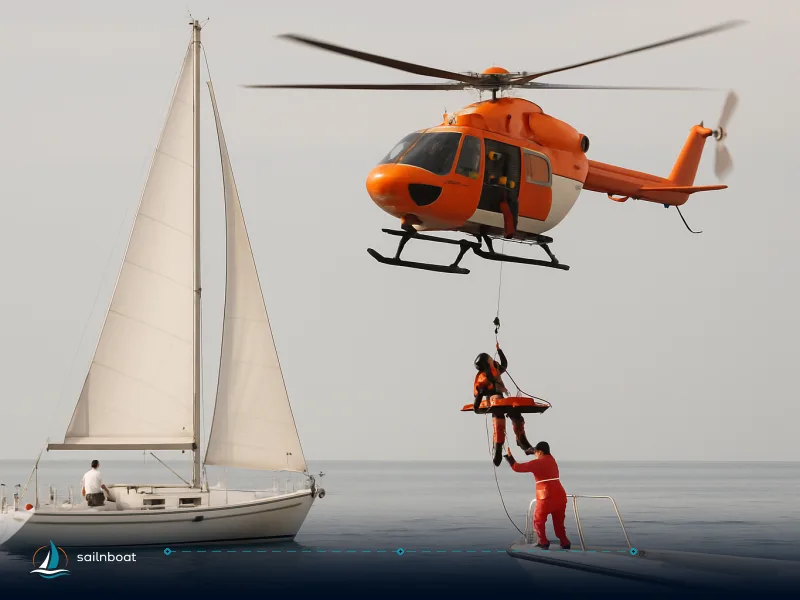
If you or a crew member needs urgent advanced care while at sea or on remote islands, transport to an appropriate medical facility or home can be exceptionally expensive. Medevac can involve a helicopter pickup, a dedicated air‑ambulance jet and ground transfers; depending on distance and provider, a single evacuation can reach tens of thousands to several hundred thousand dollars. That’s why emergency medical evacuation and repatriation limits are among the most safety‑critical parts of a travel policy for yacht charters.
Typical approach: buy emergency medical evacuation limits that reflect the remoteness and value of your charter. Comprehensive plans often offer $100,000–$1,000,000 evacuation limits; many advisers recommend at least $250,000–$500,000 if you cruise remote archipelagos or outside reach of reliable hospitals. Also check whether the policy covers evacuation coordination (most do) and repatriation to your home medical system.
Typical Scenarios Requiring Evacuation
- Serious trauma (falls, collisions) or acute cardiac/neurological events while hours from shore.
- Rapid medical deterioration of a guest requiring specialist treatment not available locally.
- Natural disasters or civil incidents that make local medical facilities unusable and require transfer to a safer medical centre or repatriation. In each scenario, an insurer’s pre‑approval and coordination centre usually manages the logistics — an administrative difference that often matters more than the raw dollar limit when a fast decision is required.
Comparing Insurance Providers and Policies
There are two useful ways to approach providers:
- Use specialist charter‑aware brokers/insurers who understand the unique timing and exposures of yacht charters.
- Use mainstream travel insurers but read their policy wordings carefully for charter exclusions and medevac limits.
Below is a practical comparison summary of commonly referenced charter providers, brokers and operators and what they typically offer. (This table is descriptive — contact the provider for exact, up‑to‑date cover and pricing.)
| Provider | Type | Charter focus / trip cancellation | CFAR available? | Medevac / evacuation limits (typical) | Notes |
|---|---|---|---|---|---|
| CharterProtect | Specialist educational broker/resource for charters | Focused on high‑value charter risks and tailored guidance for charter cancellation/CFAR options. | Advises CFAR and charter‑specific cover | Recommends high evacuation limits for remote charters | Trade‑up resource rather than an insurer. |
| NauticAssure | Yacht & charter insurance broker | Specialist broker for yacht/charter insurance and bespoke policies | Can place CFAR or cancellation packages via carriers | Works with markets that offer tailored medevac limits | Broker model; helps place specialist cover. |
| Pantaenius | Yacht insurer (longstanding in Europe) | Offers charter insurance and explicit trip cancellation products for charters | CFAR availability depends on product; their charter package includes trip cancellation options | Policies include explicit charter cancellation benefits; evacuation limits vary by plan | Pantaenius documents show specific charter cancellation wording and purchase timing. |
| Sunsail (Trip Mate / Generali) | Charter operator with travel protection | Offers Travel Protection Plan for guests administered by Trip Mate (Generali) | CFAR as part of some Trip Mate plans where available | Evacuation limits depend on the Trip Mate policy chosen | Operator‑administered plans are convenient but vary by region and season. |
| Bluebnc Yachting | Charter operator/manager | Primarily a charter operator; may advise clients on travel protection | Not primarily an insurer — can recommend protection | Not an insurer; evacuation/CFAR handled through recommended brokers/insurers | Useful for operator‑level help but confirm policy terms independently. |
| Sneed Tropical Yacht Charters | Charter booking firm | Charter agency that can advise on travel protection | May offer guidance or partner options | Insurance issued by third parties; approach via agent | Agencies often facilitate but do not underwrite. |
| IYC | Yacht brokerage & charter management | Full‑service brokerage with an insurance team for tailored solutions | Can arrange charter insurance and advise on CFAR | Has resources to source suitable evacuation limits for superyacht charters | Large charter broker with insurance services; useful for high‑value charters. |
How to use the table: if you have a standard weekender or a cheap day charter, mainstream travel policies may suffice; for multi‑week, crewed superyacht bookings or remote itineraries, prioritise providers who explicitly offer high trip cost cover and medevac coordination.
Key Features and Costs
- Premiums: travel insurance premiums commonly run about 4–10% of the insured trip cost; age, pre‑existing conditions and optional add‑ons (CFAR, higher medevac limits) push the price toward the top of that range. For high‑value charters the absolute premium will be higher even if the percentage is similar.
- Limits and sub‑limits: compare the trip cancellation limit (ideally it should equal the total prepaid non‑refundable trip cost), emergency evacuation limit (recommend $250k–$1M depending on remoteness), and medical expense limits. Many plans publish the “Schedule of Benefits”—use that table to compare.
- CFAR cost: CFAR increases premium substantially (underwriting commentary estimates the CFAR rider can increase a policy premium by several tens of percentage points). If your charter deposit is large, CFAR can still be cost‑effective as partial protection; otherwise compare the CFAR premium to the risk you are hedging.
Determining the Right Coverage for Your Yacht Charter
Factors to Consider
- Trip value: insure 100% of prepaid, non‑refundable costs if you intend to rely on CFAR; otherwise insure the parts you cannot recover (charter deposit, flights, hotel nights).
- Destination and remoteness: remote island chains and long offshore legs increase medevac risk and therefore the need for higher evacuation limits.
- Guest health and age: travellers with pre‑existing conditions need to check the plan’s pre‑existing condition waiver rules — these often require purchase within the policy’s early window and completion of medical stabilisation periods.
- Charter type: crewed superyacht charters, bareboat in exposed waters, and corporate charters have different operational exposures; choose a plan and broker that understands those specifics.
Consulting with Providers
- Ask for the Schedule of Benefits and read the exact language for “Trip Cancellation”, “Cancel For Any Reason”, “Emergency Medical Evacuation” and “Pre‑Existing Condition” clauses.
- Clarify whether the policy requires insurer‑arranged evacuation to be eligible for full reimbursement (many policies require pre‑approval of evacuations).
- For high‑value bookings, work with a charter‑aware broker who can place bespoke limits or endorsements (e.g., higher cancellation limits, specific crewed‑charter cover). Brokers such as NauticAssure or market specialists and large brokerage insurance desks can source such solutions.
Practical checklist to use when buying:
- Are charter deposits and the balance fully insurable under the policy? (Get this in writing.)
- Is CFAR available and within the purchase window for your booking date?
- What is the evacuation limit and does it include repatriation?
- Does the policy require you to attempt supplier refunds first?
- How long after purchase is the “free look” or cancellation period?
Common Exclusions and Limitations
What is Typically Excluded?
- Pre‑existing medical conditions are commonly excluded unless you meet a waiver’s strict purchase timing and stability rules.
- Known or reasonably expected events listed by the insurer (for example, risks already public and foreseeable at time of purchase) may be excluded from standard cancellation cover; CFAR can cover reasons outside the standard list but only within its own rules and purchase windows.
- Failure to purchase the policy (or CFAR add‑on) within the plan’s early purchase window usually voids CFAR eligibility.
- Many policies limit cover for adventure activities unless specified; offshore sailing and certain water sports should be checked against the policy’s activity list. Ask whether the policy covers incidents while you are under way or only when moored/ashore.
Limitations to Be Aware Of
- Time sensitivity: CFAR and pre‑existing condition waivers require early purchase (commonly within 14–21 days of first payment) and sometimes cancellation a specified number of days prior to departure.
- Documentation: insurers require medical records, proof of death, police reports, supplier cancellation invoices, and proof of non‑refundable payments — prepare to submit these promptly.
- Aggregation and limits: a policy’s maximum benefit or per‑person limit can cap recoveries on multi‑person charters; if you’re insuring a large group, ensure aggregate limits and per‑person limits are sufficient.
How to Buy — Practical Steps
- Gather your numbers: total prepaid non‑refundable charter deposit and remaining balance, flight and transfer costs, and the date of your first payment. 2. Decide your risk tolerance: if losing 50–75% of the charter deposit is unacceptable, consider CFAR; otherwise standard coverage plus a strong medevac limit may be sufficient. 3. Request the Schedule of Benefits from each insurer and compare the cancellation wording line‑by‑line. 4. For high‑value or remote charters, use a charter specialist broker who can place higher limits and understands charter contract timing. 5. Buy early: many benefits (pre‑existing condition waivers and CFAR) depend on buying insurance within the policy’s early window.
Final practical advice for charterers
- Buy coverage when you pay your deposit. The benefits that matter most for charters (pre‑existing waivers, CFAR eligibility) are time‑sensitive.
- Prioritise emergency medical evacuation limits and coordination services for remote itineraries; medevac can be financially catastrophic without insurance.
- Use a specialist broker or the charter broker’s insurance desk for high‑value or unusual charters — they can source market capacity and attach endorsements you won’t find on a retail travel policy.
Frequently Asked Questions
It typically reimburses prepaid, non‑refundable charter costs for covered reasons (serious illness, death in the family, supplier insolvency, certain weather events) and may also cover flights and other pre‑paid travel components depending on the policy.
Cancel For Any Reason (CFAR) is an optional upgrade that lets you cancel for reasons not listed in a standard policy; it usually pays 50–75% of insured non‑refundable costs and has strict purchase and timing requirements.
A single medevac flight can run from tens of thousands to well over $100,000; evacuation coverage (commonly $100k–$1M limits) prevents catastrophic out‑of‑pocket bills and usually includes coordination services.
There are specialist brokers and providers — examples include CharterProtect, NauticAssure, Pantaenius, and mainstream operators that offer travel protection (Sunsail uses Trip Mate/Generali for its protection plans). Compare their charter‑specific terms.
Travel insurance premiums commonly run roughly 4–10% of the total trip cost; the exact price depends on age, trip cost, coverage limits and optional add‑ons like CFAR.
Yes — pre‑existing medical conditions, some known events at time of purchase, failure to buy CFAR within its purchase window, and insufficient documentation are common exclusions or restrictions.
Written by
Sailnboat Editorial
The Sailnboat editorial desk covers yacht and boat chartering worldwide — routes, bases, seasons, boat types, paperwork and the practical costs that decide a trip. We are a charter marketplace, not a boat owner or a local agency: what we sell is judgement and support, so our guides are written to help you make a decision, not to sell you a specific boat. Every guide is checked against live operator and marina data before it goes out.
Fact-checked against live operator and marina data, and published under our editorial standards. Last reviewed: .