Spectator Sailing Guide: Yacht Chartering for Ironman Events in Kona
Practical checklist and routeable plan for chartering a yacht to watch the Ironman World Championship in Kailua‑Kona: mooring choices, the USCG 100‑yard buffer, shore transfers, crew and insurance notes.

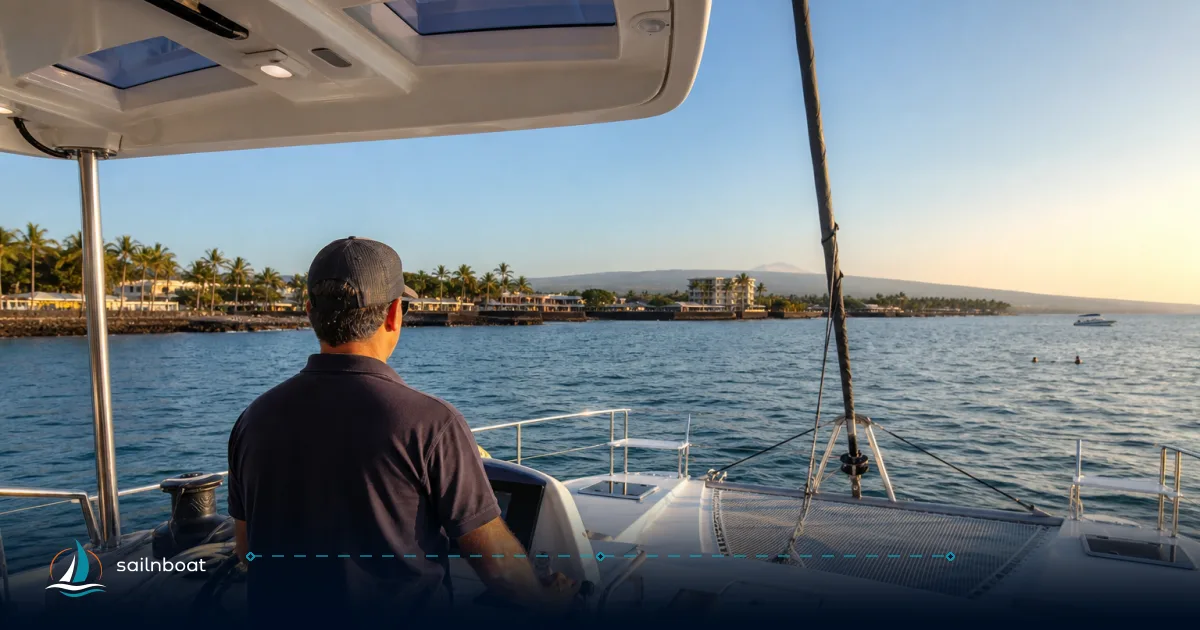
If you charter a yacht to spectate the Ironman World Championship in Kailua‑Kona, your first operational decision is where the boat will sit — on a Honokohau berth, a state visitor mooring, or held off‑anchor outside the Coast Guard’s 100‑yard buffer around the swim course.
Mooring Options: Berth vs. Anchorage
Choosing between a dock berth, an official mooring or a sheltered anchor outside the regulated area is the trade‑off between convenience and access to viewing positions. Below are the facts you need to weigh.
Honokohau Harbor Details
- Capacity and size: industry listings for visitor yacht access record a dedicated set of 50 berths that accept larger visiting yachts (indicative maximum LOA ~40 m and maximum draft ~4 m). These berths are the primary option if you need shore power, fuel or a guaranteed shore slip for crew rotations.
- Wider harbour services: the public harbor and state small‑boat complex also operate moorings, fuel, freshwater and basic shoreside services (showers, chandlery); other sources list an extended inventory of small‑boat moorings and visitor berths in the harbour. Don’t assume the 50 large‑yacht berths represent the harbour’s entire capacity for smaller craft.
- Lead time and season: expect to book large berths well ahead; charter brokers and operators commonly advise 4–12 weeks’ notice for peak race‑week slips in October. Public visitor berths or moorings may be more variable and are often allocated first‑come, first‑served.
Anchorage considerations
- Legal limits: the swim course and its 100‑yard buffer (see the next section) make anchoring inside Kailua Bay illegal on race day; any anchoring plan must place your vessel outside the regulated area. The regulated area covers the navigable waters within Kailua Bay and the swim course perimeter.
- Practical safety: Kona’s typical October pattern brings relatively calm mornings and light to moderate trade winds that build later in the day — expect wind and sea state to increase into the afternoon, which affects holding and comfort for spectator boats anchored offshore. Use heavy tackle and frequent checks: many charter captains prefer to remain under way or secured to a buoy in protected slips rather than rely on anchor holding during the full event.
Table — quick comparison: berth vs anchorage vs day‑hold outside the course
| Option | Pros | Cons | Typical use |
|---|---|---|---|
| Honokohau berth (large visitor slip) | Shore power, fuel, water, secure access to land | Limited supply in October; cost and advance booking required | Crew rotations, provisioning, guests who want town access |
| State mooring / visitor berth | Simpler to pick up, closer to harbour services | Often smaller, limited shore power; availability variable | Short stays, provisioning, staging before race day |
| Anchor / day‑hold outside regulated area | Best on‑water flexibility for viewing (outside buffer) | Must be outside the 100‑yard buffer; uncomfortable if trades rise | Race‑day spectator positioning and photo platforms |
(Use the table to pick the option that matches how much shore access your group needs and how much on‑water time you expect.)
Race‑Day On‑Water Safety and Briefing Best Practices
A chartered spectator platform behaves differently from a cruising trip. Your captain needs a clear, written race‑day plan and the crew must know what to do if the Coast Guard moves everybody.
Safety Protocols
- The legal rule: USCG Special Local Regulation §100.1402 defines a regulated area in Kailua Bay that includes the swim course and a surrounding 100‑yard buffer; spectator vessels are designated “spectators” and are prohibited from entering, anchoring, or impeding the course. Patrol craft and the Coast Guard may direct or expel vessels that do not comply. Violations can carry citations. Put simply: do not enter the course perimeter or the 100‑yard buffer at any time during enforcement windows.
- Enforcement windows: the Federal Register and Coast Guard notices list enforcement times for specific race days (for 2026 the regulated area enforcement was published for the event dates including October 10 with early‑morning enforcement hours). Expect active patrols from before the start through the initial race transitions. Plan VHF monitoring and a plan to move if hailed.
- Communications: designate the boat’s VHF watch (Captain + one crew), monitor the Coast Guard/Patrol channel the event lists in the Notice to Mariners (race week), and keep a hand‑held VHF and charged mobile as redundancy. Have a clear rule: when hailed by an official patrol, reply immediately and execute instructions without delay.
Pre‑Race Briefing
- Attend any race‑official briefings available to spectator fleet or commercial operators; these give the day’s enforcement times, patrol craft procedures and recommended spectator positions. If the event organiser or the harbour issues a spectator briefing, treat it as mandatory operational guidance.
- Onboard briefing checklist for guests: lifejackets and where they are stowed, where not to walk during maneuvering, how to act if the vessel is hailed, the captain’s emergency plan (man‑overboard procedures, medevac plan and nearest shoreside hospital), and an ETA buffer so you move early if the Coast Guard requests it.
Local Regulations and Crew Requirements
You need two separate approvals in sequence: the charter operator’s commercial rules and the public/regulatory regime enforced by the Coast Guard and state agencies.
Local Regulations
- The primary legal constraint on race day is the USCG special local regulation for Kailua Bay (33 CFR §100.1402) which defines the course area and the 100‑yard buffer and gives the Captain of the Port/PATCOM authority to control vessel movement within the regulated area. Failure to comply can result in ejection or fines.
- Harbour services and waste: Honokohau operates a fuel dock, freshwater and basic waste facilities; berth operators and the state harbour office control waste disposal and electrical availability—electrical specs in the US are 120V/60Hz but shore power availability (connector types and amperage) varies by berth and operator, so the charter contract should list whether shore power and shore‑side blackwater disposal are provided. Many brokers note you should discuss waste disposal and electrical requirements before arrival.
Crew Qualifications
- Commercial passenger operations and uninspected passenger vessels in the U.S. are generally required to be operated by credentialed individuals — think a USCG license or OUPV (often called a “six‑pack”) or a higher master endorsement — and commercial operators must hold proper commercial permits and insurance. For spectator charters that carry paying passengers, expect the operator to supply a licensed captain. For bareboat or private operations, different rules apply and the operator will set the experience and certification bar.
- State boater education: Hawaii has a boater safety card and state rules that apply to operators; many rental or charter businesses require a proof of competence or they supply a captain themselves. If you intend to operate a vessel in Hawaii waters, verify operator requirements with the charter company and the state Division of Boating and Ocean Recreation.
Insurance and Contract items to insist on
- APA / operational float: crewed charters commonly require an Advance Provisioning Allowance (APA) to cover fuel, provisions and port fees — expect a working fund in the order of 20–35% of the charter fee depending on yacht type. Make sure the contract itemises what the APA covers and the accounting cadence at redelivery.
- Damage responsibility and deposits: whether the charter is crewed or bareboat, the contract should state the security deposit/damage responsibility, what the operator’s insurance covers, and how claims are handled during regulated events. Missing a required credential for a bareboat can affect claims handling under insurance; that is a contractual and insurance interaction you should confirm with the operator.
Shore Transfers and Logistics
You’ll move people and kit multiple times: inbound to the harbour, shore turns for race viewing, and post‑race crew changes. Make those movements frictionless by planning time and transport modes.
Transfer Options
- Distances and times: Honokohau Harbour sits very close to Kona International Airport by distance (roughly 3–8 miles depending on route), which is often a short drive. Published local guidance and harbour businesses report anything from 5–20 minutes’ driving time; a practical, door‑to‑dock planning allowance of 20–35 minutes accounts for luggage, taxi/shuttle waits and race‑week congestion. If you need guaranteed punctual arrival (for example to take a berth at check‑in time or to meet a rental/supply delivery), use a booked shuttle or private transfer and plan extra slack.
- Vehicle and tender logistics: Honokohau provides trailer parking and a public lot at the harbour; for spectator and provisioning runs you’ll typically use the harbour parking or a short taxi into town. If your yacht is berthed, ask the harbour office about crew parking passes and any overnight rules for vehicles.
Parking and on‑foot spectator logistics
- Ali‘i Drive parking: popular shore views line Ali‘i Drive and race week fills the waterfront early; spectator guidance from local travel resources recommends arriving long before the swim start because spaces along the seawall fill quickly starting at dawn. Expect road closures in downtown Kona and longer walking times between drop‑off points and prime viewing positions.
Optimal Viewing Locations for Spectators
Your charter’s value is how close you get to the action within the safety and legal limits. Decide whether you want shoreline visibility, an offshore photographer’s platform, or a mixed plan.
Key viewing areas (land)
- Ali‘i Drive seawall and the small parks in front of downtown provide direct views of the swim start, the pier approaches and the finish stretch of the run; these are the highest concentration of spectators and require very early arrival. The “break wall” near Dig Me Beach and Kailua Pier provides a compact vantage for the swim‑to‑bike transition area.
Key viewing areas (sea)
- Offshore spectator positions must remain outside the USCG‑defined course area and the 100‑yard buffer; the best legal on‑water vantage is to hold a steady position just seaward of the buffer on the approach lanes where photographers and guest boats can watch the field enter and exit the water without interfering. Remember: you will be under Coast Guard control in the regulated area and must be ready to comply with calls to relocate.
Table — viewing spot quick guide
| Spot | Best for | Access notes |
|---|---|---|
| Ali‘i Drive seawall | Finish and swim start from shore | Arrive before dawn; parking limited; road closures apply. |
| Break wall near Dig Me Beach / Kailua Pier | Swim start / T1 views | Small footprint; becomes crowded quickly. |
| Offshore outside 100‑yard buffer | Photographers, on‑water spectators | Legally required distance from buoys; monitor Coast Guard; plan VHF watch. |
| Honokohau berth / fuel dock | Shore access, crew relief | Use for provisioning and crew rotations; berth availability is limited in October. |
Practical checklists — what to do, when to do it
Pre‑booking (6–12+ weeks before)
- Reserve the berth or charter yacht and get the berth and operator to document shore power, waste disposal and fuel availability. Many brokers list 4–12 weeks’ lead time for October slips for larger yachts.
- Sign the charter contract that specifies APA percentage, security deposit handling, captain credentials (OUPV/master) and the cancellation/weather policy.
Race week
- Attend any harbour or event organiser briefings; make a written race‑day plan that assigns VHF watch, man‑over‑board roles and passenger instructions.
Day before / morning of
- Fuel, top up water and provisions before the enforced event window; the Coast Guard restrictions typically start very early on race morning so plan fuel and water runs the day before or the night before if possible.
On race day
- Steer clear of the regulated area and respect any hails from PATCOM; follow the captain’s movement orders immediately. Keep passengers briefed and seated during maneuvering.
Final notes and trade‑offs
- Trade‑off: slip convenience vs on‑water flexibility. A Honokohau berth buys shore comfort and easy crew rotations but limits your best offshore photo positions; a day‑hold outside the buffer is more flexible for viewing but exposes you to changing wind/sea and typically less shore access.
- Safety first: the Coast Guard has explicit authority to control the regulated area and may change enforcement windows — your plan must treat their radio directions as binding on race day.
Plan your yacht charter for the Ironman World Championship today — book berths early, build a clear race‑day communications plan, and make sure your contract spells out crew credentials, APA and liability arrangements so you can focus on the race rather than logistics.
Plan your yacht charter for the Ironman World Championship today.
Frequently Asked Questions
Honokohau provides a mix: a set of berths suitable for larger visiting yachts—recorded as 50 slips taking yachts up to about 40 m LOA and a 4 m draft—and a broader field of small‑boat moorings and visitor berths; many spectator yachts use day‑anchoring or pick nearby harbour berths if available. Availability in October is constrained and operators typically ask for 4–12 weeks' lead time for larger berths.
Keep all vessels outside the USCG regulated area and the 100‑yard buffer that surrounds the swim course, comply immediately with instructions from official patrol vessels and monitor event notices to mariners and the Coast Guard on race morning.
From water, position outside the 100‑yard buffer in Kailua Bay near the pier approaches but well seaward of the marked course; on land, the Ali‘i Drive seawall and the break wall near Dig Me Beach / Kailua Pier are prime. Expect crowds — arrive very early for clear shore views.
The harbor is close to KOA by distance (roughly 3–8 miles depending on route); drive time on paper is short (often 5–20 minutes), but door‑to‑dock transfers commonly use a 20–35 minute planning window to allow for baggage, taxis/shuttle waits and race‑week traffic.
For commercial spectator charters you will normally have a licensed captain (USCG credentials such as an OUPV/master for uninspected passenger vessels) and the operator will hold commercial permits and insurance; expect an APA or security deposit for running costs and an explicit clause in the contract about liability during regulated events.
Written by
Sailnboat Editorial
The Sailnboat editorial desk covers yacht and boat chartering worldwide — routes, bases, seasons, boat types, paperwork and the practical costs that decide a trip. We are a charter marketplace, not a boat owner or a local agency: what we sell is judgement and support, so our guides are written to help you make a decision, not to sell you a specific boat. Every guide is checked against live operator and marina data before it goes out.
Fact-checked against live operator and marina data, and published under our editorial standards. Last reviewed: .