What Lights Are Required on a Sailboat at Night: A Skipper's Checklist
A concise, region‑aware checklist for charter skippers: which navigation lights you must show under sail, under power and at anchor, how to test them and reliable backups.

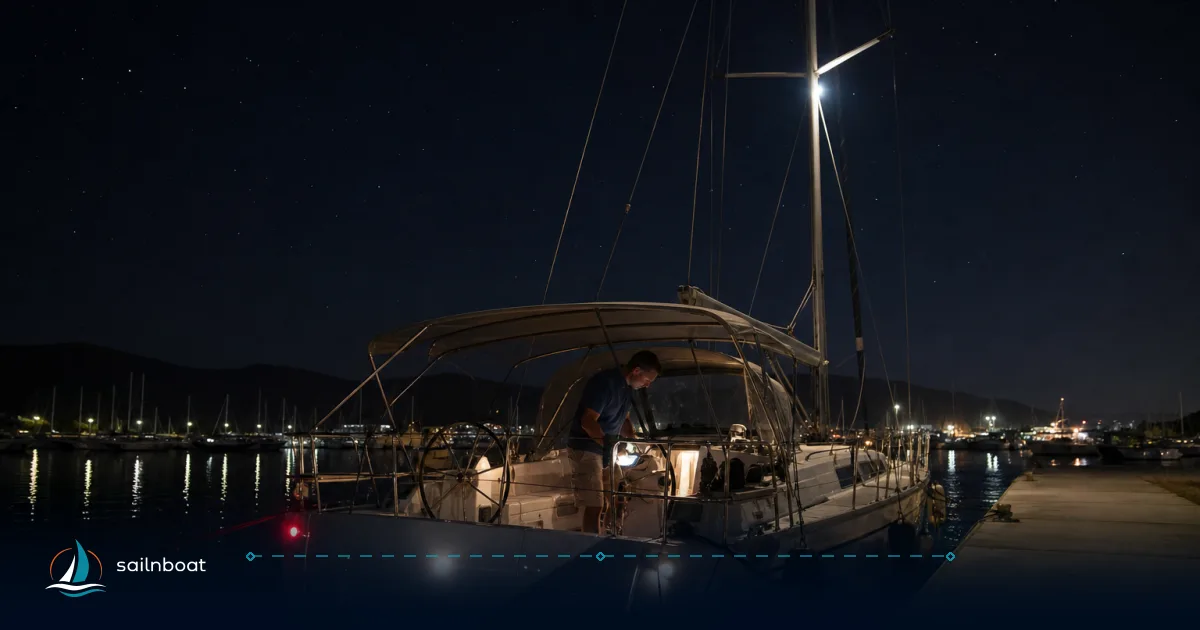
Night sailing requires more than a switched panel and discipline — it demands the right lights, correctly placed and tested before you leave the dock. What lights are required on a sailboat at night is straightforward under the COLREGs: show sidelights and a stern light when under sail; add a masthead (steaming) light whenever you are using the engine; and display an all‑round white anchor light when at anchor.
Understanding Required Navigation Lights
The International Regulations for Preventing Collisions at Sea (COLREGs) set the baseline that most flag states and local authorities follow. For a charter skipper the practical consequences are:
- Under sail (making way under sail alone): sidelights (red port, green starboard) and a white sternlight are required. Showing a masthead/steaming light tells others you are under power; if the engine is running you must use the power‑driven light configuration.
- Under power (motoring or motor‑sailing): masthead (forward white) plus sidelights and sternlight are required (a second masthead light is prescribed for large vessels only).
- At anchor: show an all‑round white anchor light where it can best be seen; vessels of certain lengths have options for two lights or different placements (COLREG Rule 30 contains the full detail).
Use this quick reference table on the boat's nav station or in your briefing pack.
| Light | Under sail | Under power / motor‑sailing | At anchor | Typical arc (COLREG Rule 21) | Minimum visibility note (Rule 22) |
|---|---|---|---|---|---|
| Sidelights (port/red & starboard/green) | Required | Required | No | 112.5° each, from right ahead to 22.5° abaft the beam. | Varies by vessel length (see Rule 22). |
| Sternlight (white) | Required | Required | No | 135° astern. | See Rule 22. |
| Masthead / steaming light (white) | Not required (unless under power) | Required when using engine | No | 225° forward sector (masthead definition). | Minimum ranges depend on vessel length (for yachts under 12m: 2 nm; 12–20m: 3 nm; 20–50m: 5 nm). |
| Tricolour (combined red/green/white) | Permitted for sailing vessels <20 m as alternative to sidelights+stern | Not for power‑driven vessels | No | Combines the above sectors where fitted at masthead. | |
| All‑round white (anchor light) | Not relevant | Not relevant | Required when anchored | 360° | Anchor‑light placements/height rules apply for certain lengths. |
Key point: the visual presence of a masthead (or its absence) is what other skippers use to determine whether you are a power‑driven vessel or a sailing vessel — that changes the rules of interaction.
Pre-Departure Checklist for Night Sailing
Start your night‑sail checks at least 30–60 minutes before planned departure so you can fix simple failures, change bulbs and brief the watch. Use this sequence every time:
- Switch‑panel check: power up nav lights from the panel and check each switch position for function and correct labelling.
- Visual lamp test at dusk: walk the boat and confirm each light shows in its correct sector (port, starboard, masthead, stern and anchor). Do this with sails set to ensure no mast or rigging shadows the lamp.
- Circuit and fuse check: verify fuses, circuit breakers and the nav lights breaker are in good condition — note any flicker or dimming. If a lamp fails, try its spare bulb and check the wiring/sockets for corrosion.
- Battery and charging: confirm battery state and that the charging system produces current when the engine runs; ensure the house battery can power the nav lights for your planned passage length without risking loss of other essential systems.
- Spares and backups: confirm spare bulbs, spare fuses, a portable all‑round LED lantern (waterproof), and a handheld torch are stowed within reach of the helm and cockpit.
- Crew briefing: assign lights checks to the first watch — who confirms the sidelights, who monitors the stern/masthead light and who handles a failed lamp during the watch.
- Log it: mark the check in the vessel log and note the battery voltage and any oddities for the next day’s maintenance.
Regulatory note: the US Inland and International Rules are aligned on the basics but apply slightly different wording in some cases — use the local navigation rules booklet for your waters in addition to the COLREGs baseline.
Testing and Maintenance of Navigation Lights
Night passages test your systems. As a charter skipper, your role is to inspect, isolate faults, and report any defects to the base — not to perform technical repairs yourself. Here’s how to ensure your navigation lights are operational and how to escalate issues for correction:
Inspection and Fault-Finding Process
- Dusk functional test: Switch on all navigation lights at dusk. Walk the perimeter of the boat and view each light from the appropriate bearing (bow, beam, stern, masthead). Confirm that the correct color and intensity are visible in each sector, with no shadows from rigging or sails.
- Isolation test: On the navigation panel, switch each lamp on individually while a crew member observes from outside. This helps pinpoint if one lamp or sector is not working, or if a switch or fuse is faulty.
- Battery and supply check: If you notice flickering or a dim light, check the battery voltage at the panel. Dimming may mean low battery or a loose connection. Make a note in the log and notify the base if the issue persists after switching to a charged battery or switching fuses.
- Lamp and fuse check: If a light fails, replace the bulb or fuse with a spare from the boat’s kit. If the lamp still does not function, check for visible corrosion or water ingress at the fixture and record the defect. Do not attempt wiring or socket repairs yourself; this is for base staff or a technician.
- Record and report: Log all failures, intermittent faults, or persistent dimming in the vessel log. Report these to the charter base at the earliest opportunity, especially before night departures.
What to Do if a Fault Persists
If you cannot restore a required navigation light with the spare bulbs or fuses provided, or if a fixture shows signs of corrosion or damage, postpone night sailing until the base has inspected and repaired the system. Most charter contracts require that you report electrical faults immediately and do not attempt technical repairs beyond basic troubleshooting.
Maintenance note for charter bases: Charter base staff should inspect sockets for corrosion, check and renew wiring harnesses where heat damage or chafing is found, and replace bulkhead seals if water ingress is detected. Skippers should not attempt these repairs themselves; instead, provide a clear, accurate report of symptoms and test results.
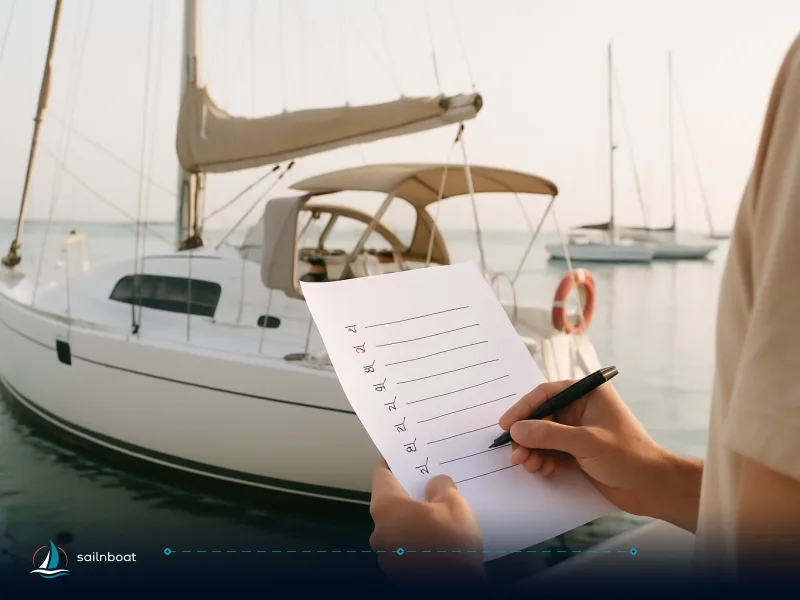
Charter bases and insurance underwriters commonly expect a visible pre‑departure lighting check; a written tick‑list makes handover faster and reduces disputes.
Typical Placement of Navigation Lights
COLREGs and Annex I set the placement and sector rules; your task is to fit lamps so they are unobstructed in all normal trim conditions.
- Sidelights: mounted as close to the bow/side as practicable and at similar vertical height so sectors are not obscured. On small yachts the sidelights may be combined in a single lantern on the centreline.
- Sternlight: fitted as nearly as practicable at the stern and elevated to avoid being hidden by cockpit structures; it must cover the 135° sector astern.
- Masthead / steaming light: on the fore‑aft centreline and higher than the sidelights when carried with them; when two mastheads are required they must be vertically separated and positioned according to Annex I spacing rules. Do not mount a masthead where radar, aerials or spreaders will obscure the sector.
- Tricolour: allowed as a single combined lantern (red/green/white) at or near the masthead for sailing vessels less than 20 m — this replaces separate sidelights and sternlight for those boats. It must not be used on a power‑driven vessel.
Tip: before you accept any charter boat, check whether the main navigation lights are at heights/positions that will be clear when the boat is heeled under sail — fixtures that look fine upright can be masked when the boat heels.
Backup Options for Navigation Lights
A failed nav light at sea is a high‑stress event; plan for it.
Primary backups to carry
- Portable all‑round LED lantern (waterproof): can be strapped to the pulpit or mast to provide a 360° white or sector light until the fixed unit is repaired. Choose one with a separate, fresh battery pack.
- Handheld tricolour/white lantern or dedicated battery tricolour masthead light: useful if your masthead or combined lantern fails; fit it on the mast or a halyard so it is visible in the correct sectors.
- Spare bulbs, spare LED modules and spare fuses stored in dry, labelled containers.
Operational backups and techniques
- Use a white torch shown in sufficient time to prevent a collision if you are a small craft and can’t display the prescribed lights — under COLREGs Rule 25(d), vessels under 7 meters with a maximum speed under 7 knots may use a torch or lantern showing a white light if practicable. This is a last-resort, temporary measure, not a substitute for compliant lighting.
- Reduce speed and increase lookouts: when a required light is out, slow down and post an extra lookout until you restore it. Increased vigilance is the safest immediate reaction.
- Circuit separation: where practical, wire a redundant nav‑light circuit to a separate breaker or battery so a single wiring fault does not darken every lantern.
Safety note: flares and pyrotechnics are distress signals and will attract attention, but they do not replace required navigation lights. Use them only as specified in the local regulations and SOLAS/flag guidance.
Verifying Local Regulations Before Departure
COLREGs are the international baseline, but national/inland rules and port authorities can add or interpret requirements differently. Always verify locally:
- Check the charter contract and the boat’s Inventory/Handover sheet — the crew handing you over should confirm the lighting configuration and spares carried. Many charter companies maintain a standard checklist.
- Consult local official sources: national navigation rules booklets, the local Notice to Mariners and the harbour/port authority. In the United States consult the USCG Navigation Rules materials; in other waters consult the equivalent authority.
- Pay attention to special local practices: some busy estuaries or traffic separation schemes require additional lighting or restrict night passages; others may impose minimum lamp visibility enforcement that exceeds COLREG minimums. When in doubt, brief the harbourmaster and ask for written guidance.
Practical confirmation steps
- Ask your charter base which set of rules they apply (International, Inland, local).
- Request the vessel’s lighting diagram and copy the locations of spare bulbs and the portable lantern location.
- If you plan to cross jurisdictions (e.g., international coastal passages), research both departure and destination state rules and any mid‑passage authorities you will pass.
Final line of defence: if you cannot guarantee the required lights will function for the planned night leg, postpone the departure or plan a day‑time run until repairs are completed.
Check your sailboat's navigation lights before your next night sail.
For base maintenance staff (Appendix)
The following tasks are for qualified base technicians, not for the charter skipper:
- Replace corroded sockets and lamp holders.
- Inspect and renew full wiring harnesses where heat damage, chafing, or water ingress is detected.
- Replace or reseal bulkhead cable glands and lamp bases as needed.
- Test lamp sectors and output with calibrated photometric equipment, especially after any fixture replacement.
Charter skippers should log defects clearly and allow base staff time to complete these repairs before night operations.
Frequently Asked Questions
Under sail show sidelights (green starboard, red port) and a white stern light; if you are also using the engine (motor‑sailing or motoring) show the masthead (steaming) light in addition. At anchor show an all‑round white anchor light (options depend on length and local rules).
Perform a dusk check at the marina: power lights from the navigation panel, verify each lamp visually from the appropriate aspect, check switches/fuses/wiring and measure supply with a multimeter if you suspect voltage issues; confirm spare bulbs, portable lights and battery condition.
Follow COLREG mounting locations: masthead/combined tricolour at or near the masthead on the fore‑aft centreline; sidelights near the bow/side; sternlight as nearly as practicable at the stern; arrange vertical separation where two masthead or anchor lights are carried.
Carry a battery‑powered all‑round LED lantern, spare bulbs/fuses, an additional handheld tricolour/white lantern or torch, and ensure a dedicated circuit for the remaining nav lights; for small craft a hand‑held white torch may legally substitute when practicable.
Check the flag‑state COLREGs application, consult the local port authority or harbormaster, read the local Notice to Mariners and ask your charter operator — requirements and tolerances (e.g., ranges, enforcement) vary by country and waterway.
Written by
Sailnboat Editorial
The Sailnboat editorial desk covers yacht and boat chartering worldwide — routes, bases, seasons, boat types, paperwork and the practical costs that decide a trip. We are a charter marketplace, not a boat owner or a local agency: what we sell is judgement and support, so our guides are written to help you make a decision, not to sell you a specific boat. Every guide is checked against live operator and marina data before it goes out.
Fact-checked against live operator and marina data, and published under our editorial standards. Last reviewed: .