What to Pack for a Sailing Trip: The Ultimate Packing Guide
A compact, decision-ready packing plan for a week-long sailing charter: soft-sided bags, essential documents, a modular clothing system, sun and safety kit, and a 10,000 mAh power bank.

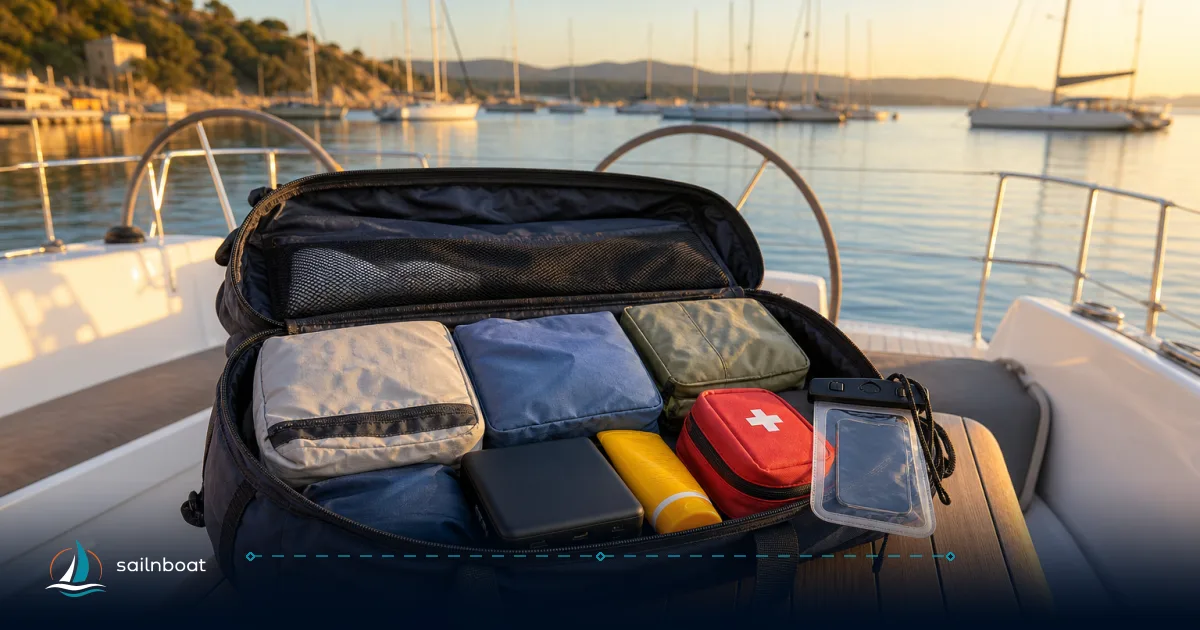
Squeeze your kit into soft bags, bring a compact safety and sun kit, and prioritise multi‑use clothing: that answers "what to pack for sailing trip" in one line.
Choosing the Right Luggage
Start with the bag — the wrong suitcase will be a daily annoyance on a yacht.
Soft-Sided Luggage
- What to use: one collapsible duffel (50–70 L) per person, plus a small soft daypack. Soft bags squeeze into cabin lockers, under berths and in hanging lockers. Many charter operators explicitly recommend soft-sided luggage for efficient stowage.
- Dry‑bag: one 5–10 L waterproof dry bag for documents, electronics and items you want to keep on the cockpit during passage. Keep it clipped inside a locker or under a bunk.
- Why not hard-shell: hard cases don't conform to recessed lockers and often block ventilation or access to lines; most sailing schools and operators advise against them.
Table — luggage comparison at a glance
| Type | Pros | Cons | When to pick |
|---|---|---|---|
| Collapsible duffel (soft) | Compressible, light, fits lockers | Less rigid protection for fragile items | Default choice for charters. |
| Soft backpack | Hands-free, good ashore | Can be bulky if overpacked | For island hopping and transfers |
| Hard-shell suitcase | Protects fragile gear | Bulky, hard to stow on board | Only if you must carry fragile gear and can check it on land |
Practical stowage tip: pack heavier items low in the bag and place them under a bunk or in a locker to lower the boat’s centre of gravity and keep passageways clear.
Essential Documents and Safety Items
You will be asked for some documents at handover; keep a physical folder and a digital copy.
Important Documents
- Pack in a slim waterproof folder: passport, travel insurance policy (print showing emergency phone), booking confirmation, the charter contract (if provided ahead), and your driver’s licence or national ID. Sailing operators routinely list these as required at check-in.
- Prescriptions and medications: original prescription labels and a short list of medicines and dosages. If you carry controlled medication, check destination rules in advance.
- Photocopies: keep paper photocopies of passport pages and insurance in the folder and photo copies on your phone or cloud drive.
- Local currency: bring a small amount of the destination currency for marina fees, tips or taxi fares — amounts required vary by country and operator, but having some local cash for small charges is often recommended; the amount needed varies widely by region and operator. Many charter guides recommend carrying local cash for small purchases and dinghy moorings.
Safety Essentials
- Seasickness kit: over‑the‑counter antihistamines (meclizine, dimenhydrinate) and, for those who prefer it, a prescription scopolamine patch; start any drug as directed (often 1–2 hours before departure for oral meds, several hours before for patches). Medical authorities list these as the primary pharmacological options for motion sickness.
- First‑aid kit: include seasickness remedies, anti‑histamine, plasters, antiseptic wipes, pain relief, wound dressings and any personal medicines. Charter companies may supply a basic first‑aid kit, but you should confirm with your operator and top it up for personal needs.
- Illumination: a headlamp (hands‑free) plus a small waterproof flashlight; keep fresh batteries in a separate dry bag.
- Knife and multi‑tool: a small folding knife or multitool (in checked luggage if flying); useful for docklines and miscellaneous repairs.
- Emergency contacts: printed and digital list including the charter base, local coastguard, and an emergency contact at home.
Operational note: what the authorities legally require is not the same as what your charter asks for — many companies have their own checklists at handover, so keep documents organised and visible.
Creating a Modular Clothing System
You want clothes that work reef‑side, on deck, and in town: aim for layers and multi‑function items.
Clothing Essentials
- Quick‑dry base: 2–3 quick‑dry shirts and 2 pairs of quick‑dry shorts. Synthetics drain and dry far faster than cotton.
- Layers: one lightweight fleece or thin insulating mid‑layer and one lightweight waterproof/breathable jacket (packable shell). A breathable rain shell is a better choice on a boat than heavy wet-weather gear.
- Footwear: non‑marking deck shoes for on-deck work and reef‑safe sandals for shore. Many charters forbid black‑soled or hard‑soled shoes because they scuff white decks; choose clearly labelled non‑marking soles or white/colourless soles.
- Swimwear and cover‑up: at least two swimsuits so you always have a dry one; a sarong or lightweight cover-up doubles as an on‑shore wrap and cockpit shade.
- One smart outfit: a lightweight shirt or dress and compact shoes for dinners ashore.
- Underwear and socks: aim for quick‑dry underwear and 1–2 spare pairs.
Packing technique — modular approach:
- Build each day’s outfit around a base layer and add/remove the mid‑layer and shell as needed.
- Use packing cubes: one cube for base layers, one for tops, one for undergarments — takes seconds to find items and keeps lockers tidy.
Seasonal considerations:
- Peak sun: add extra sun-protective clothing (long-sleeve UV shirts, broad-brim hat).
- Cooler seasons or higher latitudes: add one heavier insulating layer and a warmer hat; nights can feel colder on the water.
Sun Protection and Personal Care
Sun exposure at sea is cumulative — you will need both clothing and topical protection.
Sun Safety Gear
- Sunscreen: many sailing guides and marine authorities advise avoiding sunscreens that contain oxybenzone and octinoxate because of demonstrated coral impacts; choose mineral formulas containing zinc oxide or titanium dioxide labelled as non‑nano where possible. Scientific and environmental agencies note there is no single regulated “reef‑safe” standard, so check ingredient lists and pick products that avoid the common coral‑harmful UV filters. Many travellers and operators favour SPF 30–50 for prolonged exposure; SPF 50+ is commonly advised for long days on deck or in the tropics.
- Hat and eyewear: a wide‑brim or sailing cap and polarized sunglasses with UVA/UVB protection; secure sunglasses with a retainer.
- SPF lip balm and a lightweight UV shirt/rashguard for long exposures.
- Aftercare: aloe or a cooling gel for sunburn and a basic skincare kit (moisturiser, wound cream).
Practical habit: reapply water‑resistant sunscreen after swimming; using clothing and shade significantly reduces the amount of topical sunscreen that washes off into the sea.
Personal Care Items
- Toothbrush, travel toothpaste, biodegradable soaps/shampoo when possible (biodegradable is still best used off the boat in proper facilities).
- Small travel laundry kit: sink soap, a line and a few clips — many crews wash quick‑dry items aboard.
- Insect repellent for evening ashore (DEET or picaridin options exist); keep repellent away from plastics and painted surfaces.
Electronics and Entertainment
Electronics are helpful but heavier batteries and lots of chargers eat space — pick multi‑purpose items.
Essential Electronics
- Phone + charging cable and a 10,000 mAh (or larger if you need multiple top‑ups) portable power bank; a 10,000 mAh bank is a practical travel starting point because it fits most airline carry‑on limits (under the typical 100 Wh threshold) and will recharge a phone multiple times.
- Universal adapter: for Europe expect Type C/F; Thailand commonly accepts Types A/B/C (and sometimes O) so a small universal adapter that covers Europe and Asia is sensible. Plug requirements can vary by marina and country.
- Waterproof phone case or dry pouch and a small waterproof action camera (GoPro) if you plan on water sports.
- Portable multi‑port USB charger (USB‑C PD recommended) so you charge multiple devices from a single AC outlet on shore or from an inverter when anchored.
Safety note: chargers and power banks should be carried in your hand‑luggage on flights and not packed in checked baggage due to airline lithium battery rules. Choose units that state watt‑hours or mAh; under ~100 Wh is standard carry‑on allowance on most airlines.
Entertainment & Comfort
- E‑reader or one paperback book; a waterproof Bluetooth speaker (moderate volume) and playing cards or small travel games for evenings.
- Snorkel set: if you prefer your own fit, bring a compact snorkel mask and fins; masks that fold or have removable straps pack small.
- Journal and a waterproof pen for navigation notes, log entries, or memories.
Creating Your Packing Checklist
An organised checklist avoids that last‑minute dash for a pharmacy or dinghy‑taxi.
Downloadable Checklist
- Use a single checklist split into: Documents, Clothing, Safety & Medicine, Electronics, On‑board Comfort, Provisioning.
- Keep one checklist copy in your bag for last‑minute ticks and another in your phone (photo or simple list app).
Core checklist highlights (condensed)
- Documents: passport, travel insurance, booking confirmation, prescriptions & copies, local cash.
- Clothing: 2–3 quick‑dry shirts, 2 shorts, fleece/mid layer, waterproof shell, underwear, swimwear, one smart outfit.
- Footwear: non‑marking deck shoes + reef sandals.
- Safety/medical: first‑aid kit, seasickness medication, headlamp, spare batteries.
- Electronics: phone + cable, 10,000 mAh power bank, universal adapter, waterproof phone case.
- Misc: reusable water bottle, sunglasses retainer, small dry bag, reusable bags for laundry.
Items to Avoid
- Hard‑shell suitcases (take too much locker space) — many charters ask guests to use soft bags.
- Black‑soled shoes and high heels — they scuff decks and are often disallowed by charter companies.
- Excessive valuable jewellery — theft risk ashore and damage risk aboard.
- Glass bottles on deck — they break and are unsafe.
- Non‑reef‑safe sunscreens in reef areas — check ingredient lists and pick mineral options where coral protection is a concern.
Download our interactive packing checklist to tick items off before you fly and again at the base handover.
Final practical prep and handover tips
- Pack one day bag for arrival: passport, printed booking confirmation, a change of clothes and your dry‑bag with electronics — many bases expect you to board soon after arrival.
- Label everything: put a luggage tag with your name, phone and reservation number on each bag; tie a brightly coloured ribbon to the duffel to spot it in a dinghy.
- Leave space: you will take on provisioning (food, bottled water, fresh produce) — don’t fill every locker before provisioning day.
- Check the base’s pre‑departure email: they commonly list local currency needs, exact arrival time for handover and which documents they will scan at check‑in.
Pack to be useful, not to impress. Soft, compact and layered is your winning formula: it saves space, avoids charter fines and keeps your kit usable in sun, spray and onshore evenings.
If you want the interactive checklist we reference, download it from our packing toolkit or request it from your Sailnboat reservation support before travel — it will let you tick items by category and produce a final printable list for the base handover.
Frequently Asked Questions
Soft-sided duffels and collapsible backpacks that squash into lockers are best; hard-shell suitcases are bulky and difficult to stow.
Limit items to soft bags, pack in packing cubes and a dry bag for valuables, leave space for provisioning, and prioritise multi-use clothing.
At minimum: a personal first-aid kit, seasickness medication, a waterproof flashlight/headlamp, a charged power bank and copies of emergency contacts.
Build outfits from a few quick‑dry base layers, a lightweight insulating layer, and a waterproof shell; add reef shoes and one smart outfit for evenings ashore.
Passport, travel insurance details, booking confirmation, any visas, local ID/driver’s licence, prescription meds list and photocopies of all documents.
Bring OTC options (meclizine or dimenhydrinate) and consider a prescription scopolamine patch; start medication before you leave the dock if advised by product instructions or your doctor.
Written by
Sailnboat Editorial
The Sailnboat editorial desk covers yacht and boat chartering worldwide — routes, bases, seasons, boat types, paperwork and the practical costs that decide a trip. We are a charter marketplace, not a boat owner or a local agency: what we sell is judgement and support, so our guides are written to help you make a decision, not to sell you a specific boat. Every guide is checked against live operator and marina data before it goes out.
Fact-checked against live operator and marina data, and published under our editorial standards. Last reviewed: .