Boats for Med-Mooring: Key Features for Safe Stern-To Berthing
Practical, decision-ready guidance on which boat features make Med‑mooring simple and safe — from bow thrusters and sugar‑scoop sterns to cockpit layout and twin engines.

Boats for med-mooring should prioritise lateral control, a low sugar‑scoop stern and deck ergonomics that let one person handle the first stern lines quickly. If your boat combines a responsive bow thruster, twin engines (or effective single‑prop handling), well‑placed rudders and a cockpit laid out for rapid line work, stern‑to berthing becomes repeatable, low‑stress and safe.
Essential Features for Med‑Mooring
Bow Thruster
A bow thruster gives instantaneous lateral control at the bow when the rudder has little or no authority at slow speeds — exactly the condition you want to control when reversing into a narrow berth. Thrusters let you offset wind or current without repeatedly changing engine orders, and they let a single helmsman place the bow precisely while a crew member handles lines. Their effectiveness drops with forward speed and in strong hydrodynamic flow, so use the thruster for fine lateral adjustments rather than powering the approach.
Operational notes
- Use short, controlled bursts rather than continuous full power to avoid stressing the unit.
- If your base offers a bow‑thruster orientation briefing at handover, take it; the exact control feel varies by model and age.
Trade-offs
- Battery‑driven thrusters are quiet and efficient but have limited endurance under full load; hydraulic systems are more robust but cost more to maintain.
Sugar‑Scoop Stern
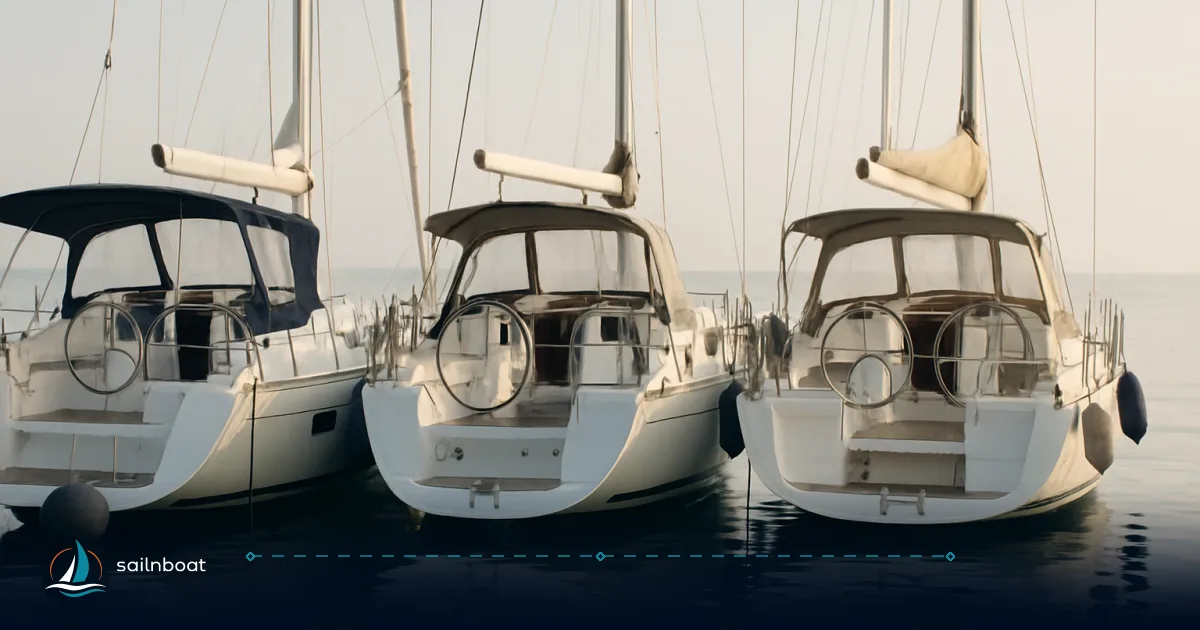
A sugar‑scoop (reverse) stern lowers the transom and often integrates a swim/boarding platform that sits just above water level. For Med‑mooring this is practical: a crew member can step ashore from the platform, handle stern lines, and return aboard without awkward lifts or long gangways. The lowered platform also gives a predictable fendering line and reduces the chance of snagging stern railings on the quay.
Practical detail
- Look for handholds and a clear path from cockpit to transom; a wide, unobstructed boarding surface saves seconds and reduces slips.
- Some bases request you use the sugar‑scoop only when permitted — check marina signage and local rules.
Twin Engines
Twin engines give two clear advantages for stern‑to control: redundancy and differential thrust. If one engine fails you still have power to steer or re‑position; more tactically, applying ahead on one engine and astern on the other produces a tight yaw moment that can rotate and hold your stern parallel to the quay without excessive speed. On many twin‑screw boats the effect is so positive that mariners regularly "walk" the stern sideways using throttle alone. Studies of twin‑screw behaviour and practitioner guides attest to this practical benefit.
Crew and maintenance note
- Differential thrust requires coordination: practise small‑scale reversals in calm water before the marina.
- Understand the manufacturer’s recommended idle and synchronisation procedures at handover.
Rudder and Propeller Configuration
Where the propeller flow passes over the rudder (prop‑ahead‑of‑rudder), steering authority at low speed is greater than on hulls where the rudder sits in relatively stagnant water. Twin‑screw boats with twin rudders usually provide the best low‑speed steering because each rudder receives direct prop wash; this amplifies helm response and makes tight rotations easier. Conversely, large single‑prop boats can exhibit pronounced prop‑walk (a transverse force) which must be anticipated and used, not fought, during stern‑to approaches. Hydrodynamic studies confirm that rudder/prop interaction is central to close‑quarters manoeuvring.
What to check at handover
- Ask whether the boat has counter‑rotating props or conventional props: counter‑rotating pairs reduce asymmetric prop‑walk.
- Confirm whether rudders are twin or single and request a quick on‑water demonstration.
Cockpit Layout
A cockpit that supports Med‑mooring places cleats, a capstan and a central winch where the person handling stern lines can reach them from the sugar‑scoop without stepping over obstacles. Clear sightlines from the helm to the transom and a layout that keeps fenders and spare lines within arm’s reach reduce seconds — and seconds matter when the boat is moments from the quay.
Checklist for ergonomics
- Short line runs: cleats positioned close to the transom path for easy access.
- Dedicated stern cleats sized for your boat’s load; pop‑up cleats or heavy‑duty samson posts are preferable.
- A fixed stern step or ladder that allows safe disembarkation onto a quay at low tide.
Step‑by‑Step Med‑Mooring Procedure
Preparation Before Arrival
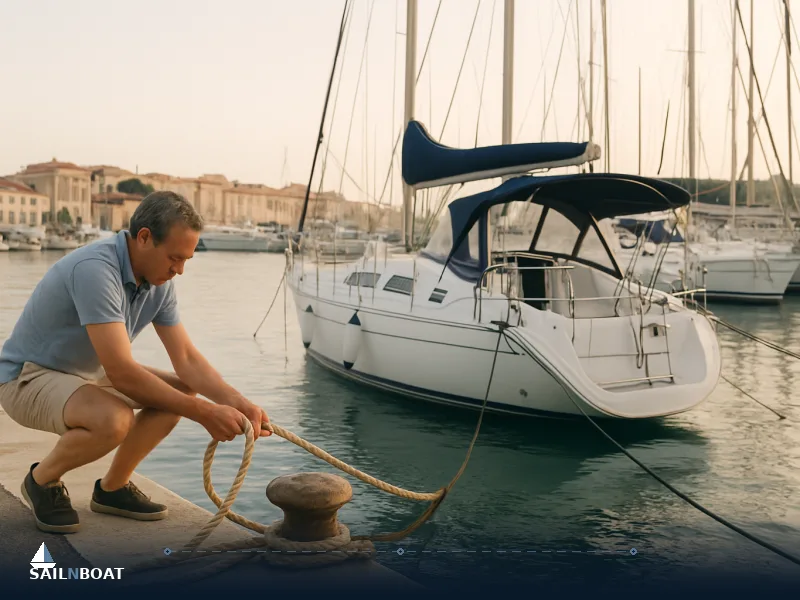
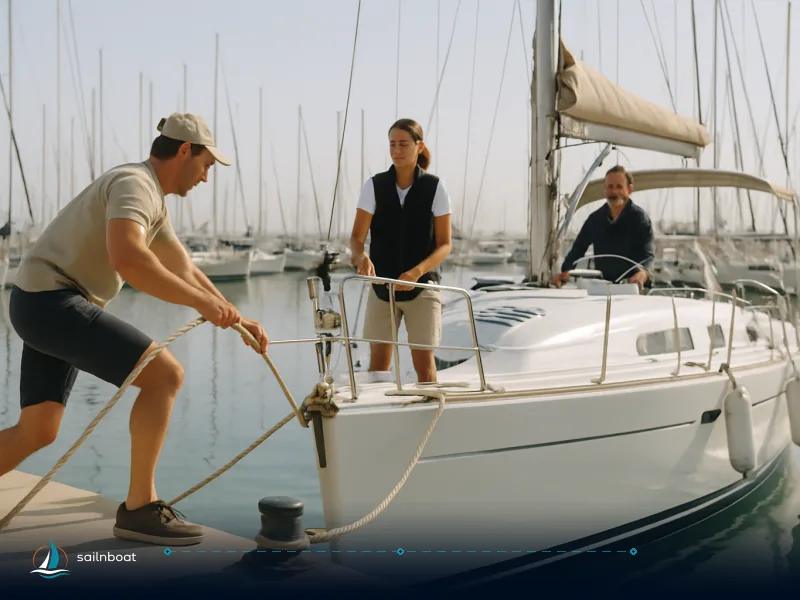
Prepare shore‑side and boat crew roles before you reach the marina: one person at the helm, one or two handling stern lines on the quay, a third ready to deploy the bow restraint (anchor or lazy line). Reconnoitre the berth from a distance: note wind direction, current, neighbours’ fender positions and whether a marina lazy line exists at that berth. Many experienced skippers plan their drop point for anchor/lazy line at least several boat‑lengths ahead of the quay so the bow restraint will hold without snubbing the chain.
Prepare gear
- Fenders on both quarters and centre‑line, plus one at mid‑stern.
- Two running stern lines prepared on the sugar‑scoop, with bitter ends coiled and labelled.
- An easily reachable bow line or anchor rope, and the boat’s warps ready in the cockpit.
Executing the Maneuver
- Approach slowly and aligned so you have room to reverse. Keep speed under close control — in many practical guides, approaches are at idle or roughly 1–3 knots and slowing as the stern nears the quay.
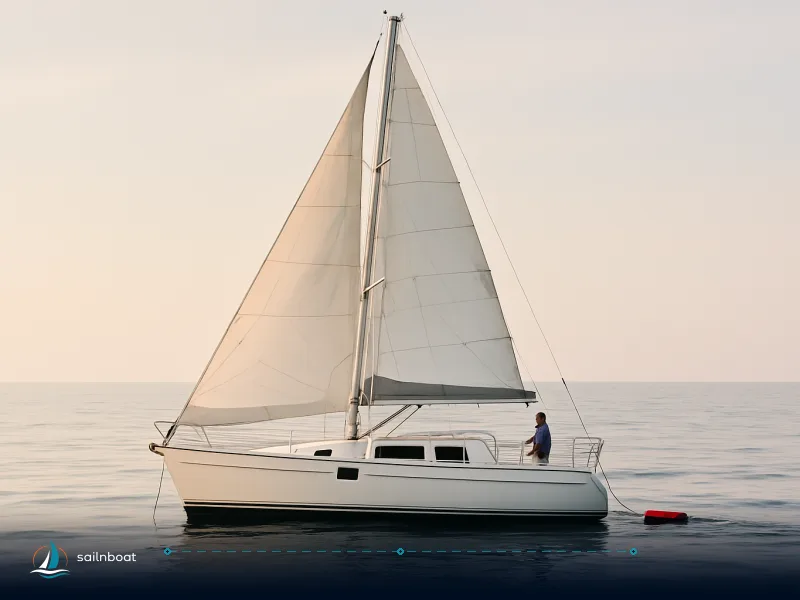
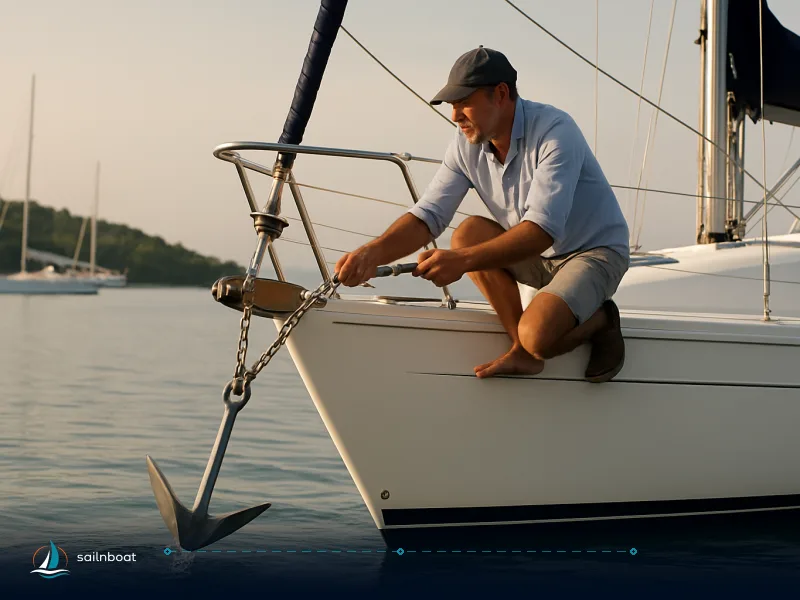
- Drop the bow restraint (anchor or pay out to a marina lazy line) before you arrive at the quay if you will use one; keep the chain running free — a snubbed or tangled rode will pull your bow and upset the approach.
- Use the bow thruster in short bursts to correct lateral drift and align the bow while the helm manages forward/reverse thrust for the stern. On twin‑engine boats, use differential thrust to rotate and hold the stern parallel.
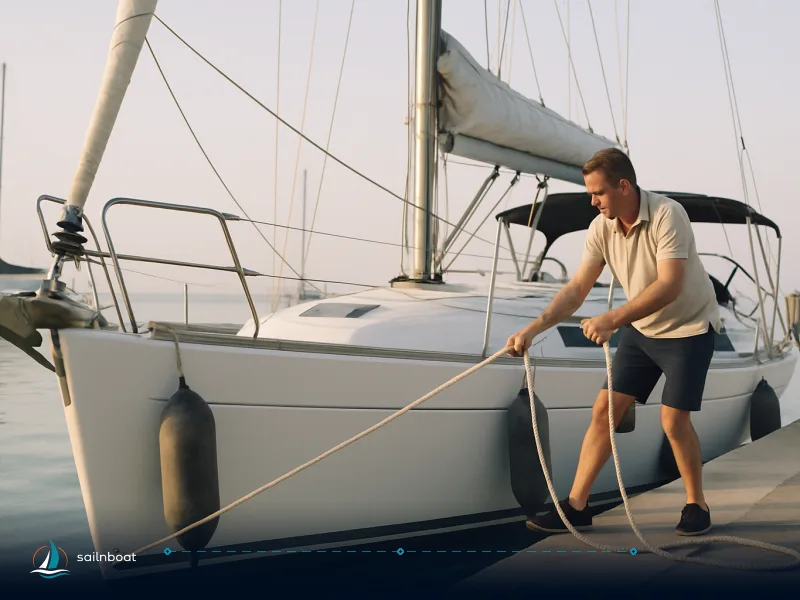
- As the stern comes alongside, have the shore‑crew take the windward stern line first (this arrests lateral motion), then the leeward stern line. Take up springs if available to prevent surge. RYA and author guides emphasise getting the first stern line ashore as the controlling action.
Practical timing
- The bow restraint (anchor/lazy line) should be active before the final reverse if the wind/current require it; otherwise secure stern lines first and then tension the bow restraint as required.
Table: Quick comparison — features that matter for med-mooring
| Model / Type | Bow thruster | Twin engines | Sugar‑scoop stern | Rudder/prop layout | Best for |
|---|---|---|---|---|---|
| MedYacht (our fleet) | Usually fitted | Often twin | Sugar‑scoop platform | Twin props / effective rudder flow | Tight marinas, inexperienced crews |
| MED42 (our fleet) | Common option | Often twin or robust single | Broad transom with step | Twin rudder or well‑placed single rudder | Mixed‑crew charters |
| Typical production monohull (40ft) | Often optional | Usually single | May have small transom step | Single prop + single rudder (watch prop‑walk) | Bluewater, deeper berths |
| Typical catamaran (40–45ft) | Often standard | Twin engines standard | Wide boarding platform | Twin props, good low‑speed hold | Shallow harbours, stable stern |
Note: model configurations vary by base and production year; check the booked boat’s equipment list when you pick up the keys.
Securing the Boat
- Put the windward stern line on first, then the leeward. Tighten incrementally and use springs to limit fore/aft movement.
- Do not fully tension the bow restraint until the stern lines are secure and you’ve confirmed the chain/line runs free. A chafed rode or snagged chain can create unexpected loads overnight.
Safety Considerations During Stern‑To Docking
Crew Communication
Assign roles and repeat them aloud before the maneuver: helm, stern‑lines, bow restraint, fender manager. Use short, distinct commands and hand signals for noisy quays — verbal commands backed by a raised arm or two fingers makes intentions clear when the quay is crowded. Confirm the person on the dock is ready before you commit throttle.
Human factors to avoid
- Don’t let the person handling the first stern line step off the transom while the boat still has significant sternway; keep the engine at idle and the helm responsive.
- Avoid multiple people clustered at the stern; a single experienced handler is safer than several unsure crew.
Environmental Awareness
Wind shifts and tidal stream can bite you in the last few metres. Monitor the wind not just at the quay but upwind of the approach — gusts can arrive suddenly off buildings or cliffs. If the wind or current looks stronger than you expected, pick another berth or request a marina assistant (if they offer one). RYA guidance and local skipper experience both stress choosing the lee berth in gusty conditions.
Contingency planning
- If you lose steerage or power during the approach, cut the engine, pay out line and use the anchor to prevent drift onto neighbours — have the anchor ready before you need it.
- Know where you will go if the berth is blocked on arrival (a holding area or an alternative mooring).
Recommended Boat Models for Med‑Mooring
We list two models from our fleet that routinely make stern‑to berthing simpler. Availability and exact equipment vary by base and year; when you book, confirm the boat’s handed equipment list. Many charter bases can fit or retrofit options such as bow thrusters when requested in advance.
MedYacht (fleet pick)
- Typical strengths: bow thruster, frequently offered with twin engines, sugar‑scoop stern and clear cockpit line runs — a layout designed for short quayside stops and regular marina work.
- Best uses: busy town quays and harbours where quick stern‑to turns and safe boarding are priorities.
MED42 (fleet pick)
- Typical strengths: optimized cockpit ergonomics for line handling, broad transom platform and rudder geometry that maintains flow at low speed.
- Best uses: groups who want easy shore access and predictable low‑speed handling in mixed wind conditions.
Comparison and trade-offs
- A catamaran in the fleet will usually have shallower draft and twin engines, which makes stern‑to simpler in shallow harbours but can require larger fenders due to wider beam. Catamarans also sit steadier alongside a quay, which eases boarding for less agile guests. Typical cruising catamarans in the 40–45ft range draw about 1.0–1.5 m compared with a monohull’s 1.5–2.2 m, which affects which berths you can use.
Booking checklist
- Ask your booking agent: "Is this hull fitted with a bow thruster? Are the props counter‑rotating? Is there a sugar‑scoop transom?" Answering those three questions separates boats that will make Med‑mooring straightforward from those that will require more crew skill.
Practical drills to practise before your charter day in a marina
- Single‑handed lateral control: with an instructor or experienced crew, practise using 10–20% bow‑thruster bursts with small forward/backing corrections to feel the coupling of thruster and engines.
- Stern‑line drills from the sugar‑scoop: one person on the transom, one on the quay; practise lines ashore and reboarding while the helm holds position with minimal thrust.
- Differential‑thrust rotation: in calm water, practise rotating the stern in place by applying ahead on one engine and astern on the other, then holding neutral.
Final recommendations and common pitfalls
- Prioritise a boat that reduces the number of simultaneous manual tasks at the end of the approach: a bow thruster and sugar‑scoop stern reduce the need for multiple crew on the transom.
- Don’t underestimate prop‑walk on single‑screw boats; learn its direction on that hull during handover.
- Expect marina rules to differ: some charge by beam and expect stern‑to; others limit stern berthing to certain quays. Ask the base about local practices and whether a marina assistant is available.
Explore our fleet and book your ideal boat for Med‑mooring. If you want, tell us your departure base and we’ll recommend specific available boats that match the features above and list the exact equipment on the hull you’ll pick up.
Frequently Asked Questions
Prioritise lateral control (bow thruster), precise low‑speed propulsion (twin engines or counter‑rotating props), an accessible sugar‑scoop stern for boarding, and cockpit ergonomics that put lines and cleats within reach; each reduces crew workload and risk during the final metres.
A bow thruster supplies immediate lateral force at the bow when the rudder has little effect at very low speeds; used with differential engine thrust, it lets you 'walk' the boat sideways into position and correct crosswind drift.
A sugar‑scoop (reverse) stern lowers the transom and often integrates a boarding platform, making it far easier and safer for crew to step ashore with warps and to handle lines from the quay.
Twin engines allow independent thrust control on each side, which greatly improves yaw control and lets you use differential power to rotate and hold the stern parallel to the quay even in wind or current.
Propeller and rudder interaction determines low‑speed response: props placed ahead of rudders (twin‑screw/twin‑rudder layouts) keep flow over the rudders and multiply control, while single‑screw single‑rudder boats rely more on prop walk and rudder angle.
A cockpit with clear sightlines to the stern, dedicated pop‑up cleats or capstans, a central winch for stern lines and a short, unobstructed path to the sugar‑scoop reduces delay and the risk of dropped lines.
Written by
Sailnboat Editorial
The Sailnboat editorial desk covers yacht and boat chartering worldwide — routes, bases, seasons, boat types, paperwork and the practical costs that decide a trip. We are a charter marketplace, not a boat owner or a local agency: what we sell is judgement and support, so our guides are written to help you make a decision, not to sell you a specific boat. Every guide is checked against live operator and marina data before it goes out.
Fact-checked against live operator and marina data, and published under our editorial standards. Last reviewed: .