Center Cockpit vs Aft Cockpit: Which Layout Works Best for Your Charter Week?
Decide between a centre cockpit and an aft cockpit by matching cabin privacy, helm sightlines, dinghy boarding and child-safety to your group's priorities; use the checklist at handover.

Centre cockpit vs aft cockpit is most usefully decided by how you will spend each day: pick a centre cockpit if evening privacy and a protected living cockpit matter; pick an aft cockpit if daytime visibility, fast water access and a social cockpit are your priorities. Below I compare the layouts strictly by the practical choices you’ll face on a one‑week charter and give a checklist you can use at booking and handover.
Privacy and Cabin Arrangements
A charter decision often starts with cabins: who sleeps where and how much separation you need.
Center Cockpit Privacy
Centre‑cockpit boats commonly place a full or near full‑beam owner/aft cabin under the cockpit, separated from the saloon by a passage and the companionway. That arrangement gives an obviously private aft cabin with its own en‑suite on many production cruisers — useful when adults want late nights or separate dressing space. Interior volume is commonly redistributed to make the aft cabin roomy without making the saloon feel tiny; engine access is often under the cockpit which helps serviceability.
Practical consequences on a charter week
- Quiet evenings for a couple in the aft cabin while others use the saloon.
- Reduced foot traffic past the aft cabin at night, as forward-cabin crew do not need to pass through the aft cabin to reach the companionway, but they will still use the companionway for deck or head access.
- Cabin access: expect a short internal corridor or a door from the saloon to the aft cabin on many centre designs.
Aft Cockpit Privacy
Aft cockpit layouts often have cabins that open more directly into social areas; a stern cabin will normally be adjacent to — or open onto — the cockpit or saloon. That means shorter runs for luggage or when dressing but also more foot traffic and reduced acoustic privacy. On many aft‑cockpit charter yachts the master is forward or midships rather than a full‑beam aft owner’s suite. The trade‑off is usually social convenience for private space.
Practical consequences on a charter week
- Easier movement for a group that socialises in the cockpit and saloon together.
- Less separate 'owners' space for those wanting quiet or a separate bedroom door.
- Consider cabin door locks, if privacy is important (not all charter boats fit robust locks).
Cockpit Shade and Helm Visibility
Two operational items that shape comfort and safety every day: how well you sit in shade and what the helmsman can see.
Shade in Center Cockpit Yachts
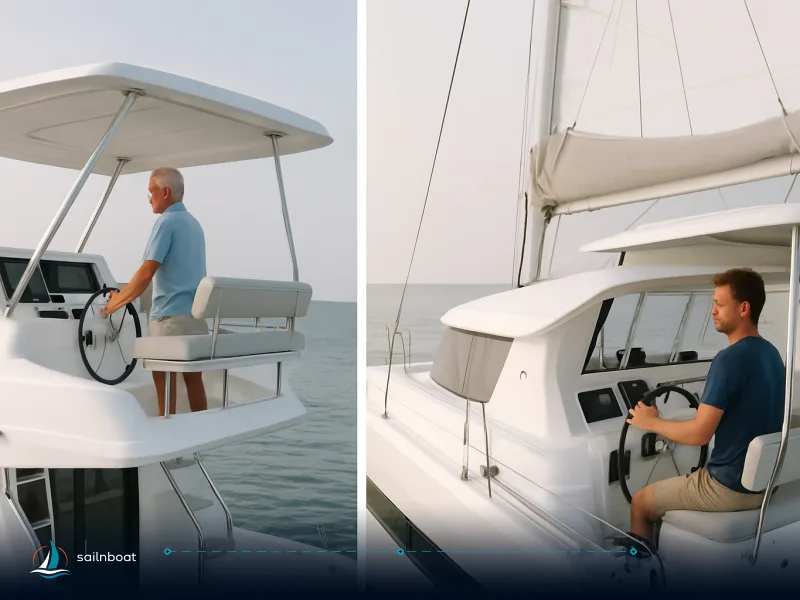
A centre cockpit is typically set amidships with coachroof around it and higher coamings; that geometry usually gives better shelter from sun and chop, and biminis or hardtops integrate cleanly to extend shade without blocking access. For charters that spend long afternoons at anchor or moored in a harbour, the sheltered feel is tangible — less sunscreen, easier conversations and a cockpit that can serve as an extra living room.
What to check at handover
- Is the bimini large enough to shade the whole cockpit when the mainsail is down?
- Can the sprayhood be fitted forward to block morning sun or drizzle?
- Are cockpit lockers ventilated (important if you’ll store wet kit)?
Helm Visibility in Aft Cockpit Yachts
Aft cockpits typically put the helm lower and closer to the transom, which often gives the helmsman an unobstructed sightline to both the sails and the stern — a practical advantage when manoeuvring under power or keeping the crew clear when hauling the dinghy. That clearer forward and aft view also shortens reaction times during close‑quarters work. The trade‑off: many aft cockpits are more exposed to sun and sea spray and can feel windier on passage.
If you or your skipper value clear lines of sight for frequent short passages, mark helm sightline as a high‑priority check during your walk‑around.
Dinghy Access and Child Safety
Boarding the tender, supervising children and moving between water and cockpit are frequent charter tasks — get them right and the week feels easy.
Dinghy Access in Center Cockpit
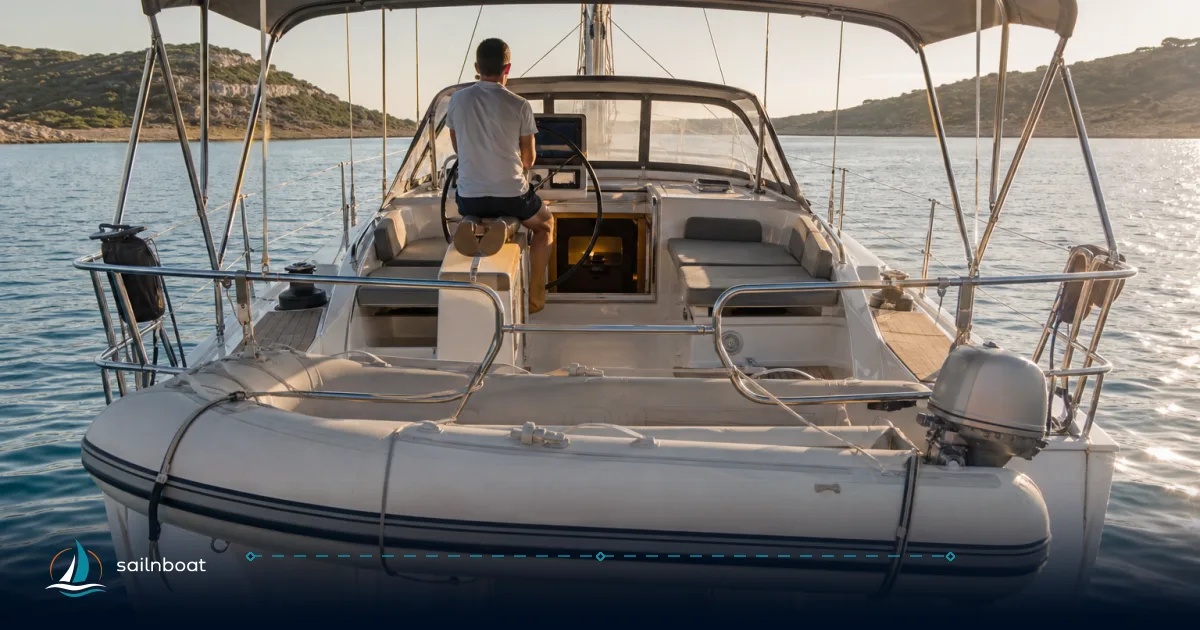
Many centre‑cockpit yachts position the tender and davits at the transom where boarding is done from a swim platform or steps behind the stern; that route keeps boarding flows away from the cockpit when the dinghy is launched and recovered. Davits and a swim platform can make tender boarding a two‑person job that avoids moving through the main cockpit during launch. On the other hand, the cockpit is physically further from the waterline so moving a child from cockpit to dinghy usually requires careful handling down steps or a boarding ladder.
Checklist items for dinghy handling
- Confirm davit SWL and the tender’s weight.
- Verify condition and location of the boarding ladder/platform (folding transoms change the boarding step).
- Practice one tender embark/disembark with the charter crew during handover.
Child Safety in Aft Cockpit
Aft cockpits on many modern production boats can be quite enclosed with high coamings and fixed seats, which may help create a contained play area for small children, though actual containment and safety depend on the specific design and features. But layouts vary dramatically — a low transom or open bathing platform reduces that containment; similarly, a mainsheet running across the cockpit can be a hazard if children move about unobserved. Safety hinges more on specific hardware (cockpit gate, lifeline height, grab rails, non‑slip) than on the layout label alone.
Practical child‑safety actions
- Ask for cockpit gates to be fitted for children if not standard.
- Check stanchion and lifeline height and any gaps a child could slip through.
- Agree a single supervised boarding point for dinghy trips and test it during handover.
Suitability for Different Groups
Match layout to the way you’ll spend the day, not just to the headline label.
Families and Center Cockpit Yachts
Why it works
- Separation between social area and sleeping areas reduces late‑night disturbance.
- Protected cockpit space is a calmer place to keep small children entertained.
- A full‑beam aft cabin gives parents a private suite while kids share forward cabins.
Trade‑offs
- Typically higher cockpit floor: a centre cockpit can feel a little more ‘up’ and therefore more motion prone in a seaway on some models; check how the boat rides in a blow if crossing open water is on your agenda.
Active Groups and Aft Cockpit Yachts
Why it works
- Easier, faster access to the water for paddleboards, snorkelling and quick swims.
- More direct flow from cockpit to bathing platform or tender — good when you plan several water outings each day.
- Social cockpit layouts with side benches promote group conversation and make sunbathing simpler.
Trade‑offs
- Less overnight privacy if you want separate owner space.
- Potentially less shelter from weather: you may spend more time in the sun or shower unless the boat has a substantial bimini.
Comparison at a glance
| Feature | Centre Cockpit | Aft Cockpit |
|---|---|---|
| Privacy (night) | High — separated aft cabin | Moderate — cabins open to social areas |
| Helm visibility | Often restricted by coachroof | Usually clearer sightlines |
| Cockpit shade/shelter | Generally excellent | Often more exposed |
| Dinghy boarding | Transom with swim platform; boarding may be via steps | Quick boarding from low transom or platform |
| Child containment | Good (more enclosed cockpit) | Can be good if gates and coamings fitted |
| Best for | Families, long evenings ashore | Active groups, frequent water sports |
Decision Checklist for Charterers
Below is a booking/handover checklist you and your broker can use. Treat this as a working script: walk it off with the base during handover.
Key Questions to Ask the Base (before booking)
- Which cabin is full‑beam and does it have an en‑suite? (important if adults want a private cabin)
- Where are the davits and where is the tender stowed? What is the tender’s weight and how is it launched?
- Is there a gate in the lifelines at the transom for boarding, and can it be secured? Is there a dedicated child‑safety package?
- How large is the swim platform (or steps) and does it fold down? Is the boarding ladder in good condition?
- What is the mainsheet layout (in cockpit, on coachroof, or on a traveller)? This affects cockpit usability during sailing.
- Are jacklines and a liferaft fitted and where are PFDs stored?
Inspection Points During Handover (on the quayside and afloat)
- Walk to the stern and board the tender once to check the flow and effort for boarding (time it; feel for awkward steps).
- Stand at the helm seated and standing; assess visibility to both the bow and the boom, and check the presence and reach of windlass/anchor controls.
- Open cockpit lockers; inspect drainage scuppers and test that cockpit drains clear (pour bucket of water).
- Inspect the companionway: check the sliding hatch and washboards for ease of use and security while the boat is moored alongside.
- Check davits and their pins, shackles and wiring; raise the tender a few inches and confirm the winch and securing straps.
- Test bimini and sprayhood deployment; confirm canvas zips and fastenings are in working order.
- Confirm location and condition of lifejackets/PFDs and child harnesses if requested; locate grab rails and jacklines.
- Review the mainsheet and winch positions: are sheets routed out of the cockpit when anchoring or socialising?
Practical handover routine: allocate 10–15 minutes for a short tender launch test, 5 minutes for helm sightlines and 5 minutes for a safety kit walk‑through. That small investment prevents the most common mismatches between expectation and reality.
Final trade‑offs and how to choose
- If your week is built around long afternoons moored ashore, quiet nights and separate sleeping space for parents, favour a centre cockpit and prioritise a yacht with a wide aft cabin and a large bimini.
- If you’ll spend most days on the water, want quick dunking and tender runs, or will be frequently manoeuvring in and out of marinas, favour an aft cockpit with good transom access and clear helm sightlines.
- Safety for children is determined by specific features (gates, lifelines, non‑slip, clear boarding plan) more than by layout name; always treat safety as a configuration question to resolve at handover.
Choose the layout that answers the single most important question for your week: will you spend longer in the water and cockpit during daylight (choose aft), or do you need sleeping privacy and a sheltered cockpit for evening living (choose centre). Use the checklist above when booking and at handover — it’s the fastest way to make the layout you choose actually work for your crew.
Consider your group's priorities for privacy, water access and helm sightlines, then use the checklist above to pick the layout that will make your charter week run smoothly.
Frequently Asked Questions
Centre cockpits usually give a separated aft master cabin with en-suite access and less direct foot-traffic from the cockpit; aft cockpits often mean cabins open directly onto social spaces and can feel less private.
Centre cockpits are typically more sheltered by surrounding coachroof and coamings and take bimini/sprayhoods well; many aft cockpits are more exposed and rely on bimini or a sprayhood for shade.
Aft cockpits generally give clearer, lower-line sightlines to the sails and stern; centre cockpits sit higher and can have restricted forward visibility depending on coachroof and sheet runs.
Centre cockpits usually provide better separation between sleeping and social areas, a larger aft cabin, and a more enclosed cockpit area — useful for small children and mixed-age crews.
Centre-cockpit yachts often place boarding at the stern via a platform or steps with davits nearby; aft-cockpit boats vary widely but can offer quicker, lower water access especially where transoms fold down.
Neither layout is intrinsically 'safe' — safety depends on features (cockpit gates, coaming height, lifeline setup, jacklines). Centre cockpits reduce immediate stern exposure; aft cockpits can be more enclosed in some designs.
Test davits/tender boarding, confirm cockpit drainage and bridge-deck height, check companionway gate and grab rails, stand at the helm to assess sightlines, and verify PFD storage and jacklines.
Written by
Sailnboat Editorial
The Sailnboat editorial desk covers yacht and boat chartering worldwide — routes, bases, seasons, boat types, paperwork and the practical costs that decide a trip. We are a charter marketplace, not a boat owner or a local agency: what we sell is judgement and support, so our guides are written to help you make a decision, not to sell you a specific boat. Every guide is checked against live operator and marina data before it goes out.
Fact-checked against live operator and marina data, and published under our editorial standards. Last reviewed: .