Marina Beam Limits: Ensuring Your Catamaran Fits the Berth
A practical, step-by-step guide that shows you how to measure a catamaran's beam, read marina beam limits, what to ask marinas and brokers, and realistic contingency options when your cat is too wide.

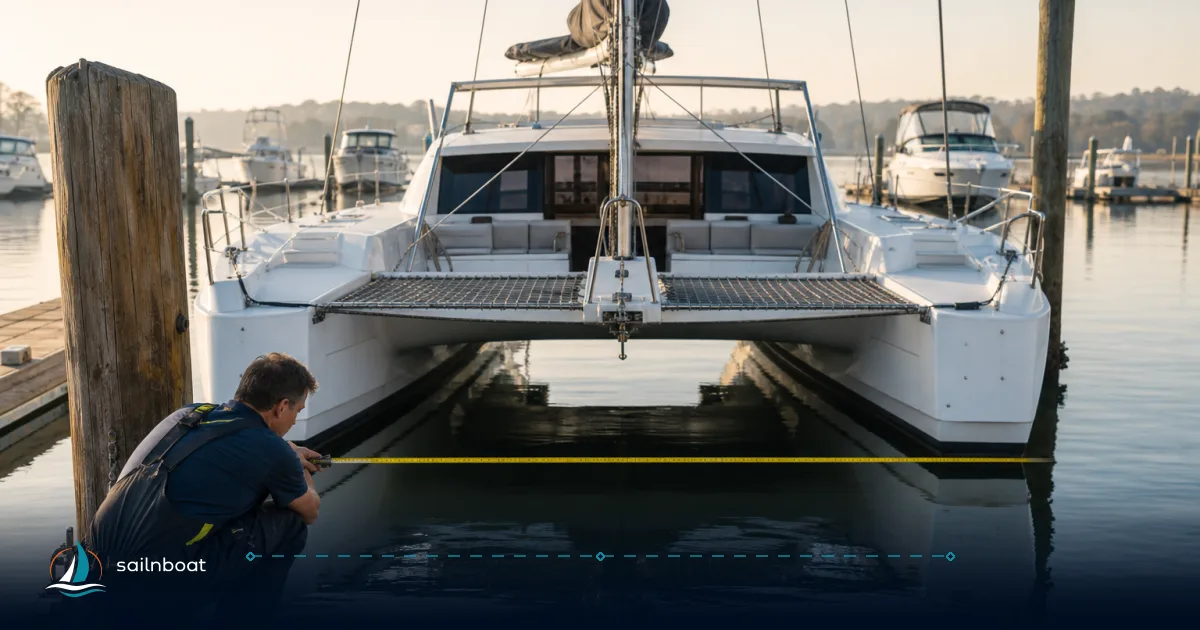
If your catamaran’s beam is wider than the space the marina expects, you can be refused a berth or face hefty surcharges — so check the marina beam limits before you arrive. Measure your widest hull dimension, add the real-world fendered width (beam overall), then confirm the berth type, finger length and whether the marina routinely accepts multihulls; that single sequence answers whether your boat will fit and what plan B looks like. Below is a step‑by‑step practical workflow and the exact questions to put to a marina or broker.
Measuring Your Catamaran's Beam: A Step-by-Step Guide
Start with the two numbers marinas care about: the hull beam (manufacturer’s spec) and the beam overall (the hull plus any permanent or typical protrusions and the fenders you will use).
How to measure beam (practical steps)
- Find the widest point: walk both sides of the boat and locate the maximum transverse section — on most cruising cats this sits amidships or slightly aft.
- Measure hull beam: with the boat afloat and level, measure perpendicular to the centreline from the outermost structural surface on port to starboard. Record in metres (or ft). Manufacturer spec sheets list this as “beam.”
- Measure beam overall: repeat the measurement including pulpits, bathing platforms, outboard brackets, davits and any fixed rub rails. This is the number marinas treat as the true footprint for docking.
- Add fender width: fit the fenders you actually plan to use (or the size you’ll normally inflate). Measure the additional width they add when compressed in contact with a pontoon — this converts the hull beam to the final safety clearance you need in a berth. Treat this as non‑negotiable: marinas often expect fenders to sit between waterline and pontoon.
- Record both numbers clearly on a piece of paper you can send to the marina: “Hull beam = X m; Beam overall (with davit/pulpit) = Y m; Fendered width = Y + 0.2–0.4 m typical (use your actual fender size).”
Notes on accuracy and what marinas will ask for
- Use the larger, fendered, “beam overall” when querying berth suitability; marinas base clearance on what you will present at the dock.
- If the specification sheet gives only hull beam, say so when you contact the marina and supply your measured beam overall.
Interpreting Marina Specifications: Decoding Berth Dimensions
Marina listings and price sheets typically give a “maximum beam” or an “included beam” for each length band — but those numbers come with local practice and assumptions.
What those numbers actually mean
- “Included beam” or “berth includes beam up to X m”: that number often assumes a monohull hull beam and does not include wide catamaran fenders or davits. In some marinas the published rate for a length bracket explicitly assumes a particular beam (for example, some price lists show a 4 m beam included for boats up to 16 m). If you are a catamaran this can trigger a surcharge.
- “Maximum beam” is the physical limit the pontoons, finger spacing and fairway allow; however, allowance for manoeuvring, windage and neighbouring craft often reduces the safe practical maximum. Big transiting marinas can have very large declared beams, but smaller island marinas often assume narrow monohulls (and expect stern‑to placement).
Typical ranges and what to expect
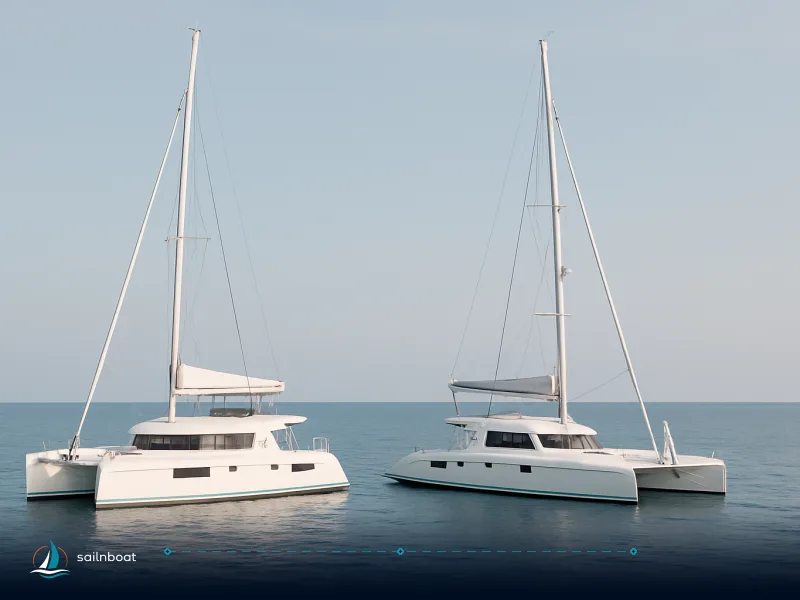
- Cruising catamarans: many current production cruising cats fall in the 6.0–8.0 m beam band (20–26 ft) for 40–45 ft models; smaller 36–40 ft hulls can be ~5.9–6.8 m. Use the model spec when you need a baseline.
- Mediterranean marinas: a sizable portion of small‑to‑medium Mediterranean harbours list included beams that reflect monohull norms (roughly 3.5–4.5 m) so wide cats often exceed “included” beam and either pay extra or require an alternative berth type. Larger international marinas will publish larger maximums or dedicated catamaran slips.
How to read a marina plan (what to ask the harbour master to clarify)
- Is the berth alongside (side‑to) or stern‑to? (This changes required clearances.)
- What is the berth’s “included beam” and the absolute maximum permitted beam?
- Finger length and spacing (see the next section for why this matters).
- Fairway width between pontoons and the turning basin depth.
- Are catamarans charged a premium or required to book wider berths well in advance? (Some marinas apply a catamaran surcharge or increase the tariff percentage for cats.)
Engaging with Marinas and Brokers: Essential Questions to Ask
Before you book, ask the marina or broker these exact, decision‑grade questions. If you put everything in writing you’ll avoid misunderstandings at arrival.
Critical questions (send by email and follow up by VHF on arrival)
- Exact maximum permitted beam for the berth I’m booking — and whether that figure is hull beam or beam overall.
- Berth type: stern‑to (lazy‑line), alongside (finger), or sheltered mooring buoy — and which is used for boats my size.
- Finger length and double‑berth spacing (or channel width) for that slip. If they quote a standard, ask for the berth drawing or dimensions. The design guidance used in many marina plans recommends finger lengths tied to the vessel LOA (for example, design standards often use finger length ≈0.8 × LOA as a planning rule).
- Is the marina comfortable with catamarans of X m beam? If yes, how often do they accept this size in high season?
- Are there fendering or fender‑compression requirements — and is there a maximum fender thickness that must be used?
- Is there a catamaran surcharge or a separate catamaran tariff? Ask for the exact fee and when it applies (high season, weekends). Some marinas explicitly increase daily rates for cats.
- Haul‑out/travel‑lift width if you need yard work — what’s the maximum beam the travel lift or rack can accept? (A marina may accept you afloat but not be able to lift the cat.)
- Approach & mooring assistance: do they provide marineros or linesmen for stern‑to mooring, and on what channels should you call on arrival?
Short email template (one line each): “We have a catamaran LOA __ m; hull beam __ m; beam overall with davit/fenders __ m. Please confirm berth type, maximum permitted beam (specify which measure), finger length/spacing, any catamaran surcharge and travel‑lift maximum width.”
Contingency Planning: Options When Your Catamaran Exceeds Limits
If the marina says “no” to your beam overall, you still have practical options — each with trade‑offs in handling, cost and convenience.
Comparison table: common alternatives
| Option | Typical space/requirement | Pros | Cons |
|---|---|---|---|
| Book a wider slip at a larger marina/port | Slip explicitly sized for wide multihulls (often ≥6 m beam) | Straightforward, alongside access, shore services | Often more expensive; may be far from itinerary |
| Stern‑to (Mediterranean med‑mooring) | Needs quay with mooring points; uses lazy line/anchor | Very space‑efficient in town quays; common in Med | Requires practice; windage and close neighbours increase risk in strong winds. |
| Take two adjacent berths / raft across two berths | Two berths side‑by‑side or pontoons that allow bridging | Useful where marina permits; keeps you close to base | Requires harbour approval; may block neighbours; extra cost |
| Outer pontoons or catamaran‑specific piers | Purpose‑built wide catamaran berths | Easiest handling; designed fendering & services | Limited availability; book months ahead in high season |
| Swing/mooring buoy or anchor out | Buoy rated for your boat or good sheltered anchorage | Cheapest option; privacy | No shore power/water; haul‑out/shore access by tender; weather exposure |
| Shift to nearby sheltered harbour | Find alternate harbour with wider berths | Often available within short distance | Extra navigation; possible extra fees and time |
Evidence and practical notes
- Mediterranean towns and many Croatian marinas commonly use stern‑to (med‑mooring) with a lazy line handled from the pontoon; this is space‑efficient and frequently the default for town quays. It requires a confident backing technique and crew practice.
- Some marinas explicitly charge more for catamarans or list a smaller “included beam” and a catamaran tariff; check marina tariffs — you can save surprises by asking for the exact line item. For example, some published tariffs show a separate catamaran rate or additional percentage applied to the normal rate.
- If haul‑out or yard work is needed, confirm travel‑lift width and pad spacing — a marina may accept you afloat but lack a travel‑lift wide enough to haul the boat. Big regional marinas publish travel‑lift beam limits; ask for them.
Quick decision workflow if refused at check‑in
- Ask the harbourmaster to propose an immediate alternative berth or outer pontoon.
- Request a temporary raft/adjacent slip if possible and document approval in writing (email/receipt).
- If no walk‑on alternative exists, accept a recommended anchorage and ask about tender rules and night watch.
- For repairs or haul‑out, ask which nearby yard has the necessary travel‑lift width and book a slot.
Understanding Mooring Practices: Regional Differences Explained
Mooring technique and berth geometry are as important as the raw beam number. Two regions commonly compared by charterers are the Mediterranean and tropical/Caribbean bases.
Mediterranean marinas (practical reality)
- Stern‑to (Mediterranean) mooring with a lazy line and short anchor or bridle for cats is often used in Mediterranean harbours, including in the Adriatic and some small island towns. A mariner on the quay typically helps — but the manoeuvre requires practice in wind. This system reduces required lateral berth width but demands stern access and crew coordination.
- Smaller island marinas often list an “included beam” that suits monohulls; catamarans can be accepted but may pay a premium or need a larger berth. Book early for summer.
Tropical and Caribbean marinas (practical reality)
- Some Caribbean and Atlantic marinas offer alongside slips, wider docks, and berths that can accommodate multihulls; major marinas may list large multi‑hull berths and travel‑lift capacities suited to catamarans, but this varies by location. This typically makes alongside berthing easier for cats, but premium marinas can be expensive.
- In some tropical cruising grounds you’ll also find abundant well‑rated mooring buoys — a good alternative if you don’t need shore power and the weather is settled.
How regional differences affect berth selection
- If your itinerary is Mediterranean town quays, plan for stern‑to capability and make sure your crew can perform med‑mooring under pressure; otherwise, arrange a wider berth in advance.
- If you are cruising the Caribbean, request alongside slips or cat‑friendly pontoons and confirm travel‑lift widths for any yard work; many marinas publish catamaran capacities.
Practical checklists (print and send)
Quick measurement checklist (what to send to a marina)
- Hull beam (manufacturer spec) — X.x m.
- Beam overall (with davit/pulpit) — X.x m.
- Fenders used and compressed width — add Y cm.
- LOA and draft.
- Do you intend stern‑to or alongside? (state preference).
- Travel‑lift/haul‑out required? If yes, specify required lift width.
- Expected arrival date/time and VHF channel for harbourmaster.
Questions to ask the marina/broker (one‑line answers to get):
- Maximum permitted beam (which measurement?).
- Berth type offered for that slot? (stern‑to/alongside/buoy).
- Finger length and spacing / fairway width. (Design standards often use finger length ≈0.8 × LOA as a rule of thumb for safe berthing).
- Catamaran surcharge or different tariff? Exact amount.
- Travel‑lift maximum beam and cradle spacing.
Final practical advice and trade‑offs
- Early booking buys choice: in popular seasons catamarans compete for a small number of wide berths — book months ahead for peak summer in the Mediterranean and for December in the Caribbean.
- Training matters: if your itinerary requires stern‑to med‑mooring, practice on a calm day or request a marina hand to help on first arrival — this reduces risk and speed of turnaround.
- Don’t assume “largest berth available” is free of manoeuvring hazards: check fairway depth and neighbouring boats’ profiles; a wide beam and big deckhouse catch wind and complicate stern‑to work.
If you do one thing next: measure your beam overall with the fenders you will actually use, send that single figure to the marina and ask explicitly whether it fits the berth they’re offering — then get their reply in writing.
Quick reference — further reading for planners
- Design and marina guidance documents discuss finger length and berth geometry when planning slips (useful if you are assessing a marina plan).
- Country and marina tariff documents often state the included beam and catamaran rates — check the marina’s published price list or brochure.
Measure your catamaran’s hull beam and beam overall now, email the numbers to your marina, and confirm the berth type before you board; that single check prevents the largest charter‑week headaches.
Frequently Asked Questions
Measure the hull at its widest point (perpendicular to centreline). Then measure 'beam overall' including pulpits, davits and the fendered width — use the larger figure when checking marinas.
There is no single standard; many Mediterranean marinas allocate berths sized for monohulls (around 3.5–4.5 m beam); larger marinas accept catamarans up to ~6 m or more — always confirm with the marina.
Ask for maximum permitted beam, berth type (stern‑to/alongside), finger length and spacing, fairway width, lifting/haul‑out width, and any catamaran surcharge or restrictions.
Options include stern‑to if the harbour uses Mediterranean mooring, booking a wider berth at another marina, raft/adjacent berths, using outer pontoons, or anchoring — each has pros/cons for handling and cost.
Mediterranean marinas commonly use stern‑to (lazy line) mooring and tighter berths; many tropical/Caribbean marinas offer more alongside slips or purpose-built catamaran berths — check local practice.
Written by
Sailnboat Editorial
The Sailnboat editorial desk covers yacht and boat chartering worldwide — routes, bases, seasons, boat types, paperwork and the practical costs that decide a trip. We are a charter marketplace, not a boat owner or a local agency: what we sell is judgement and support, so our guides are written to help you make a decision, not to sell you a specific boat. Every guide is checked against live operator and marina data before it goes out.
Fact-checked against live operator and marina data, and published under our editorial standards. Last reviewed: .