Essential Deck Hand Signals for Noisy Marinas and Anchorages
A compact, practical guide to the deck hand signals crews need when shouting won’t work—approach, stop, cast off, wind calls and man‑overboard, with a short rehearsal plan.

Deck hand signals are the quickest way to manage berthing, line handling and emergencies when engines, generators and traffic drown speech. Use a very small, agreed set of gestures — approach, stop, cast off, come ahead, and a clear man‑overboard pointer — and rehearse them until they are automatic; this will cut down mistakes, wasted time and risk in noisy marinas and crowded anchorages.
Understanding Standard Deck Hand Signals
There is no single universal rulebook for yacht deck hand signals; commercial ports, sailing schools and recreational marinas often use slightly different gestures and each operator may expect something different. For that reason agree your set with the charter base or harbourmaster at handover and nominate one person to be the signaller during any manoeuvre.
Below is a compact, practical vocabulary that most crews will recognise or be able to agree quickly with a base. The table helps you compare at a glance.
| Signal | Gesture (day) | When to use | Visibility tip |
|---|---|---|---|
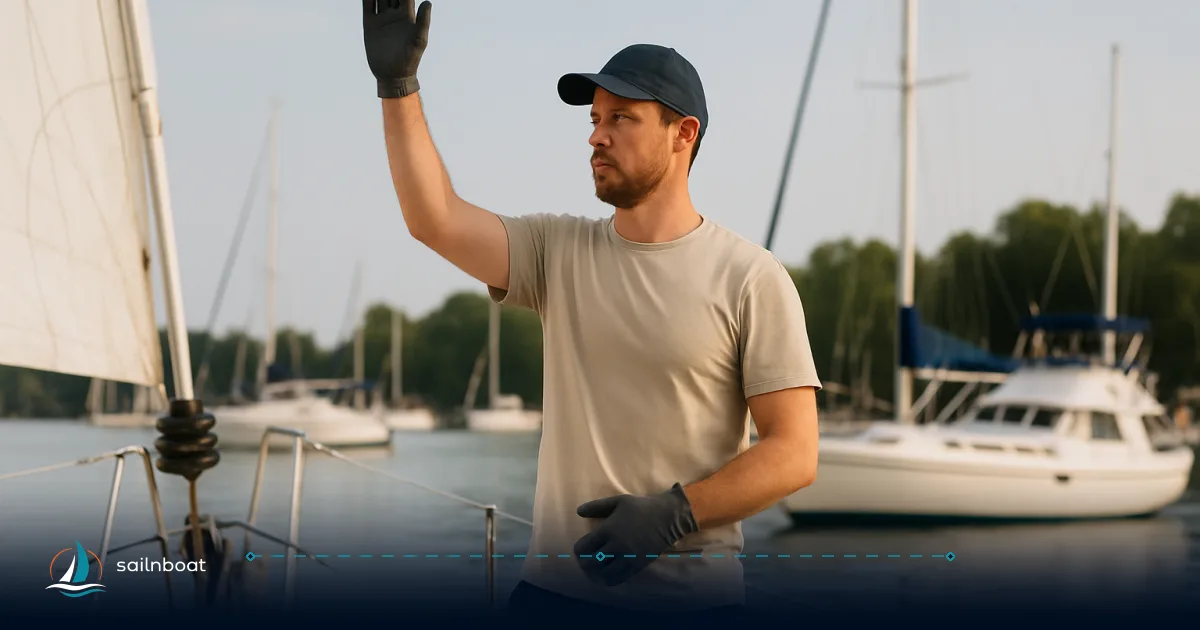
| Approach / Come ahead | One arm raised vertically or arm extended forward with palm facing up, moving forward | Bringing the boat to the berth, approaching a RIB or another vessel | Signaller stands well above deck level (cockpit/coachroof) and repeats until acknowledged |
| Stop / Engines neutral | Both arms extended horizontally with open palms forward, or both hands raised above shoulders, palms out | Halt engines, freeze position while crew prepare lines | Make the stop large and slow; use a whistle blast as backup if this is your local practice |
| Cast off / Let go | Sharp upward motion of the arm with cupped hand (as if flicking a line), or circle the hand | Instruct crew to release a line or cast off moorings | Follow with a clear “ready” sign from the person holding the line if possible |
| Slow / Ease | Both hands moving downward in a controlled patting motion | Reduce speed for precise positioning | Use several slow repetitions until helm acknowledges |
| Come alongside / Hold position | Arm extended, palm down and moving back toward the signaller | Move the vessel toward the indicated spot | Combine with pointing to the cleat/pile and a second confirmation from the crewman on the berth |
| Point-to-MOB | Outstretched arm pointing steadily at the person, never stop pointing | Keep the victim in sight and guide recovery boat/helmsman | A second crew member should act as continuous pointer; use a dan buoy / life ring flagged with "O" where available |
Common gesture variants above are widely used in mooring and training manuals and by sailing schools — adapt the specific motion to exactly what your signaller will perform and make that the crew’s standard for the trip.
Key signals for approach and stop
- Approach/come‑ahead: a single raised arm or forward palm motion communicates forward movement; helm pairs this with slow throttle. Use short, repeated movements rather than small flicks so the helm can read them at distance.
- Stop/neutral: large, deliberate both‑arms open/palms‑out or both‑arms‑raised signals immediate cessation of movement; if noise allows, follow with an audible stop signal. Commercial guidance stresses a single signaller and immediate halt if signals fail.
Signals for casting off and wind direction
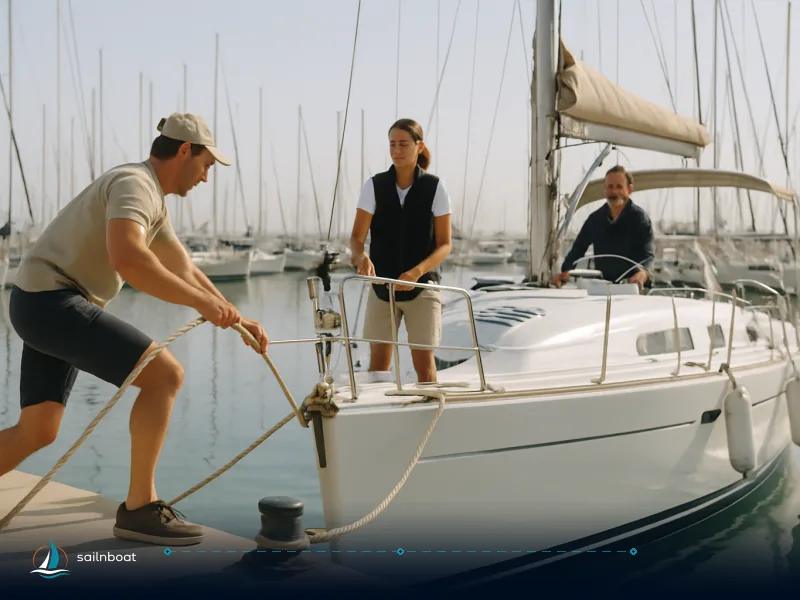
- Cast off/let go: a firm upward cupped motion is an intuitive cue to release a line; ensure the line‑handler first gives a small “ready” wave so the signaller knows the line is under control.
- Wind direction/wind call: point deliberately with a flat arm in the wind’s direction (or show “wind” with hand flutters); use this to indicate which side to take the yacht to avoid drifting while approaching. Where gusts matter, combine the wind signal with a “slow” command to the helm.
Non-Verbal Communication Methods
Hand signals are the backbone, but they work far better combined with simple visual aids and body positioning.
Using Visual Cues
- Flags & paddles: a small, high‑visibility hand‑flag or paddle can increase the range and clarity of a hand signal — useful for busy marinas and when you need to catch the skipper’s eye at a distance. The International Code of Signals also reserves specific flags for emergencies (for example, the Oscar flag is historically linked with man‑overboard).
- High‑visibility clothing / armbands: the signaller should wear a bright lifejacket, reflective vest or armband so they stand out against marina clutter. Many port manuals recommend the signaller be visually distinct from other crew.
- Lights & strobes at night: use a small torch, strobe or headlamp to punctuate a signal; repeat the motion with the light for the helm to confirm. COLREGs govern navigation lights (not hand signalling) but a focused searchlight or strobe makes a hand gesture visible after sunset.
Body Language and Positioning
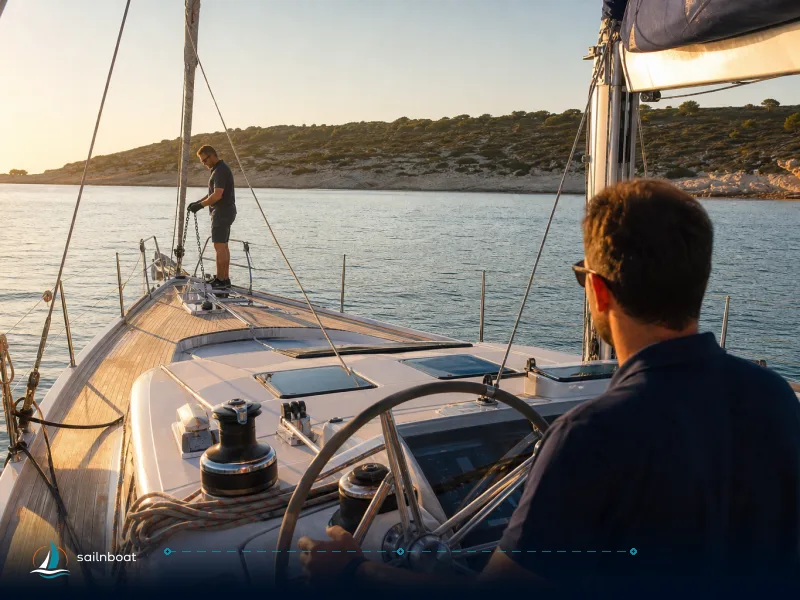
- Eye contact & stance: position the signaller where the helm can see both their face and hands — the coachroof, cockpit coamings or a short ladder on the quay are common spots. Face the helm squarely; avoid side‑on gestures that look like normal working movements.
- Single signaller rule: only one person gives the movement commands to the helm at a time; others can assist with line handling but should not duplicate or contradict the signaller’s motions. This rule is repeated in safety guidance across maritime operations.
Emergency Hand Signals and Their Meanings
When something goes wrong, simplicity and redundancy save lives. Choose a few unmistakable emergency gestures and rehearse them.
Common Emergency Signals
- Distress / pick‑up: both arms raised straight above the head (forming a Y) or both arms raised with palms inward — a universal visual for “pick me up” to aircraft and small boats in close support. In small‑boat rescue practice, persistent raised arms are used to attract attention.
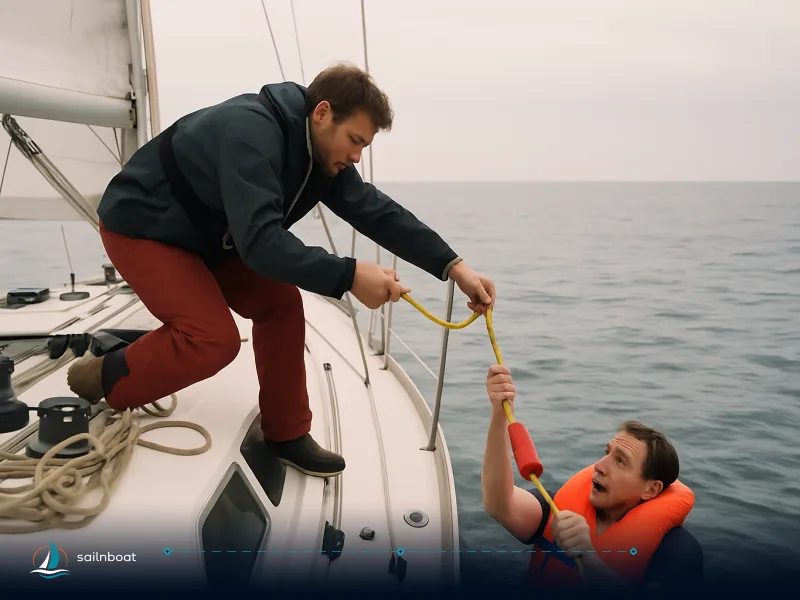
- Man overboard (MOB): point continuously at the person in the water with one arm extended; throw a life ring, mark the position with a buoy/dan‑buoy and keep pointing until recovery. In many training guides the immediate tasks are shouting “Man overboard!”, throwing floatation and designating a pointer — the pointing hand prevents the victim from being lost in the swell.
- Emergency stop / abort: an urgent, repeated full‑arm circular motion toward the body is sometimes used locally to mean “stop what you are doing / abort now”; you may also use a whistle or horn blast for emphasis if this is your agreed practice.
Contextual variations
Emergency meanings vary by service (navy, SAR, port authority) and local practice; the International Code of Signals supplies formal flag meanings (including the man‑overboard association for the O flag) but day‑to‑day crew practice is local and pragmatic. Always make an emergency procedure part of your pre‑departure briefing so everyone’s mental model matches.
Onboard Rehearsal Routine for Charter Crews
Practice is the difference between a clean pick‑up and panic. A short, regular routine embeds signals for everyone on board.
Setting up rehearsals
- Brief (3–5 minutes): review the agreed signal list and assign roles — signaller (person who gives helm commands), pointer (MOB), stern crew (line handler). Keep the set to 6–8 gestures maximum.
- Dry run (5–10 minutes): on deck with no engine, walk through approach, stop, cast off, hold, slow and pointing—every crew member must both give and receive each signal so everyone recognises them.
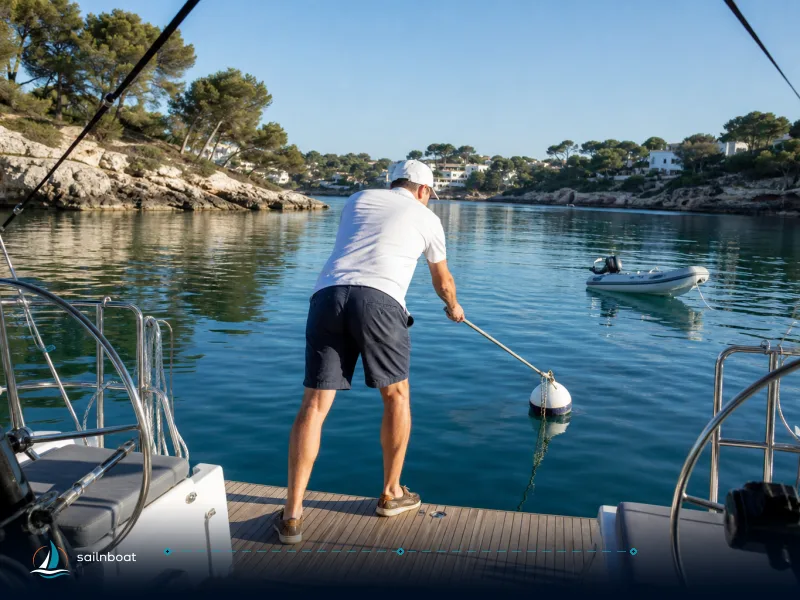
- Underway practice (10 minutes): perform a controlled approach to a buoy or quiet mooring, practice a stop and a cast‑off. Finish with a single quick MOB drill: shout MOB, throw a buoy, point and recover the buoy by bringing the boat round under control. Total time: aim for a 10–20 minute pre‑departure cycle; repeat a full MOB drill once during a week‑long charter or after crew changes.
Evaluating and adjusting signals
- Debrief (2–5 minutes): after each rehearsal say what worked and what didn’t; adapt one signal at a time rather than changing several gestures at once.
- Keep a short signal card: laminate a one‑page guide with your chosen gestures and tape it inside the companionway. This avoids “interpretation drift” over a week of charters.
Practical note: many charter operators expect you to use their agreed signals at handover — if you prefer a different set, negotiate it then and run the brief with the base staff present.
Best Practices for Using Deck Hand Signals
Consistency is key
- Use the same gestures across the whole crew and every watch. Small variations (a slightly different wave) are where errors originate. Reinforce the set by using it for routine tasks, not only emergencies.
Adapting to different conditions
- Visibility: if the signaller cannot be seen, stop and re‑establish a visible signalling position; regulatory guidance for other industries emphasises halting operations if signals are not reliably transmitted — the same principle applies on yachts.
- Noise: add a single short whistle or horn blast as a confirmation cue where permitted by local rules. In congested harbours you may need an audible backup; keep the pattern simple: one short for “acknowledge”, two short for “ready”, one long for “cast off/underway” (agree the pattern with your base).
Who should be the signaller?
Pick a calm, visible, experienced crew member — often the bosun or senior crew — and keep that person as the default signaller for the charter. If they are handling a busy task (lines, fenders) nominate a second signaller rather than try to multitask.
Final Tips for Effective Communication
- Keep your set tiny. A crew that reliably executes six gestures will outperform a crew with an unwieldy list of 20 signals.
- Visual redundancy wins: use gloves with bright cuffs, a flag or a torch when the situation requires it.
- Safety hierarchy: when signals conflict or are unclear, the safest action is to stop the manoeuvre and re‑establish communication. This is a standard safety principle across signalling guidance.
- Log lessons learned: after each busy berthing or MOB practice, note one improvement and make it your crew’s next habit.
Implement these hand signals and the short rehearsal routine on your next charter. A small, rehearsed vocabulary and a single, visible signaller will shorten docking times, reduce mistakes and — most importantly — give you control when sound fails.
Implement this set during your pre‑departure brief and run a 10–15 minute drill before you leave the dock.
Frequently Asked Questions
There is no single global standard; however, many operators share a compact set: approach (one arm up), stop (both arms horizontal, palms out or raised open hands), cast off (sharp upward cupped hand), come ahead (arm extended, palm forward moving), and point-to‑MOB (point at the person and keep pointing). Agree the exact gestures with your base before operations.
Use visual aids (coloured flags, paddles, high‑visibility armbands), a single nominated signaller, and lights or strobes at night; always back gestures with a single confirming audible signal when possible (short whistle/toot).
Common emergency signals include both arms raised for distress/pick‑up, a sustained circling arm motion to indicate cast‑off or abort (context dependent), and pointing to show the position of a person in the water; always follow with a VHF MAYDAY or DSC alert if the situation requires.
Schedule a 10–15 minute pre‑departure briefing and drill: assign roles (signaller, helm, pointer), rehearse approach/stop/cast‑off/come‑aboard and a man‑overboard recovery. Debrief after the drill and agree any local adaptations.
Yes—marina and commercial port practice vary. Many regulations require you to agree non‑standard signals with operators before work begins, so confirm the set with your charter base or harbourmaster.
Written by
Sailnboat Editorial
The Sailnboat editorial desk covers yacht and boat chartering worldwide — routes, bases, seasons, boat types, paperwork and the practical costs that decide a trip. We are a charter marketplace, not a boat owner or a local agency: what we sell is judgement and support, so our guides are written to help you make a decision, not to sell you a specific boat. Every guide is checked against live operator and marina data before it goes out.
Fact-checked against live operator and marina data, and published under our editorial standards. Last reviewed: .