Short-Handed Sailing on a Charter: Techniques for Two-Person Crews
Practical, step-by-step techniques for couples and two-person crews to handle sails, reef early, use autopilots safely, and run watch routines that keep the boat moving and both crew rested.

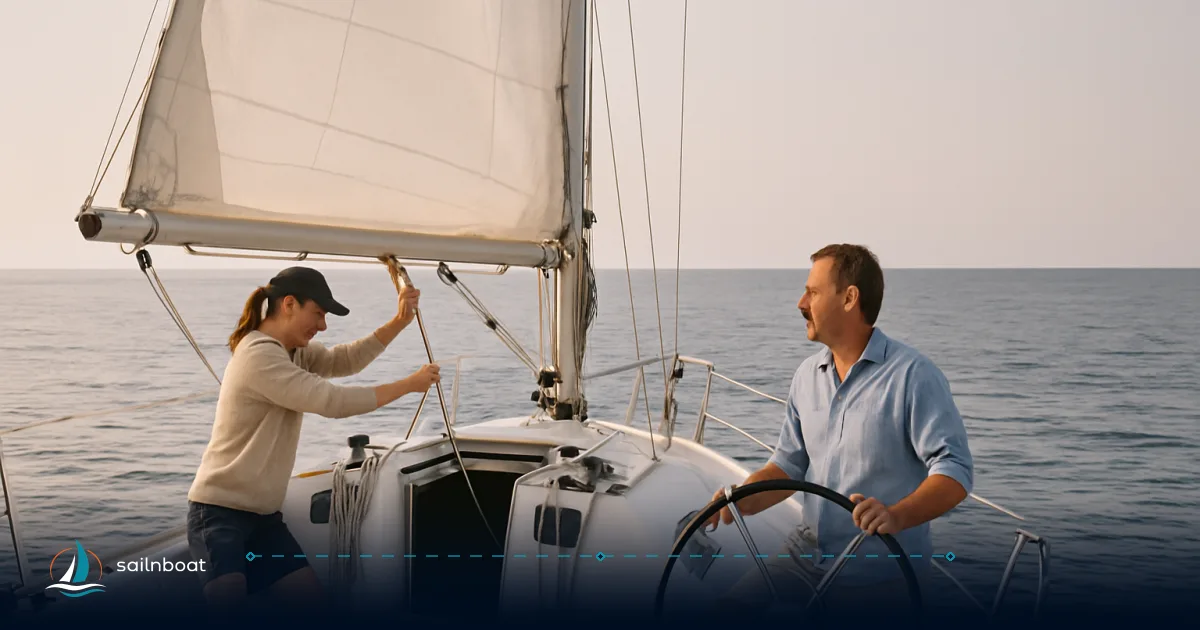
Short-handed sailing on a two-person charter works if you make the boat do the heavy lifting: lead primary halyards, reef and furling lines aft into clutches and winches, use the autopilot or wind‑vane as a reliable third hand, and adopt a simple, consistent watch and log routine. The advice below gives you the practical layout, step sequences and decision rules you need so you and your crew can manage passages safely and without unnecessary forward‑deck work.
Simplified Sail-Handling Techniques
When you have two crew, every trip forward is a chore and a risk. The objective is simple: keep the primary sail controls within reach of the cockpit and make every control operable by one person at a time.
Leading Control Lines to the Cockpit
- Which lines to lead aft first: mainsail halyard (or in-mast/bottom furling control), genoa/jib halyard, primary reef lines (for first and second reefs), mainsheet and traveller control, furling line for headsail, boom vang/topping lift and a boom preventer/trim line if you use one regularly.
- Hardware layout: use a deck organiser (turning blocks/sheaves at the mast base or coachroof) to route each line cleanly to rope clutches on the coachroof/cockpit coaming, then to dedicated winches. A good organiser reduces friction and wear on clutches.
- Clutch and winch discipline: assign clutches by function (e.g., halyards on the inboard bank, reefing/furling on the outboard), label them, and keep the most frequently used lines on the winch nearest the helm. Avoid funneling too many heavily loaded lines through a single winch or clutch bank — this increases wear and can leave you without an available winch in a busy manoeuvre.
- Practical rigging tips:
- Fit slightly longer halyards when leading aft so you can ease the line without fighting the clutch.
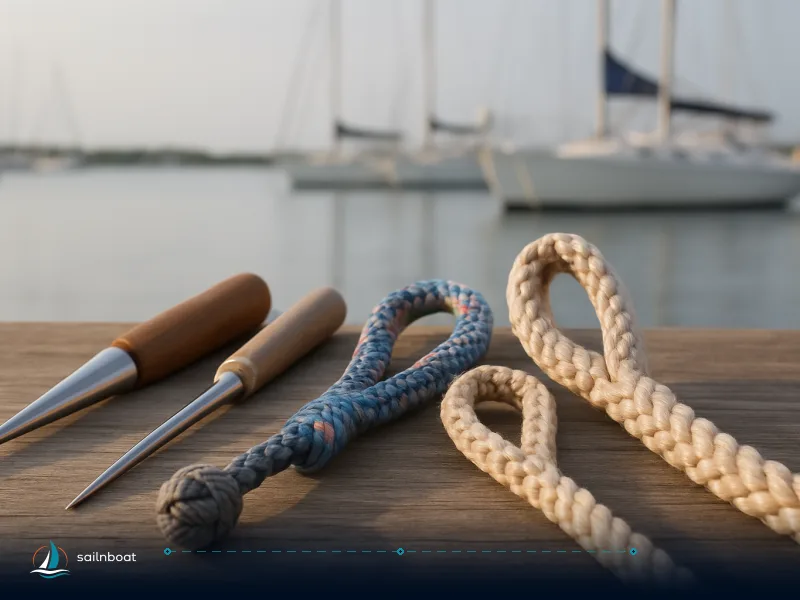
- Use colour coding or heat‑shrink wrap on tail ends so you don’t fumble in a squall.
- Keep a short “hand” (3–4 m) of tail on the clutch ready for fast grab-and-pull, and store extra tails tidily to avoid snags.
- Pre-charter checklist: at handover identify where the base has led halyards and reefing lines, confirm which winches are electric, and ask to demonstrate the clutch/winch layout before you leave the dock.
Practical note: many charter yachts already lead essential lines aft, but the arrangement varies — plan the first hour after checkout to test every clam cleat, clutch and winch to see what works for you.
Efficient Reefing Procedures
Two-person crews win or lose by reefing decisions. Reefing early keeps motion, helm balance and crew safety within comfortable limits; reefing late forces risky forward‑deck work and can escalate to broaching or uncontrolled gybes.
Timing for Reefing
- Reef early and often is the governing rule. As a calibrated practical range, many cruising skippers reef when apparent wind increases to a level that causes excessive heel, heavy weather helm, or consistent whitecaps. The specific wind speed for first reefing varies by boat design, sail plan, and load—consult your yacht’s manual or operator for recommended reefing thresholds. This varies by hull form and displacement — lighter, beamy boats will reef earlier than heavy displacement yachts.
- Make it routine to put in (or at least rig) a reef at dusk even if conditions are calm: doing this removes the need to go forward at night and avoids improvising reefing under low visibility. The RYA recommends preparing for night conditions and reducing night-time workload as part of safe cruising practice.
Practical reef sequence for short-handed crews
- Pre-check: route each reef line to the cockpit so reefing can be achieved without two people forward. If the boat has single-line/one‑line reefing, confirm its behaviour in light conditions first.
- Typical slab reefing steps (for cockpit‑led lines):
- Trim up into a controlled state (head to wind if possible for older slab systems) and ease main halyard slightly to take pressure off the reef cringle.
- Secure the reefing tack/clew lines from the cockpit using the designated clutch/winch.
- Re-tension the halyard and reefing lines to tidy the reef and re-trim the sail.
- Adjust headsail (roll or furl partially) immediately to rebalance helm.
- If the boat uses in-mast or in-boom furling, practise the sequence in calm conditions so you can furl/reduce canvas smoothly without jamming.
Operational trade-off: slab reefs give better sail shape and are quicker to adjust on many charterers' yachts; in-mast/in-boom furling is easier to use but can be harder to completely depower in a blow.
Utilizing Autopilots and Wind Vanes
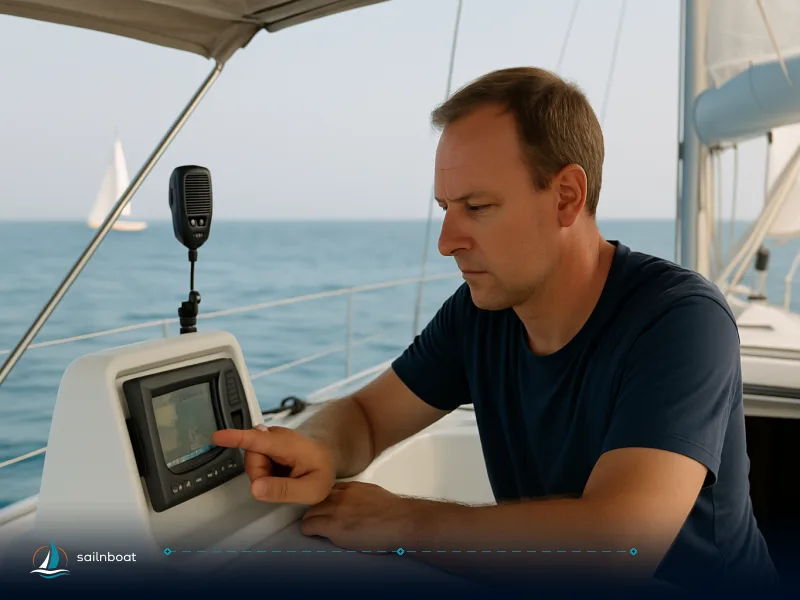
A correctly used autopilot or wind vane is effectively a reliable “third crew member” for short-handed passages. They free a hand for trimming, helming corrections and lookout — but only when used with clear safety discipline.
Acting as a Third Crew Member
- What they do: both autopilots (electric/servo-driven) and wind vanes steer the boat so you can trim and tweak sails without a person at the wheel; wind vanes are mechanically driven and excel at long-term course keeping on offshore points of sail, while electric autopilots are better for tight manoeuvres and close-quarters steering.
- Safe use checklist:
- Test: before you rely on the system, practise engaging and disengaging in sheltered waters so both crew know the feel and the fail modes. Manufacturers make specific instructions for engaging autoheading and disengaging to standby; learn the device’s physical standby button and clutch method.
- Before sail handling: engage the autopilot/wind vane to hold a steady course while you sheet, furl or reef. Do not leave the autopilot unmonitored during a manoeuvre — it must be ready to be disengaged.
- Disengage procedure: know the exact disengage action for your unit (button press, wheel clutch lever, or manual override). In emergencies a quick tap to Standby or physical clutch release should put helm control back to the human. Skippers are responsible for ensuring all aboard can disengage the autopilot.
- Limitations and gotchas:
- In heavy seas or when steering loads spike (e.g., squall, brief gybe), autopilots can struggle or overheat; manual helming is sometimes safer for short bursts of difficult steering.
- Never assume the autopilot will handle an accidental gybe — use a preventer on the boom or keep the mainsheet restrained during downwind work.
Downwind Sailing Techniques
Downwind sailing is where two-person crews either enjoy steady miles or get exhausted chasing sail trim. Choose stability over theoretical extra speed.
Sail Configuration for Downwind
-
Best options for low workload:
-
Poled-out headsail (jib/genoa poled to windward) with mainsail trimmed to leeward — stable, forgiving and straightforward to reef/trim. Poled-out headsails are widely used for long downwind runs because they keep the headsail working away from the main’s wind shadow.
-
Deep reach under main + genoa (sheeted out on same side) — simpler than constant pole changes and useful in rolly seas.
-
Avoid: leaving the boom uncontrolled and “gybing all standing” (wing-on-wing without a preventer) in strong winds or confused seas — accidental gybes are the common cause of injuries and gear failure. Use a strong preventer and, when in doubt, bring the mainsail down to reduce boom loads.
-
Comparative table — downwind options for two-person crews
| Setup | Workload | Stability | When to use |
|---|---|---|---|
| Poled-out headsail + main | Medium | High | Extended downwind legs, steady trades or moderate winds |
| Deep reach (main + genoa) | Low | Medium-High | Rolly seas, short legs, when you want fewer sail changes |
| Wing-on-wing (no preventer) | High | Low (risk of accidental gybe) | Only in light, very steady winds and with experienced crew |
| Spinnaker/asymmetric | High | Medium (fast) | When you have experience, or in daylight with calm seas |
Practical note: if you plan repeated pole moves, consider whether a second pole (or adjustable whisker package) is available on the chartered yacht — otherwise the boat's simplest stable rig will be fastest overall.
Developing Realistic Watch Schedules
A watch system for two people must balance continuous lookout with long enough continuous sleep to be restorative. Agree the schedule ashore and stick to it.
Watchkeeping Structures
-
Common rotations for two-person crews:
-
Alternating 3‑hour watches (e.g., 00:00–03:00 / 03:00–06:00): frequent handovers, keeps both crew engaged. Good for near‑shore or busy traffic areas.
-
Alternating 4‑hour watches (e.g., 20:00–00:00 / 00:00–04:00 / 04:00–08:00): longer off‑watch sleeps, fewer handovers — preferred on long offshore legs.
-
Mixed (staggered) patterns: e.g., 2‑hour short watches around dusk/dawn combined with longer overnight blocks during quiet nights.
-
How to choose: use 4‑hour watches if you need longer consolidated sleep (off-watch block of 4 hours is more restorative); choose shorter watches when traffic or weather requires more frequent checks.
-
Handover routine (keeps mistakes low): at changeover agree on the immediate plan (next waypoint, sail plan, any pending manoeuvres), confirm alarms are set (AIS, anchor, bilge), and make the logbook entry (see next section).
-
Fatigue rule: if either crew feels too tired to helm or make decisions, reduce sails and slow down — fatigue reduces decision quality faster than speed loss matters.
-
Watch system comparison table
| System | Typical use | Pros | Cons |
|---|---|---|---|
| 3‑hour alternating | Coastal/offshore in traffic | Regular checks, breaks monotony | Interrupts sleep cycles more often |
| 4‑hour alternating | Offshore, quiet nights | Longer sleep blocks | Longer handover, heavier single watches |
| 2/3 mixed | Dusk/dawn busy period + long night | Flexible, covers busy times | More planning needed |
Logbook Essentials for Short-Handed Sailing
A disciplined log is your memory, evidence and safety fallback. Make a brief entry at every watch change — the few extra minutes repay themselves.
Key Logbook Entries
At each watch change record at minimum:
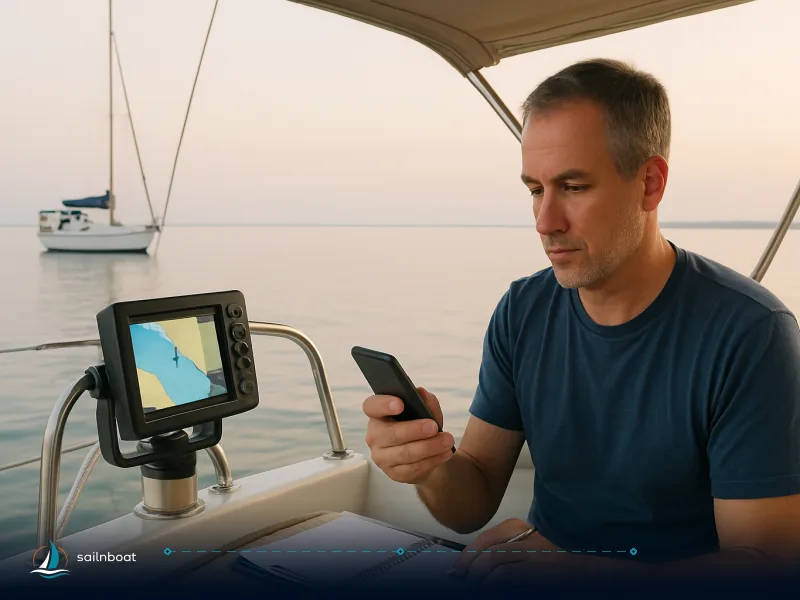
- Time (UTC or local — pick one consistently) and position (latitude/longitude).
- Course (heading or COG) and speed (SOG).
- Wind direction and strength (apparent and, if available, true), barometric pressure.
- Sea state/visibility and any notable weather trends.
- Sail plan and any sail or rigging changes (reefs, furling, sail swaps).
- Traffic encounters, near‑misses, or navigational hazards.
- Any equipment issues, alarms or maintenance tasks.
- Name of on-watch and off-watch crew and a short note of immediate actions to follow.
Template short watch-entry (example):
- 22:00 UTC — 36°12.34'N 15°45.67'E — COG 112° T / SOG 5.6 kn — Wind 150°T / 18–20 kt — Baro 1011 hPa — Sea: 1.5 m swell — Sail: 1st reef main, genoa 75% — Notes: AIS contact at 23 M to port, autopilot engaged; check mainsheet clutch.
Practical tip: keep both a digital log (for timestamped GPS) and a paper backup. Make entries concise; a log that’s kept is worth more than a perfect one left blank for being onerous.
Final checklist before you cast off
- Walk the deck: confirm tail lengths, clutch positions and that lines run cleanly aft.
- Agree reef points and the routine for reefing at dusk (who handles which lines).
- Run a quick autopilot/wind-vane engage/disengage drill in the marina or sheltered waters.
- Decide and write the watch schedule on the companionway bulkhead; practise one handover before leaving.
- Stow or secure any deck gear you won’t need and set jacklines/gear for any expected forward work at night.
Short-handed sailing on charter is about predictable systems that reduce friction and risk: cockpit-led controls, a practiced reefing routine, a reliable autopilot as a hands-off helper, conservative downwind choices, and a simple watch + log discipline. Apply the checklists above on the first day of your charter and you’ll turn uncertainty into routine — and free yourself to enjoy the miles.
Frequently Asked Questions
Lead halyards, reef and furling lines aft through deck organisers to line clutches and a dedicated cockpit winch or two; label and arrange clutches by function and keep common running-rigging on separate winches to avoid overload.
Engage the autopilot/wind vane to steer while you trim/sheet; test engagement modes and the manufacturer’s standby/disengage method before leaving safe waters and keep a quick-access plan to switch to manual steering.
Reef early — many cruisers take a first reef around ~15–20 knots apparent wind — and adopt a habit of putting in a reef at dusk so you minimise night-time forward-deck work.
For low workload choose a poled-out headsail or sail on a deep reach with main+genoa; if you must gybe, do it controlled with a preventer and the helm prepared — avoid leaving the boom uncontrolled in strong winds.
Use a fixed, agreed rotation (examples: alternating 3-hour or 4-hour watches, or a staggered 2/3 pattern) that keeps handovers brief, ensures one crew sleeps uninterrupted where possible, and fits the passage profile (coastal vs offshore).
At each watch change record: time, position (lat/lon), course, speed (SOG), wind direction and strength, barometric pressure, sea state/visibility, sail plan changes, traffic or incidents and any equipment faults.
Written by
Sailnboat Editorial
The Sailnboat editorial desk covers yacht and boat chartering worldwide — routes, bases, seasons, boat types, paperwork and the practical costs that decide a trip. We are a charter marketplace, not a boat owner or a local agency: what we sell is judgement and support, so our guides are written to help you make a decision, not to sell you a specific boat. Every guide is checked against live operator and marina data before it goes out.
Fact-checked against live operator and marina data, and published under our editorial standards. Last reviewed: .