How to Reef: A Practical Guide for Charter Skippers
A concise, action‑focused guide that tells you when to reef, exactly how to slab‑reef main and foresail, and a safe single‑handed sequence you can practice on your next charter.


Reef before control is lost: a practical trigger is persistent apparent wind of about 15–20 knots, or whenever heel, weather helm, or rudder angle rise to the point that your boat becomes uncomfortable to steer or crew movement is compromised. This article answers "how to reef" with clear, repeatable slab‑reefing sequences for main and foresail, single‑handed options you can rely on, and the safety checks to prevent sail or crew damage.
When to Reef: Identifying Optimal Conditions
A good reefing rule is to act early. A persistent apparent wind in the 15–20 kt band commonly prompts crews to put in a first reef on cruising boats; by the mid‑20s you should be thinking second reef, a smaller headsail or both. Use wind speed as a guide, but prioritise boat behaviour: increasing heel (often >15°–20° on many cruisers), growing weather helm, excessive helm input, or a large gust spread are equally valid triggers. Sea state and crew ability change those numbers—short, choppy waves or inexperienced crew mean reef sooner.
Recognising wind cues
- Watch apparent wind, not just instrument numbers: gusts that spike above your steady wind are the immediate threat.
- Telltales and tell‑tale behaviour will show when the sail is becoming overpowered (choking or repeatedly stalling).
- Rudder angle: if you must hold more than a modest amount of rudder to maintain course, consider depowering.
Assessing your boat’s performance
- Heel and speed together tell the story: a slightly flatter, reefed boat often sails faster upwind than an over‑heeled boat that sloughs off speed due to leeway.
- Consider crew safety and comfort: can everyone move securely, and are hatches/gear fastened? If not, reef.
Step-by-Step Slab Reefing for Mainsail
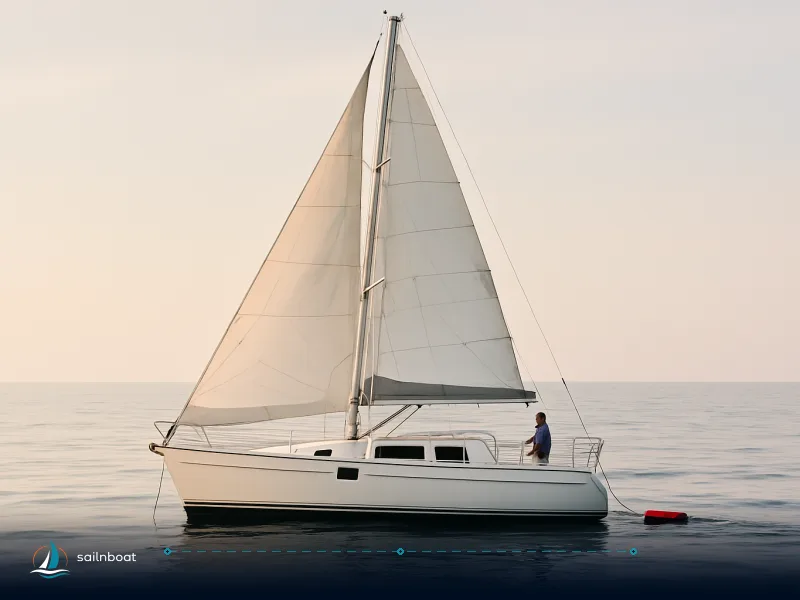
Slab (jiffy) reefing is the standard on most charter cruisers: fixed reef cringles create a new tack and clew, giving a predictable reduction in area. The exact reduction varies by sail shape (often ~25–40% for the first reef on many coastal cruisers), so treat the number as a guide and judge by boat behaviour.
Preparing to reef
- Announce your intentions to the crew and assign jobs (mast, pit, cockpit). Make one person responsible for halyard and another for reef line if you have crew.
- Clear and stow loose items; close hatches. Keep everyone out from under the boom until it is supported.
- Lead all reefing lines and halyard tails so they run freely to winches accessible from the cockpit where possible. Check for snags or wraps.
Executing the reef — reliable, repeatable slab sequence
- Choose a safe patch of water and a stable point of sail. Upwind, you typically head up (luffing the main) briefly; downwind, bear away so the main eases. Either action should be controlled — don’t gybe.
- Ease the mainsheet and vang/kicker so the boom is unloaded; support the boom with topping lift or rigid vang if needed.
- Ease the main halyard to the pre‑marked reef point (many sails have a visual mark or a stitched line). Lower until the luff reef cringle aligns with the gooseneck or tack hook.
- Hook or secure the tack cringle at the gooseneck (or attach the tack line/run the downhaul). Make this secure before taking strain on the clew.
- Tighten the reefing line(s) at the clew, using a self‑tailing winch where available, until the clew reef cringle comes down to the boom and the foot is reasonably flat.
- Retension the halyard to remove flogging (don’t over‑tension — you want a firm luff but not a wrinkled sail), set the outhaul/boom vang for correct shape, and re‑trim the mainsheet.
- Secure any loose reef points (bunt ties or reef ties) so the leftover canvas can’t flog. Check sail shape and steering balance.
Quick checklist for mainsail reefing (printable)
- Lines led and clear ✔
- Boom supported before major lowering ✔
- Tack secured before reefing clew ✔
- Reefing line on a self‑tailing winch (if solo) ✔
- Halyard retensioned, vang/outhaul trimmed ✔
Step-by-Step Slab Reefing for Foresail
How you depower the headsail depends on the system: roller‑furling jibs/genoas are reduced by furling; hanked sails require different handling or a smaller working headsail. Roller systems give quick, incremental control from the cockpit; that's why many charter boats use them.
Preparing for foresail reefing
- Keep the boat balanced: if you’re going to furl in the genoa, ease the genoa sheet so the sail begins to furl cleanly without backwinding the main.
- Communicate: headsail changes change balance quickly, so coordinate helm and sheet work.
Reefing the foresail — roller furling (typical cockpit method)
- Ease the genoa sheet to reduce load so the luff can roll easily onto the foil.
- With a steady helm (autopilot or hand on the wheel), pull the furling line in small, controlled increments; avoid trying to rapidly furl under full load.
- Stop and sheet in once the desired area is wrapped; trim for balance, then fine‑tune the main. If gusts are the issue, furl to a smaller, safer area rather than full furl immediately.
If the headsail is hanked on
- You may need to drop the sail partially and re‑attach or change to a smaller sail. Do this in sheltered water if possible. Keep the boat’s head up and the sheet under control while the sail is handled. For hanked sails, have crew at the forestay and pit to lower the halyard and re‑secure the new tack/clew position.
Single-Handed Reefing Techniques
Single‑handed reefing is practicable and safe when you plan each move. The two most important enablers are (1) keeping control of course (autopilot or a steady hand on the wheel) and (2) cockpit‑led control of halyard and reefing lines. Practise the whole sequence in calm conditions until the motions are second nature.
Preparation and planning (solo)
- Lead reefing lines, halyard and topping lift to the cockpit or to easily reachable winches before you leave port.
- Stow winch handles where you can reach them with one hand. Use a self‑tailing winch for reefing lines.
- Pre‑brief a single‑hand sequence in your head: "point, ease, lower to mark, hook tack, winch clew, retension, trim." Practise this in light airs until muscle memory forms.
Executing a safe single‑handed reef (typical flow)
- Engage autopilot or bring the boat onto a stable close-hauled or close-reaching course you can hold while you work.
- Ease the mainsheet and vang so the boom is unloaded; tension the topping lift if you need to hold the boom level.
- Ease halyard to reef mark with one hand; feed tail to the cockpit.
- Hook the tack (or tension the tack line) — if you cannot get forward, use the downhaul/reef tack line from the cockpit.
- Use a self‑tailing winch to haul the reefing line at the clew until the clew sits on the boom; then re‑tension the halyard and trim.
- Re‑check helm balance and sail shape; tidy tails and tie bunt lines.
If you have no autopilot
- Make short, controlled course changes to luff the main, step back to the cockpit to tension lines, then resume steering — keep each move minimal and deliberate. If conditions are deteriorating, consider heaving to or dropping sail at the lee anchor rather than attempting a complex solo reef in a blow.
Safety Checks Before and After Reefing
Pre‑reefing safety checks
- Lines and hardware: inspect reefing lines, halyards, shackles and reefing cringles for wear before you start. Replace or rig a spare if there is doubt.
- Crew position: make sure anyone forward is clipped on with a harness and tether, and that nobody stands under an unsupported boom.
- Sea room: choose open water for your first reef — avoid headlands, shipping lanes or strong tidal flows while you practice.
Post‑reefing assessment
- Trim: re‑tension halyard and reef lines so the luff is firm but not over‑stressed; set outhaul and vang to a flatter shape appropriate to the reduced area.
- Look for chafe: reef points and lines can chafe the sail—inspect the luff and leech at the reef cringles periodically.
- Balance: check helm load and make small sail or course changes until the boat tracks neutrally with manageable rudder.
Common Mistakes in Reefing and How to Avoid Them
Overlooking timing
- Mistake: reefing too late and fighting control in a gust.
- Fix: reef earlier — use the 15–20 kt band as a decision point for many cruising yachts, and always weigh sea state and crew.
Improper line management
- Mistake: tangled reef lines, jammed blocks or halyard wraps.
- Fix: lead lines cleanly, flake them on deck in clear coils, put them on a self‑tailing winch, and practise the full sequence in calm conditions.
Failing to support the boom
- Mistake: lowering the halyard without topping lift/vang control and allowing the boom to drop onto the deck or crew.
- Fix: always support the boom (topping lift or vang) while you lower the halyard and secure the tack.
Using the wrong technique for the sail plan
- Mistake: trying to quickly furl a heavily sheeted genoa without easing sheets — this jams the furl and can injure crew.
- Fix: ease sheets first; furl in controlled increments; if unsure, hand‑over to a smaller working jib.
Quick Comparison: Reefing Systems (at a glance)
| System | Best for | Speed / Ease | Cockpit control | Notes |
|---|---|---|---|---|
| Slab (jiffy) reef | Most cruising mains | Moderate | Often needs foredeck for some steps | Predictable shape; good sail control when properly done. |
| Roller furling jib/genoa | Charter headsails | Fast | Full cockpit control | Easiest for solo/couple crews; risk of luffing under load if not eased first. |
| In‑mast / in‑boom furling | Simplified reefing | Fast | Full cockpit control | Convenient but compromises mainsail shape; check manufacturer notes for limits. |
| Storm sail / trysail | Heavy weather | Slow (rigging needed) | Secure once set | Use when reefing is insufficient; rig before conditions worsen. |
Practice plan and final checklist
Practice sequence to build confidence (recommended)
- Calm day: practice one reef upwind and downwind with crew, timing each step until it feels smooth.
- Solo practice: lead lines to cockpit and perform the full single‑handed routine in light air with an autopilot engaged.
- Emergency drill: practise dropping the main or setting a trysail in a controlled exercise so everyone knows their role.
Final reefing checklist (before you leave the cockpit)
- Lines clear, led to winches and flaked ✔
- Autopilot set or helmperson briefed ✔
- Boom supported and crew clear ✔
- Halyard mark identified ✔
- Bunt/reef ties ready ✔
Enhance your confidence: rehearse these sequences until the sequence is automatic and the motions are safe. Practice is the difference between a routine reef and an emergency scramble. CTA: enhance your sailing skills by practicing reefing techniques in safe conditions.
Frequently Asked Questions
Reef early: a practical trigger is when apparent wind is consistently in the 15–20 kt range, or earlier if the boat heels beyond comfortable control or gust spread is large; sea state and crew experience also matter.
Prepare the crew and lines, head to a safer point of sail, ease kicker and mainsheet, lower the halyard to the reef mark, secure the tack cringle, tension the reefing line to bring the clew to the boom, retension the halyard and trim controls.
Set the autopilot or fix a steady heading, lead reefing lines to the cockpit, use a self‑tailing winch, bear away so the main luffs, complete the reef sequence, then trim the sails and course.
Don't reef too late; don't let lines tangle or reefing cringles jam; support the boom when lowering the halyard; and never leave crew under an unsupported boom during the operation.
If you have a furling headsail, furl in small increments while keeping the boat balanced; for hanked sails, shorten the sheet, lower or furl enough to the next reef point, then re‑trim the sheet and check sail shape.
Written by
Sailnboat Editorial
The Sailnboat editorial desk covers yacht and boat chartering worldwide — routes, bases, seasons, boat types, paperwork and the practical costs that decide a trip. We are a charter marketplace, not a boat owner or a local agency: what we sell is judgement and support, so our guides are written to help you make a decision, not to sell you a specific boat. Every guide is checked against live operator and marina data before it goes out.
Fact-checked against live operator and marina data, and published under our editorial standards. Last reviewed: .