How to Charter a Yacht in the Mediterranean: A Complete Guide
A practical, step‑by‑step checklist for chartering a yacht in the Mediterranean — choose the right base, decide bareboat vs skippered, understand licences, VAT, marina fees, deposits and insurance.

Chartering a yacht in the Mediterranean means choosing a country, the right boat and the right level of crew, then matching licences, taxes and insurance to that choice. In practice: pick a base with the wind and island pattern you want, decide bareboat or skippered, confirm which qualifications (ICC/RYA/SRC or local licence) the operator requires, and budget VAT, marina nights, APA and a security deposit before you sign.
Choosing the Right Base: Evaluating Mediterranean Countries
Your base choice drives most operational and budget decisions: which islands you visit, the wind regime, whether your credentials are accepted and how much VAT or local taxes apply. Below are the common charter hubs and what they mean in practice.
Top Mediterranean Charter Bases
- Croatia — Dalmatian coast (Split, Zadar, Dubrovnik). Excellent island hopping and berths that favour sailing between protected bays; operators commonly require recognised skipper credentials plus a VHF (SRC). Croatia applies a reduced VAT treatment on accommodation‑type charter services (see table).
- Greece — Ionian and the Cyclades. Huge choice of bases and boats; expect stronger summer winds in the Aegean (the Meltemi) and frequent requests for RYA/ICC or equivalent paperwork. Many Greek operators quote a discounted charter VAT under conditions.
- Italy — Sardinia, Sicily, Amalfi, and the Tuscan archipelago. Good marina infrastructure but generally higher VAT and marina costs in popular ports; local licences and port rules vary regionally.
- Spain — Balearic Islands (Mallorca, Ibiza). Easy access from major airports; standard Spanish VAT applies and marinas on Mallorca/IBZ are busy and comparatively expensive in July–Aug.
- France — French Riviera (Nice, Antibes, Saint‑Tropez). Premium berths and services; standard French VAT and some marinas with very high peak‑season rates.
- Montenegro — growing superyacht/charter scene (Tivat/Porto Montenegro). Standard PDV is 21% nationally, though some charter business models and exemptions mean the effective tax on a specific charter can vary by operator.
VAT Rates and Licensing Requirements — at a glance
The fiscal treatment of a charter (VAT applied to the base fee, taxed as accommodation, or treated differently) varies by country and sometimes by voyage pattern (start/finish in different countries). Operators commonly build local VAT into their advertised prices; when they don’t, ask for the VAT line explicitly.
Comparison table — typical VAT or tax handling and common licence expectations
| Country | Typical VAT / tax note | Common licence accepted | VHF (SRC) usually required |
|---|---|---|---|
| Croatia | Reduced VAT on accommodation‑type charter often applied (commonly cited around 13%). | ICC or recognised national skipper licence; operators check recognition lists. | Yes — many operators and port authorities require a VHF/SRC. |
| Greece | Operators commonly quote a discounted VAT band (many list ~12% for charters under specific rules). | RYA certificates, ICC or equivalent are widely accepted but acceptance varies; some companies require a qualified co‑skipper. | Often required; companies typically expect at least one SRC or equivalent on board. |
| Italy | Standard VAT 22% applies; some services may have different treatment. | RYA/ICC and national licences generally accepted; check local operator. | VHF often expected; check charter terms. |
| France | Standard TVA 20% (metropolitan). | RYA/ICC commonly accepted for charter companies; local checks vary. | Often expected for operators of commercial/charter boats. |
| Spain | Standard IVA 21% (national rate); charter operations follow local rules. | ICC/RYA normally accepted by private fleets; operators differ. | Depends on operator; ask ahead. |
| Montenegro | Standard PDV 21%; some operators quote special arrangements for charter fees — expect variation. | Local rules differ; check operator. | Varies; confirm per charter. |
Notes: VAT lines above are the common, operator‑level practice seen in 2024–2026 market documents; actual treatment depends on the operator’s fiscal residency, whether the yacht leaves the country during the charter and national tax rules. Where VAT treatment matters to your final price, require a written breakdown in the quotation.
Bareboat vs. Skippered Charters: Assessing Your Options
Bareboat Charters
What you get: the yacht without professional crew; you steer and manage provisioning, navigation and berthing yourself. Pros:
- Lower weekly cost than crewed boats (no daily skipper/chef fees).
- Full control of itinerary and schedule. Cons / practical points:
- The operator will require evidence of appropriate competence (see Licensing section below) and may add a co‑skipper requirement or a check‑out sail if they have doubts.
- You are responsible for damage and for managing APA usage (if applicable). When to choose it: you and your crew have recent experience on similar‑sized boats, are comfortable with coastal navigation and harbour procedures, and want to maximise time offshore.
Skippered Charters
What you get: a professional captain (and often additional crew). Pros:
- Removes licensing risk and lets you relax; skipper provides local knowledge of anchorages, regulations and weather windows.
- Skipper can offer guest training if you want to learn while cruising. Cons:
- Crew cost and gratuities increase the weekly bill; on plus‑expenses superyacht contracts APA can be 30–35%+ of the base. When to choose it: you lack the required licences, or you prefer to focus on holidaying rather than sailing.
Trade‑offs: bareboat saves crew fees but shifts responsibility and increases the importance of a clear boat condition inventory at handover; skippered charters cost more but reduce operational risk and speed up enjoyable cruising.
Licensing and Qualification Requirements
Common Licensing Options
- International Certificate of Competence (ICC): widely used as evidence of competency though its formal legal acceptance differs by country; many charter operators accept an ICC as proof of competence.
- RYA Day Skipper / Coastal Skipper: frequently accepted by charter companies as proof of practical ability — some operators accept RYA certificates directly, others want an ICC or additional evidence.
- ASA/US Sailing certificates (ASA 104 / IPC) — accepted by many international fleets when properly documented (sometimes with an IPC endorsement).
- VHF operator certificate (SRC / Restricted Radiotelephone): very commonly requested — Croatia specifically expects a VHF cert on board and many operators insist on it during check‑in.
Country‑Specific Practicalities
- Croatia: operators commonly require a recognised skipper licence and a VHF (SRC) certificate; the Croatian ministry publishes which foreign licences are recognised and companies will check against that list. If your licence does not list VHF, bring a separate SRC.
- Greece: many operators accept RYA and ICC; some require a competent co‑skipper for larger islands or certain boats and will check recent experience. Expect to show both licence and a sailing CV for bareboat hires in peak season.
- Italy/France/Spain: operator policies vary — RYA/ICC/ASA certificates are frequently accepted by international fleets, but national port authorities may still request documentary evidence in case of an incident. Confirm with the charter company and bring originals.
Practical tip: send scans of your skipper licence, VHF certificate and a short sailing CV to the base prior to arrival; many operators will pre‑approve competency and save time at check‑in.
Understanding VAT, Taxes, and Marina Fees
Breakdown of Costs — what to expect
- VAT: standard national VAT varies (Italy 22%, France 20%, Spain 21%); charter operators commonly apply a reduced or special VAT band for accommodation‑type services in places such as Croatia (commonly cited ~13%) and Greece (operators often list ~12% under certain rules). Ask for the VAT line on the quote and whether the price is "VAT included".
- Marina fees: vary by country, marina size and season — small local marinas can be €30–€60/night; main‑season marinas in Mallorca, the Côte d’Azur or Capri can be significantly more expensive than local marinas, with nightly rates for a typical cruising monohull varying widely depending on location, season, and marina category—confirm current rates with your chosen marina or operator; catamarans often pay a width surcharge (commonly 1.3–2×). Use nightly ranges for pre‑charter budgeting.
- Fuel: marine diesel prices fluctuate with global energy markets and local taxes; plan on a wide range for marine diesel prices at port pumps, as they fluctuate with global energy markets, local taxes, and country—confirm current prices with your operator or local marina, and expect higher prices in remote islands or peak season. For trip planning, estimate fuel and generator consumption from the boat’s specification and multiply by current port pump prices.
- Provisioning: supermarket runs and provisioning services differ widely—allow a broad range for a week’s provisioning for four people, as costs depend on dietary preferences, wine/spirits, and how often you eat ashore—confirm with your operator or a provisioning service for a more accurate estimate.
- APA / plus‑expenses (motor & crewed yachts): on professional plus‑expenses contracts, APA is a pre‑funded on‑account sum to cover fuel, berthing, food, port dues, embarkation charges and crew expenses — commonly 20–35% of the base charter fee depending on vessel type (sailing yachts tend to be lower; motor yachts higher). Get a line‑by‑line APA estimate and ask which costs are included or excluded.
Cost comparison table — sample extras for budgeting (per week, typical ranges)
| Item | Typical range (EUR) |
|---|---|
| Marina berth (per night) | €30 — €250 (location & season) |
| Marine diesel (per litre at pump) | €1.00 — €2.20+ (market volatility) |
| Provisioning (4 pax, week) | €200 — €600+ |
| APA (plus‑expenses charters) | 20% — 35% of base charter (varies by yacht type). |
| Security deposit (hold) | €1,500 — €5,000+ for typical 40–50ft yachts (higher for large or luxury yachts). |
Additional costs to watch for
- Port taxes/visitor fees at island authorities (variable; some charge per person).
- Waste handling or tourist taxes in certain marinas.
- Extra equipment hire (SUP, watersports) and early/late check‑in fees. Ask your broker/operator for an itemised quote that separates VAT, marina nights, APA and extras.
Seasonal Timing and Weather Windows
Optimal Sailing Seasons
- Shoulder seasons (May–June and September–October) are the operational sweet spot: gentler winds, lower marina rates and fewer crowds. You get long daylight, warm sea temperatures in June and September, and easier berthing. These months are the best balance of weather and cost.
- High summer (July–August) guarantees heat and long nights ashore but brings more crowded marinas, higher prices and stronger predictable winds in some areas.
Weather Patterns to Consider
- Aegean / Cyclades (Greece): the Meltemi (strong northerly/etesian wind) runs from late spring into early autumn and blows hardest in July–August; it can produce prolonged 20–35+ knot conditions and creates strong channels and local wind acceleration. Plan crossing days around the Meltemi and use sheltered anchorages on windward days.
- Adriatic (Croatia, Montenegro): generally lighter winds than the Aegean in summer, with well‑protected bays but occasional bora or sirocco who can increase local seas. Watch forecasts and plan flexible legs.
- Western Med (Balearics, Sardinia, Riviera): summer sea breezes and local gusts; lanes and popular anchorages are crowded in July–Aug.
Operational rule: pick legs you can shorten or skip (harbour to harbour distances measured in nautical miles), and don’t schedule inflexible arrival/departure days that demand offshore passages on marginal forecasts.
Insurance and Deposit Expectations
Types of insurance and deposit mechanics
- Security deposit (damage deposit / hold): typically blocked on your credit card at handover; common ranges for 40–50ft sailing yachts lie between €1,500 and €5,000. Luxury or motor yachts carry much higher deposits. The deposit covers accidental damage, dock strikes and major equipment loss; lawful deductions are itemised by the operator.
- Deposit‑insurance: some operators or third‑party providers offer insurance products that can reduce or replace the credit‑card hold in exchange for a non‑refundable premium, but availability and terms vary—confirm with your operator whether such options are offered. Expect CDW costs typically quoted as a percentage of the deposit; exact terms vary.
- Hull and third‑party liability: the yacht’s operator must maintain insured hull and liability cover; read the charter contract for cover limits, exclusions (e.g., willful neglect, unlicensed operation) and the handling of weather‑related claims.
- Personal travel/medical evacuation: sea travel with offshore passages makes a medical evacuation policy sensible, especially if you cruise remote coasts.
Refund and cancellation considerations
- Deposits are released after handover inspection and return of the yacht undamaged; operators will often require a few days to process the return depending on payment method and local bank rules.
- Cancellation policies vary: many offer full refunds up to a defined cut‑off date, partial refunds thereafter, and special non‑refundable offers for discounted rates. Keep the cancellation clause visible in the contract and consider trip‑insurance that covers cancellation for defined reasons.
Pre-Charter Action Checklist
Essential documentation to have ready before check‑in
- Originals and scanned copies of skipper licence(s) (RYA/ICC/ASA etc.) and VHF/SRC certificate — operators will want originals at handover.
- Passports for all crew and relevant visas if required.
- Credit card with sufficient available limit for the security deposit (or a pre‑arranged deposit‑insurance/CDW).
- Signed charter contract and proof of insurance where applicable.
- Sailing CV (short list of recent boats/experience) if you are operating as skipper — many bases request this for bareboat hires.
Final preparations in the week before departure
- Confirm check‑in / check‑out times (many bases list check‑in midday and check‑out mid‑morning, but exact hours vary with operator).
- Ask for an itemised quote showing base rate, VAT, APA estimate, marina nights included and excluded extras.
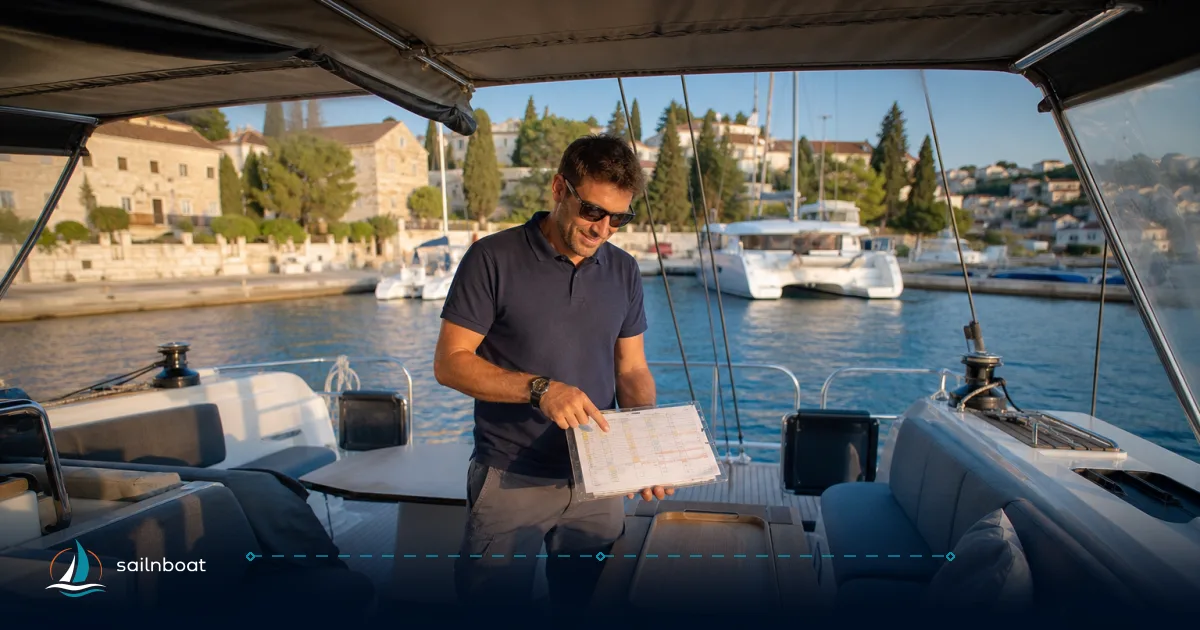
- Request the exact inventory/condition report you will sign at handover and the boat’s handover checklist.
- Check local navigation notes, seasonal notices to mariners and any port restrictions for your itinerary.
- Book first and last night marina berths — doing so saves time and usually money.
At handover — inspect, photograph, clarify
- Walk the boat with the base representative and photograph every area: hull, prop, rudder, rigging, sails, deck fittings, upholstery and inventory list. Make the representative note any pre‑existing damage.
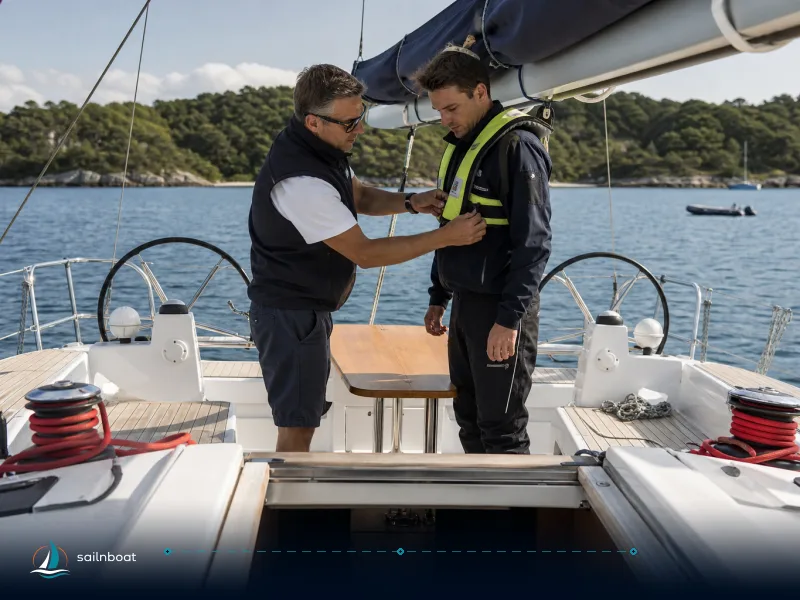
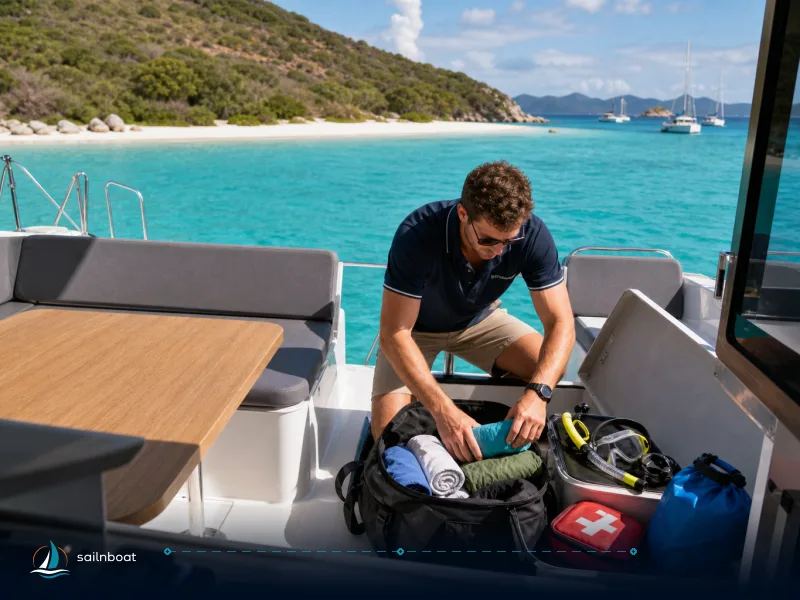
- Confirm how to use the safety equipment (EPIRB, liferaft, bilge pumps) and locate the first‑aid kit.
- Clarify the engine refueling procedure and where to top up fuel at return (you may be asked to return with the same fuel level).
- Agree on late‑return penalties and the process for reporting any small damages.
Start your booking with these priorities: confirm which licences the base accepts, insist on an itemised quote with VAT and APA shown, and secure deposit options (CDW or deposit insurance) if you want to reduce the credit‑card hold.
Final note — the single most common failure in Mediterranean charters is administrative: arriving without the right paperwork or with insufficient card limit for the deposit. Resolve those two before you leave home and you will avoid most check‑in headaches.
Start planning your Mediterranean yacht charter today. Choose the base that matches the wind, islands and paperwork you want; confirm licence and VHF acceptance in writing; budget VAT, marina nights, APA and a deposit hold; and arrive at handover with originals, photos and a clear checklist. Safe cruising.
Frequently Asked Questions
Standard VAT varies by country: Italy ~22%, France ~20%, Spain ~21%; several charter destinations apply reduced or special VAT rules for accommodation-on-board (Croatia commonly applies a reduced VAT band around 13% on accommodation; Greece operators often quote a discounted 12% rate under specific conditions). Montenegro uses a standard PDV of 21% but some charter businesses operate under special arrangements—expect variation by operator and itinerary.
There is no single EU licence: many companies accept the ICC or RYA certificates, but acceptance varies by country and company—Croatia commonly asks for a recognised skipper licence plus a VHF/SRC; Greece often accepts RYA or ICC but may require a qualified co‑skipper or operator proof; always check the operator’s policy before booking.
Bareboat gives you full control and lower crew costs but requires a recognised skipper and usually a VHF certificate; skippered charters include a captain (and often host/crew), add daily crew costs but remove licensing risk and provide local knowledge.
Marina fees in the Med vary widely—budget roughly €30–€250 per night depending on country, season and marina; marine diesel commonly ranges approx €1–€2+/L at port pumps; provisioning for four people for a week typically runs €200–€600 depending on choices.
Shoulder seasons (May–June and September–October) give milder winds, fewer crowds and lower prices; high summer is reliable for warmth but expect stronger winds in the Aegean (the Meltemi from June–September) and higher marina rates.
Charterers should ensure the yacht has third‑party liability and hull insurance; review the charter contract for the security deposit/excess and consider deposit‑insurance or a collision damage waiver (CDW) to reduce your exposed hold.
Confirm licence and VHF acceptance, check exact VAT treatment in the quote, clarify what's included (marina nights, outboard fuel, linens), budget APA and deposit, buy deposit insurance if desired, and inspect and photograph the boat at handover.
Written by
Sailnboat Editorial
The Sailnboat editorial desk covers yacht and boat chartering worldwide — routes, bases, seasons, boat types, paperwork and the practical costs that decide a trip. We are a charter marketplace, not a boat owner or a local agency: what we sell is judgement and support, so our guides are written to help you make a decision, not to sell you a specific boat. Every guide is checked against live operator and marina data before it goes out.
Fact-checked against live operator and marina data, and published under our editorial standards. Last reviewed: .