Maldives Atoll Hopping: Planning Your Private Yacht Charter
A practical, decision-ready guide to maldives atoll hopping by private yacht: when to go, two sample itineraries (7 and 10–14 days), provisioning and bunkering realities, dive crew needs, and transfer options from Velana International Airport (MLE).

The fastest, most practical answer: maldives atoll hopping is best planned for the dry season (typically December–April, with November and April as transition months) with longer, 10–14 day charters if you want to reach Baa (Hanifaru) and the remote thila dive sites, while one‑week trips are ideal for the central atolls around Malé and Ari.
Optimal Seasonality for Atoll Hopping
Best Months to Sail
-
Weather window: the Maldives has two broad monsoon patterns. The drier, calmer period is during the northeast (or “dry”) monsoon and transitional months — typically December through April, with November and April as transition months — and this is the season most charter operators prefer for atoll‑hopping itineraries. The southwest (wet) monsoon runs approximately mid‑May to November and brings more frequent squalls and stronger winds. Plan your trip for December–April for the most predictable sea state, with November and April as transitional periods.
-
Wildlife trade‑off: if your goal is manta encounters in Baa Atoll (Hanifaru Bay), that hotspot is busiest during the southwest monsoon (roughly May–November), with the best odds from June–October — so there is a trade‑off between calmer cruising and peak manta season. Schedule longer trips or accept some rougher passages if Hanifaru is a priority.
-
Sea conditions and planning: during the wet monsoon, speedboat transfers across channels can take longer or be postponed; seaplane and domestic flight schedules are also more likely to shift for weather. If you travel in May–November, build extra buffer days into the itinerary for transfers and at‑sea transit.
Sample Itineraries for Your Yacht Charter
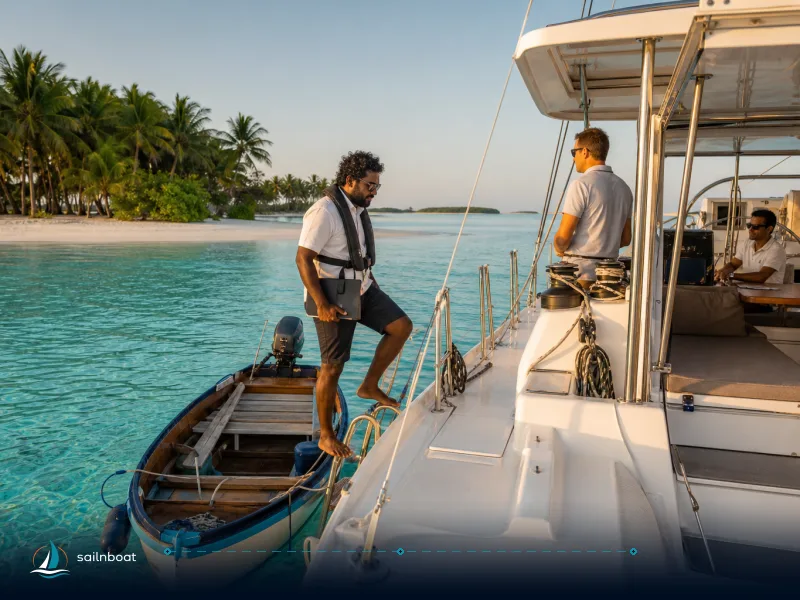
Below are two operationally realistic itineraries written for a crewed private yacht starting and ending at the Malé / Hulhumalé area — the standard embarkation zone for most charters. Distances are shown as approximate nautical miles (nm); estimated transit times use typical cruising speeds (see notes). Where a site is in a protected area (Hanifaru), access restrictions or snorkel‑only rules are called out.
Cruising speed assumptions for planning (typical ranges): sailing yachts ~6–8 knots, catamarans ~8–12 knots, crewed motor yachts ~12–18 knots — use your boat’s published cruise speed to convert the listed distance to transit time.
One‑Week Itinerary (7 days) — Central loop (North Malé → North Ari → South Malé)
This loop keeps daily passages short and focuses on high‑value dive/snorkel sites inside the central atolls.
| Day | Plan | Approx. transit (nm) | Notes |
|---|---|---|---|
| Day 1 | Embark Hulhumalé / Malé; short hop to North Malé reefs and a first snorkel | 5–12 nm | Quick check of systems, short snorkel to get gear working. |
| Day 2 | North Malé to Rasdhoo / North Ari (Maaya Thila or nearby thilas) | 30–35 nm | Maaya Thila is a classic thila/dive site with night‑dive potential; currents can be strong — use a competent dive guide. |
| Day 3 | Full day diving/snorkeling in North Ari (Maaya Thila, Fish Head, Madivaru) | 0–10 nm | Multiple dives; tender used for site access. |
| Day 4 | North Ari to South Ari (manta points / whale shark chances depending on season) | 15–30 nm | If manta season is in effect, plan for early morning dives. |
| Day 5 | South Ari to Vaavu or South Malé lagoon — sandbanks and local island visit | 20–30 nm | Good sheltered anchorages for afternoon beach walks and lagoon activities. |
| Day 6 | South Malé snorkeling, guest‑island visits, short sail back toward Hulhumalé | 15–25 nm | Re‑provision if needed at Malé/Hulhumalé. |
| Day 7 | Return and disembark Hulhumalé / Malé | 5–15 nm | Allow time for customs/clearance and scheduled transfer to MLE if required. |
Why this loop: it keeps the longest open‑water leg below a few hours for typical charter speeds, concentrates dive value, and leaves time for weather buffers and night diving where conditions permit. Use local day‑by‑day decisions to move farther afield if weather allows.
10–14 Day Itinerary — Extended atoll hopping (Malé → Ari → Baa → Rasdhoo → Malé)
This longer itinerary gives you the option to reach Baa (Hanifaru) for mantas, then return via Ari and Rasdhoo for thilas and channels.
| Day range | Plan | Approx. transit (nm) | Notes |
|---|---|---|---|
| Day 1 | Embark Malé/Hulhumalé; short checks and overnight near Hulhumalé | 0–10 nm | |
| Day 2–4 | Cruise to North Ari (Rasdhoo / Maaya Thila), explore thilas and channels; multiple dive days | 30–40 nm each major leg | Rasdhoo is ~58 km (≈31 nm) from Malé — a useful waypoint. |
| Day 5–7 | Head north toward Baa Atoll (Dharavandhoo / Hanifaru area) — can be a long transit; allow full day to reposition | ~60+ nm (Malé → Hanifaru ≈117 km / 63 nm) | Malé → Hanifaru is ~117 km (~63 nm) — plan fuel and an overnight reposition if you are on a sailing yacht. Hanifaru is snorkel‑only and busiest May–Nov. |
| Day 8–10 | Spend 2–3 days in Baa atoll: Dharavandhoo, local reefs, Hanifaru snorkel windows (timed to tide) | Local hops | Hanifaru access is regulated; coordinate times with local authorities and guides. |
| Day 11–13 | Return south via Ari for a final series of thila dives and channels; overnight anchorages in protected lagoons | 20–40 nm per transit | |
| Day 14 | Return to Malé / Hulhumalé and disembark | 0–40 nm | Allow extra time for customs and airport departures. |
Operational notes for longer routes:
- Transits to Baa are real ocean passages compared with short central atoll hops; allow extra fuel, crew rest rotations and an alternative plan if the weather deteriorates.
- Hanifaru Bay is a protected site within the Baa Atoll biosphere reserve and is snorkel‑only; plan snorkel windows to coincide with tidal feeding events and the park manager’s schedule.
Provisioning and Bunkering Considerations
Food and Supplies
-
Best provisioning hub: Malé (and the Hulhumalé area) is where you’ll get the widest choice of fresh produce, fish and groceries; the Malé local market supplies fresh fruit, vegetables and the day’s catch. Expect to top up perishable stores before a long reposition to the outer atolls. Plan your main provisioning in Malé or the Hulhumalé supermarkets on embark day.
-
Pre‑ordering: many charter teams ask you to submit a provisioning list in advance (48–72 hours) so the base can pre‑buy and load. If you need specialist ingredients or imported brands, order them before arrival; local availability varies island‑to‑island. Supermarket choice and opening hours are concentrated around Malé and Hulhumalé.
-
Fresh fish & local purchases: fish markets in Malé are an inexpensive, reliable source of day‑fresh catch — useful if you want to eat local seafood and control galley costs.
Fuel, Water and Mooring Fees
-
Bunkering: the Maldives has an active commercial bunkering sector (Thilafushi, Thilafushi terminal and other suppliers) that delivers marine diesel across the atolls — major suppliers operate barge/bunker services and scheduled deliveries. Bunkering is available but must be booked in advance; barge deliveries to anchorage or marina are the normal method. Plan fuel orders through your charter manager or appointed local supplier.
-
Typical pattern: most charters refuel at Malé/Hulhumalé or use scheduled bunker deliveries from Thilafushi or nearby terminals before long reposition transits. If you plan back‑to‑back long legs (e.g., Malé → Baa → northwards), schedule a full bunker before leaving the central atolls.
-
Mooring/berth fees: Malé and Hulhumalé offer yacht berths and pontoons (the Hulhumalé berth area is the common embarkation point), but fees vary by berth, season and vessel size; many charter companies include a standard embark/disembark berth in the charter price, while additional overnight marina stays or superyacht berths are charged separately. Confirm exact fees with the base.
-
Fresh water: water bunkering (barge delivery) is commonly available through the ports authority and private suppliers; schedule deliveries rather than relying on ad hoc availability on remote islands.
Crew Requirements for Diving and Snorkeling
Diving Support
-
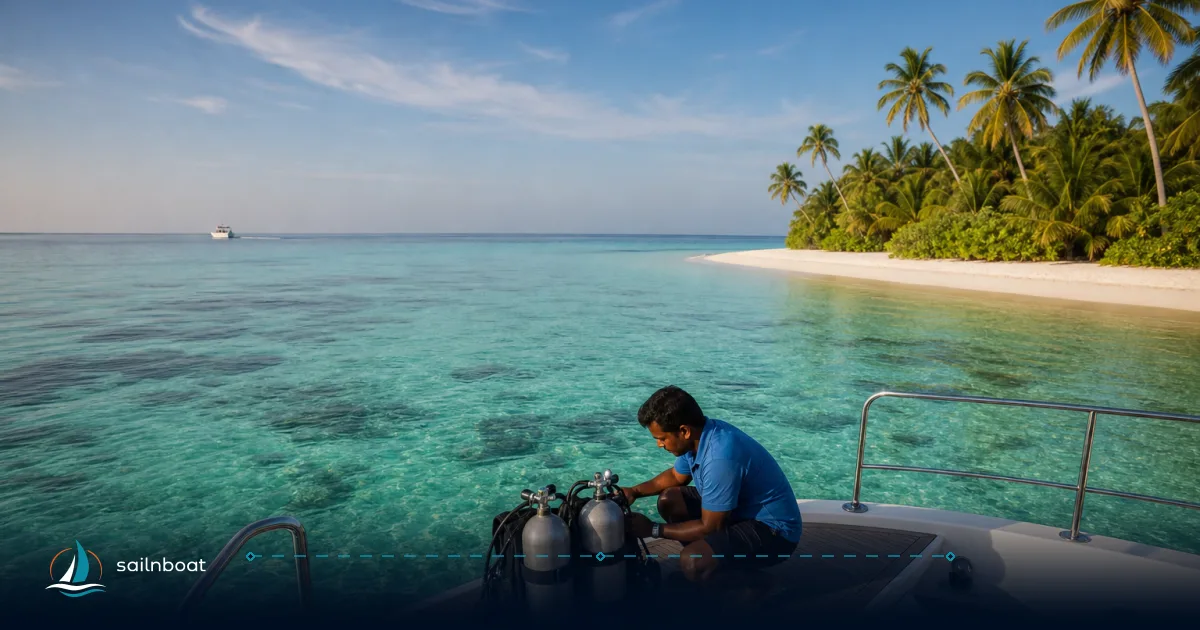
Staffing: for regular scuba you should plan to have at least one PADI/SSI‑certified divemaster or instructor aboard (or hired locally) plus a dive tender and adequate space for tanks and weights. Many crewed charters either include a dive team as an optional extra or work with local dive operators to supply staff, cylinders and a compressor. Confirm what is included in the charter contract (tanks, weights, nitrox, guided dives).
-
Equipment & logistics: some liveaboard‑style yachts come fully set up for diving with compressors, storage for 12‑litre tanks and an inventory of regulators and BCDs; smaller luxury yachts may rely on local dive centres for equipment rental and guided dives. If you need specific equipment sizes or nitrox fills, request that when you book.
-
Marine protected areas: Hanifaru Bay (Baa Atoll) is managed as a protected area with strict rules — it is snorkel‑only and access is controlled; diving is not allowed inside the bay. Your dive team or local guide will know the time windows and approach procedures. Plan the snorkel trip as a guided shore/tender operation with park fees or permit handling included.
Snorkeling Guidance
-
Local guides add value: in remote atolls local guides are especially helpful for reading currents and timing tidal feeding events (manta and whale‑shark gatherings). They also handle protected‑area procedures. Expect to hire a local guide per trip or for specific sites — many operators bundle this into an excursion cost.
-
Safety protocols: use reef‑safe sunscreen, maintain safe distance from rays and sharks, and brief guests on current management and tender procedures before any snorkel. Your captain and dive leader will insist on floatation/safety monitors for larger groups.
Transfer Logistics from Velana International Airport (MLE)
Transportation Options
-
Short hops (Malé / Hulhumalé): Velana International Airport (MLE) sits on Hulhulé island next to Malé and connects to Hulhumalé by the Sinamalé Bridge; road transfer to Hulhumalé is typically 10–15 minutes, and tender or speedboat transfers to Malé and nearby yacht berths take a few minutes to under an hour depending on your exact landing point. For most central‑atoll embarkations the practical options are taxi/road to Hulhumalé then a short tender or road transfer to the yacht.
-
Speedboat: speedboat transfers are the normal choice for nearby atolls (North/South Malé, Rasdhoo) — short runs are typically 30–90 minutes depending on distance and conditions. Schedules can be shared or private; if yours is a late international arrival, overnight in Hulhumalé rather than risking a late speedboat is prudent.
-
Seaplane and domestic flights: seaplane is the fastest practical way to reach outer atolls quickly — many seaplane sectors to central and nearby atolls run 20–40 minutes; Baa Atoll / Hanifaru and some Ari Atoll connections commonly use seaplane or a domestic flight plus a short speedboat. Seaplane providers run scheduled shared transfers and private charters; note tight luggage limits and weather‑dependent operations.
Common Boarding Points
-
Hulhumalé / Malé yacht berths: Hulhumalé and Malé Yacht Harbour are the standard embarkation and clearance points for crewed charters — they sit closest to the airport and are convenient for last‑minute provisioning. Confirm your embarkation quay (some berths are stern‑to pontoons, others are free anchorages with tender pick‑up).
-
Ari and Rasdhoo region: many charters position at Rasdhoo/North Ari when the itinerary focuses on thilas and night dives. Rasdhoo is roughly 58 km (≈31 nm) west of Malé and is a practical first waypoint.
-
Baa (Hanifaru) access: to reach Hanifaru you typically stage through Dharavandhoo (domestic flight or speedboat) or use a seaplane; the distance from Malé to Hanifaru is about 117 km (≈63 nm), so expect a multi‑hour reposition if you travel by sea.
Final operational checklist before you book
- Confirm the charter operator’s standard embark/disembark quay in Malé/Hulhumalé and the included transfer type (tender, speedboat, seaplane).
- Submit a provisioning list 48–72 hours before embark if you need specific items.
- Schedule any bunker/water barge deliveries before leaving the central atolls; long reposition legs to Baa require a full fuel plan.
- Book dive staff or confirm a local dive centre for tanks, nitrox, and guided dives; plan snorkel excursions in protected areas with licensed guides.
Start planning If Hanifaru and manta season are fixed priorities, treat that as the itinerary anchor and arrange your charter dates around the season (May–November) and accept rougher transits; otherwise favour November–April for calmer seas and easier transfers from MLE. Once you pick dates and an embarkation base (Hulhumalé / Malé is the practical default), your broker should firm up the provisioning list, dive staffing and bunkering windows — those logistics are where time and money are actually spent on a Maldives atoll‑hopping charter.
Start planning your Maldives atoll hopping adventure today — choose your season, confirm embarkation at Hulhumalé/Malé, and build a 7‑ or 10–14 day plan around either central‑atoll diving or the Baa manta window.
Frequently Asked Questions
The most reliably dry, calm weather for cruising is during the northeast (dry) monsoon and transitional months — broadly November through April; note that the southwest monsoon (approx. mid‑May to November) brings wetter weather and stronger winds, but it is also when manta activity peaks in some atolls (Hanifaru/Baa).
Yes — a focused one‑week circuit keeps you in the central atolls (North Malé → North Ari → South Malé), while a 10–14 day route extends north to Baa (Hanifaru/Dharavandhoo) and Rasdhoo/Aris for varied diving and manta encounters; sample day‑by‑day legs and likely transit times are included in the article below.
Provision in Malé/Hulhumalé (local produce market and supermarkets); fuel and water bunkering are available in the central islands and through commercial bunker suppliers operating from Thilafushi and Ihavandhippolhu — but require scheduling and sometimes barge delivery.
Hire at least one certified dive guide/instructor and a dedicated dive tender if you plan regular scuba; many charter operators include a dive team or can arrange PADI/SSI‑certified staff and tanks, while snorkel trips often use local guides who know currents and protected‑area rules (Hanifaru is snorkel‑only).
Short transfers to Malé/Hulhumalé take 10–30 minutes by road or speedboat; for outer atolls you will use seaplane (shared or private) or domestic flight plus speedboat — seaplane sectors commonly run 20–40 minutes to central atolls and longer to Baa. Confirm provider schedules and baggage limits when you book.
Written by
Sailnboat Editorial
The Sailnboat editorial desk covers yacht and boat chartering worldwide — routes, bases, seasons, boat types, paperwork and the practical costs that decide a trip. We are a charter marketplace, not a boat owner or a local agency: what we sell is judgement and support, so our guides are written to help you make a decision, not to sell you a specific boat. Every guide is checked against live operator and marina data before it goes out.
Fact-checked against live operator and marina data, and published under our editorial standards. Last reviewed: .