Noise at Anchor: Understanding Sources and Solutions
Practical guidance for charterers who want quiet nights: what makes noise at anchor, how different boats transmit it, and the exact questions to ask your charter base.


Noise at anchor is usually equipment noise, not wind or waves — and that matters because you can ask about it before you book. If you want quiet nights, understand which systems (generator, A/C compressor, watermaker, inverter fans, bilge pumps, exhaust) create the sound, how hull layout changes how you perceive it, and which operational choices or modifications actually stop it.
Common Noise Sources at Anchor
Start by treating each item as a separate sound source with different behaviour: some make a constant low-frequency hum (diesel gensets, exhausts), others a high-pitched whine or intermittent clack (inverter fans, pumps). Below are the typical equipment types you’ll encounter and what to expect in practical terms.
Types of Noisy Equipment
-
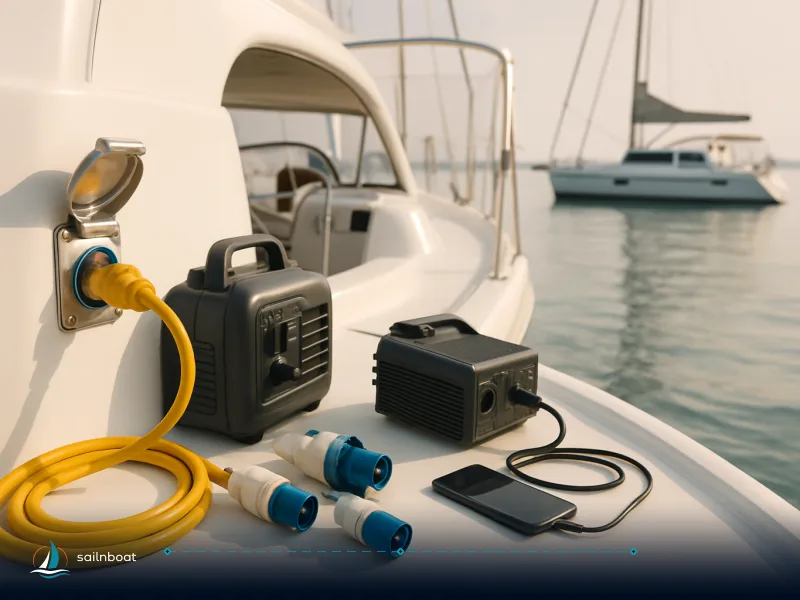
Generators — Small inverter or portable petrol generators can be quiet by design; typical marine diesel gensets commonly measure in the ballpark of ~60–75 dB at a few metres under normal running conditions, with quieter dedicated marine designs sometimes specified at low-60s dB at 7 m and less‑quiet, unshielded units far louder close to the engine. Measurement depends on distance, enclosure, mounting and load.
-
Air‑conditioning compressors — Split or compact marine A/C compressors often put airborne noise into bilge or machinery spaces; the cabin (indoor) sides of modern marine split units commonly register in the low‑to‑mid 40s dB range at the passenger ear point, while the compressor/pack in its locker will be louder to anyone near it.
-
Watermakers — High‑pressure pumps on conventional (older) watermakers can be loud; manufacturer and technical guides commonly report conventional units can run in the high‑60s to mid‑80s dB range at close distance, while newer reverse‑osmosis designs and purpose-built 'quiet' models are typically around 8–12 dB lower. Expect the unit noise to be localised and sharply reduced by an acoustic box.
-
Inverters and battery chargers — The power electronics themselves are silent, but forced‑air cooling fans, transformers or switching components can make a steady hum or whine; measured fan/inverter noise values at close distance are often reported in the 50–60 dB range and fall off quickly with distance. Onboard, inverter fans can be the dominant overnight sound if batteries are charging or under load.
-
Bilge and service pumps — Small DC bilge and freshwater pumps are intermittent but noticeable because of vibration transfer to the hull; well‑mounted modern pumps often run below about 50–60 dB at close proximity, but high‑speed or poorly mounted units can be louder and more intrusive. Manufacturer specs vary by model.
-
Exhausts and engine ventilation — Exhaust risers with poor water‑injection or missing mufflers transmit tonal exhaust notes; sound level varies widely with engine size, mufflering and whether the engine is enclosed — the proximity of the exhaust outlet to the cockpit or transom determines how intrusive the sound will be.
Table — Equipment and typical close-distance ranges (practical, comparative)
| Equipment | Typical close-range sound (representative) | How it behaves |
|---|---|---|
| Small inverter/petrol genset | ~50–60 dB at a few metres (quiet models) | Continuous hum while running; higher pitch on petrol inverters |
| Marine diesel genset (standard) | ~60–75 dB at several metres (varies with load) | Low frequency, transmits through structure if poorly mounted. |
| A/C compressor (indoor effect) | Indoor: low‑40s dB; compressor locker louder | Intermittent compressor on‑off cycles; insulation reduces cabin impact. |
| Watermaker pump | High‑60s to mid‑80s dB (older units) | Short bursts while producing water; very noticeable if run overnight. |
| Inverter / charger fans | ~50–60 dB at close distance | Continuous fan noise under charging/ heavy inverter load. |
| Bilge & freshwater pumps | ~40–60 dB typical (model dependent) | Pulsed/ intermittent noise; mounts and hoses determine vibration. |
(These ranges are representative — manufacturer specs and measurement distance matter. If a spec sheet shows dB at 1 m or 7 m, note which.)
Noise Transmission Across Boat Types
How the boat is built and where equipment sits matters more than the absolute dB number. Two identical machines can feel very different depending on hull structure, mounting and the living‑space layout.
Catamarans vs. Monohulls vs. Powerboats
-
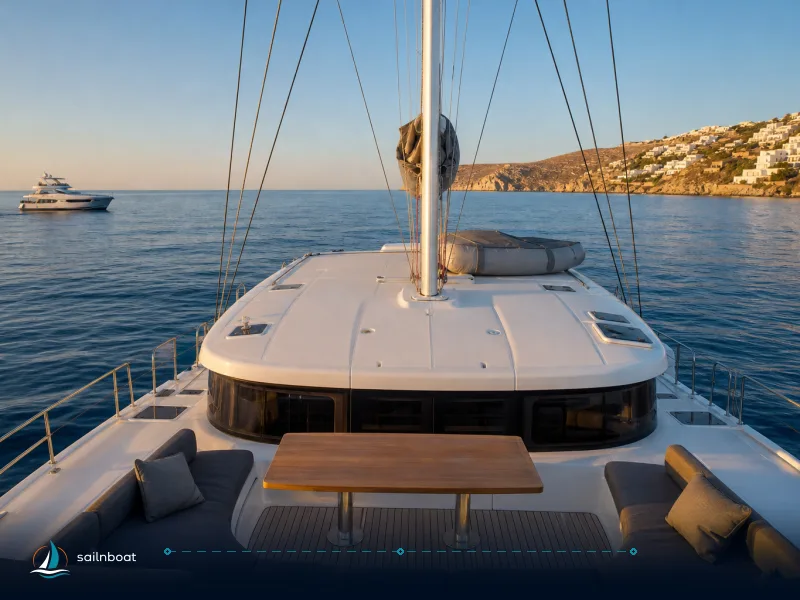
Catamarans — Engines, gensets and some service equipment are usually located in separate hull engine rooms or dedicated compartments in each hull; the bridgedeck saloon therefore often benefits from physical separation and a degree of acoustic isolation from hull machinery. That layout can reduce airborne noise in the central living area, though structure‑borne vibration can still transmit through stringers and steps if mounts are poor. Manufacturer specifications and catamaran technical sheets commonly show engine/generator rooms inboard/on the hull rather than beneath the saloon.
-
Monohulls — On many cruising monohulls, the engine sits under the cockpit/companionway (behind the saloon bulkhead). That proximity to the central living space and companionway often makes engine noise and vibrational transmission more immediately noticeable in the saloon and sleeping cabins. Listings, owner manuals and service guides routinely describe engine access under companionway steps.
-
Powerboats (planing or semi-displacement) — Layouts vary widely. Some motorcats and larger powerboats have separated mechanical rooms; smaller planing boats may produce more hull slap or propulsion noise. In general, power propulsion running at idle can create a continuous background that is tougher to eliminate than a single isolated generator in a well‑insulated locker.
Trade‑off to state plainly: catamaran separation reduces saloon noise but doubles the number of machinery spaces to maintain; a monohull’s single engine room simplifies systems but can put that noise closer to your cabins.
Assessing Noise Levels Before Chartering
You can avoid most surprises by asking targeted, operational questions and by interpreting the answers.
Key Questions to Ask
Use this checklist with the base — ask for succinct answers and, if possible, for decibel or technical specs in writing:
- What are the vessel’s "silent hours" policy (if any) and how strictly is it enforced?
- Does the generator have a low‑noise or economy mode, and can it be scheduled/timed? (Some gensets have automatic timers or economy settings.)
- Where is the generator and the main water‑pump/watermaker located relative to sleeping cabins and the saloon? (Hull engine room, aft lazarette, under cockpit, etc.)
- Is the genset run inside an acoustic enclosure or on vibration‑damping mounts? (Ask for brand/model of mounts or enclosure where fitted.)
- What battery capacity and inverter size are onboard, and how long will batteries sustain overnight loads (lights, refrigeration, small A/C) without the genset? Request amp‑hours and usable % SOC assumptions.
- Will the watermaker or air‑con run overnight by default or only when requested?
- Are inverter or charger fans audible inside cabins when charging? (Inverter/charger noise often decides nighttime comfort more than a rarely-run genset.)
- Are there recent noise‑reduction upgrades (new mounts, sound shields, insulated lockers)? When were they fitted?
- Can the base show you the genset running at handover so you can assess noise in person before committing?
- If quiet nights are mission‑critical, can they advise a specific boat in their fleet that is the quietest?
How to interpret answers:
- “Yes, there’s a sound shield and rubber mounts” = good.
- “Batteries can sustain lights and fridge for X hours” = ask for the actual amp‑hour figure and typical refrigerator draw.
- “We don’t allow A/C overnight” = useful policy to reduce noise but check enforcement and guest comfort trade‑offs.
Reducing Generator Noise During Your Charter
Operational choices and small retrofits make a big difference. These are techniques and their realistic payoff.
Tips for Quieter Operation
- Time the genset for daytime charging — run 0900–1700 if possible so any necessary runs happen while you’re off‑boat or awake. Daytime operation reduces perceived annoyance even if the dB is unchanged.
- Prefer running high‑noise devices (watermaker, heavy batteries, shore‑power style battery charging) while away from the boat or during daytime. Watermakers especially should be scheduled for daytime unless the unit and enclosure are explicitly quiet.
- Confirm the genset has a proper acoustic enclosure and resilient mounts — a sound shield and anti‑vibration mount system typically reduce transmitted structure‑borne noise more than simple barrier insulation. Specialist marine noise control firms and OEMs emphasise mounts + enclosure together for best effect.
- Check exhaust muffler arrangement and water injection riser — a noisy exhaust outlet near the transom or cockpit is often the most intrusive single source; a properly routed and water‑cooled exhaust with a good muffler helps.
- Ask if the base can supress inverter fan noise (some inverters have quieter fan profiles or can be set to temperature‑controlled fan curves).
- If permitted, fit soft‑mount isolation for portable pumps or request the base to service a noisy pump — replacing an old pump or remounting it can remove a persistent tick or hum.
Safety note: Never disable engine or generator safety systems for noise reasons (e.g., ventilation blowers, fire dampers).
Alternative Power Options to Minimize Noise
If silent anchor nights are a top priority, look for boats with deliberate low‑noise power architectures.
Exploring Alternative Solutions
- Larger battery banks + inverter — With enough battery capacity sized to your overnight load (fridge, lighting, nav instruments), you can run silently through the night and only start the genset to recharge during daylight; ask the base for usable amp‑hours and a realistic runtime under the expected loads. Many modern charter yachts offer this as an option. (Battery size and inverter efficiency determine actual night hours.)
- Solar panels — Solar reduces genset runtime and is silent; panels themselves are silent, though inverters and combiner boxes can produce fan or transformer hum. Inverter noise is usually local and falls with distance.
- Hybrid/DC gensets / quiet DC gensets — Some manufacturers build low‑noise DC gensets or encapsulated marine gensets explicitly quoted in the mid‑50s dB at 7 m under controlled conditions; those are a good option where battery recharge must be occasional but quiet. Ask for the maker’s dB(A) at 7 m spec sheet.
- Complete hybrid systems — On newer yachts the genset only runs for long periods when batteries need bulk recharge; the vessel’s control system handles quiet charging windows. These platforms can be the quietest, but they are still subject to installation quality and battery sizing.
Understanding Typical Noise Levels
A short primer on interpreting dB numbers so you can judge a spec sheet or a base’s answer.
Noise Level Ranges
- Small quiet inverter generators / well‑enclosed modern marine gensets: mid‑50s dB measured at 7 m in manufacturer literature.
- Typical compact marine diesel genset: often quoted in the mid‑60s to low‑70s dB range at specified distances (7 m or similar) depending on load and enclosure; running at close quarters near the machine or in the engine room will be significantly louder.
- Inverter/charger fans and transformers: measured close up they are often reported in the 50–60 dB range; they drop quickly with distance but can be audible overnight if located under a berth or locker.
- Watermaker pumps: older high‑pressure pump assemblies often read into the 70s–80s dB at close distance; purpose‑built low‑noise models are notably quieter.
- Bilge and small service pumps: wide range; well‑mounted modern units can be under ~50 dB at close range but aggressive, high‑rpm pumps can be louder.
How to use these numbers:
- Always note the measurement distance (1 m, 3 ft, 7 m are common). A spec quoting dB at 1 m will read very high compared with a 7 m figure.
- The perceived annoyance depends on frequency — low‑frequency hums (diesel genset) travel further and feel louder at night than the same dB of high‑frequency noise.
- Ask the charter base for manufacturer sound‑pressure figures and the measurement distance; prefer quoted figures at 7 m or manufacturer standard ISO test conditions.
Practical checklist before you book (printable)
- Confirm silent hours and enforcement.
- Ask if A/C or watermaker runs overnight by default.
- Request generator model + manufacturer dB spec (and at what distance).
- Where is the genset located (aft lazarette, hull engine room, under cockpit, etc.)?
- Are vibration mounts and an acoustic enclosure fitted?
- Battery amp‑hours and usable percentage (how many hours off‑genset for your likely loads).
- Inverter model and whether its fan runs while charging overnight.
- Can you inspect the boat with the genset and inverter running at handover?
- Which unit in the fleet is the quietest and why?
Final trade-offs and the simplest rule
If you need guaranteed quiet nights, prioritise (in order): battery capacity sized to your overnight load + solar, a documented quiet‑genset specification (dB at 7 m) with an acoustic enclosure, and a layout where major machinery is physically separated from sleeping spaces. If you must accept a genset, arrange for daytime charging and confirm a quiet‑mode or timer — that combination removes most real‑world night‑time disturbance.
Contact your charter base to request the genset/inverter model specs and battery amp‑hours before you book — the few minutes it takes to ask saves nights of bad sleep.
Frequently Asked Questions
Generators, air-conditioning compressors, watermakers, inverters and their cooling fans, bilge and service pumps, and exhaust or engine ventilation systems are the common culprits; each produces different frequency content and perceived loudness.
Catamarans often place engines/generators inside the hulls away from the bridgedeck living area, which can reduce airborne noise in the saloon; monohulls commonly house the engine under the companionway, which can transmit vibration into central living spaces; powerboats vary with engine-room layout and tend to have louder propulsion noise if engines run at idle while at anchor.
Ask about silent hours, generator low‑noise modes or automatic timers, generator location relative to cabins, battery capacity and inverter type, whether watermaker or A/C runs overnight, and what onboard noise‑mitigation (sound shields, mounts) is fitted.
Use the genset by day for charging, request sound shields and vibration mounts, run high loads (cook, watermaker) while away from the boat, switch to battery power overnight when capacity allows, or choose a vessel with a quieter DC/inverter genset.
Yes: larger battery banks with an inverter, solar charging to reduce genset runtime, hybrid systems and some modern DC gensets designed to run quietly are effective alternatives to continuous noisy generators.
Written by
Sailnboat Editorial
The Sailnboat editorial desk covers yacht and boat chartering worldwide — routes, bases, seasons, boat types, paperwork and the practical costs that decide a trip. We are a charter marketplace, not a boat owner or a local agency: what we sell is judgement and support, so our guides are written to help you make a decision, not to sell you a specific boat. Every guide is checked against live operator and marina data before it goes out.
Fact-checked against live operator and marina data, and published under our editorial standards. Last reviewed: .