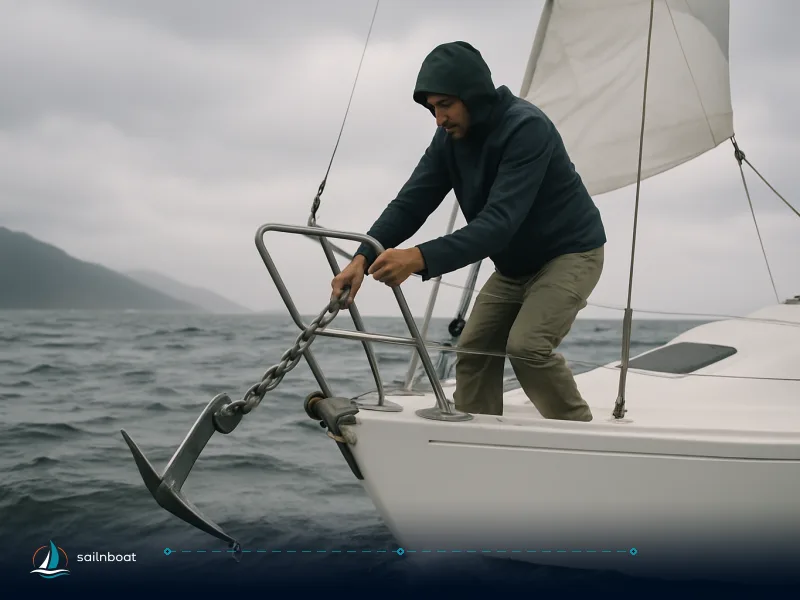
Understanding Anchoring Gear: A Complete Guide for Sailors
A practical, decision-focused guide to anchors, chain types, ground tackle and scope so you can choose and use anchoring gear with confidence.

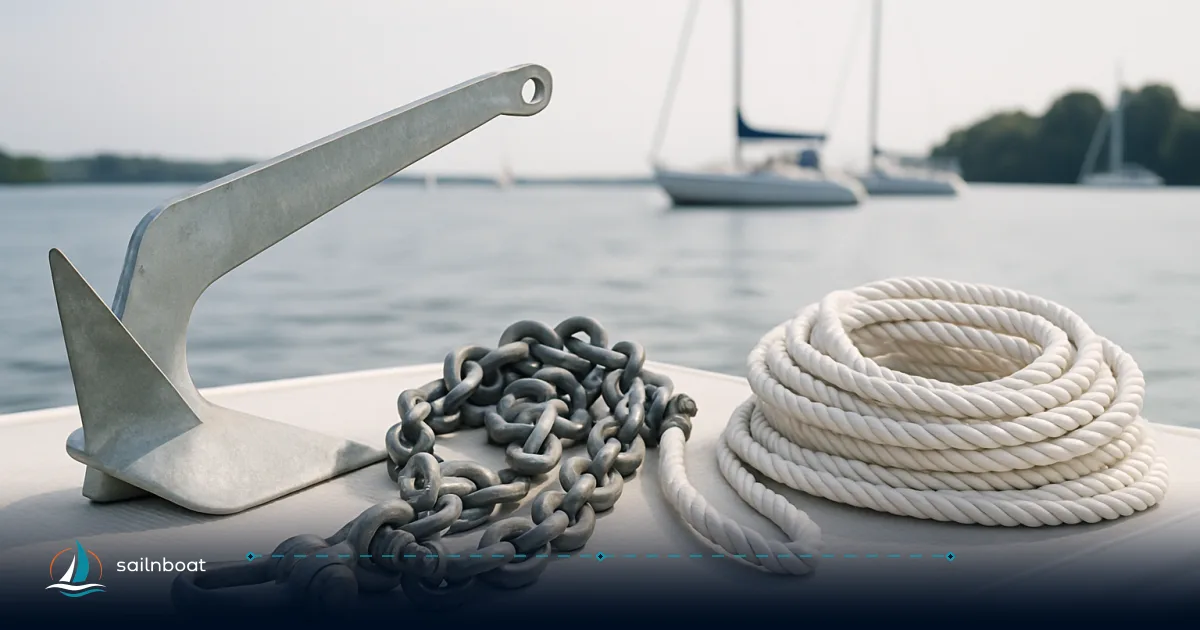
Anchoring gear decides whether you sleep through the night or get woken to reset in the dark: pick the right anchor shape and size, match the chain and rode, and use correct scope and technique for the seabed and conditions.
Types of Anchors and Their Suitability
The modern anchor market groups designs into plow, fluke, claw, and scoop (or “roll‑bar / concave”) styles; each has predictable strengths and limits.
Common Anchor Types
-
Plow (CQR, Delta)
-
How they work: a plow-shaped blade drags and digs as the boat backs down. CQR is a hinged plow (helps reorient on the bottom); Delta is a fixed-plow self‑launching shape.
-
Best for: mixed sand, grass and some rocky bottoms; fits many existing bow rollers.
-
Trade-offs: slower to bury than modern scoops; CQR’s hinge can be maintenance‑sensitive.
-
Fluke / Pivoting‑fluke (Danforth, Fortress)
-
How they work: large flat flukes that bury deeply in soft sand and mud.
-
Best for: soft mud and clean sand; excellent holding-to-weight ratio for anchoring in calm to moderate conditions.
-
Trade-offs: poor in weed, kelp or rocky bottoms; some models are lightweight (useful as second/backup anchors).
-
Claw / Bruce
-
How they work: a curved “claw” form that tends to dig and re‑set quickly.
-
Best for: general-purpose use when you want a reliable one‑piece anchor that often resets after a pullout.
-
Trade-offs: not the absolute best holding per kg versus modern scoops; performance varies by manufacturer.
-
Modern scoops / roll‑bar (Rocna, Mantus, Manson, Spade)
-
How they work: concave blades and roll‑bars or geometry that force the anchor to the ideal burying attitude and bite quickly.
-
Best for: mixed bottoms and situations where fast, reliable setting and re‑setting are needed — they generally have the highest holding power for their weight.
-
Trade-offs: heavier for same stamped sizes, and you should verify fit with your bow roller/windlass.
-
Lightweight specialist (Fortress)
-
How they work: high‑strength aluminium‑magnesium alloys give excellent holding for low mass — useful as primary on many small cruisers or as a secondary.
-
Best for: sand and mud where a lightweight anchor reduces handling effort.
-
Trade-offs: less suitable in rock or dense weed, and they usually require some chain even on small boats.
Comparison table — quick at‑a‑glance (best use, pros, cons)
| Anchor | Best bottoms | Pros | Cons |
|---|---|---|---|
| Plow (CQR/Delta) | Mixed sand/grass, general use | Reliable in many conditions, fits rollers | Slower to set than scoops; CQR hinge needs inspection. |
| Fluke (Danforth/Fortress) | Sand, soft mud | High holding per kg; light and stowable | Poor in weed/rock; needs good burying area. |
| Claw (Bruce) | Mixed, rocky | Simple one‑piece, good reset | Variable holding vs modern scoops. |
| Scoop / Roll‑bar (Rocna/Mantus) | Mixed, weed, mud, sand | Fast set, excellent holding, resets | Heavier; check roller/windlass compatibility. |
(Choose an anchor type for the seabed you anchor in most often; many cruisers carry a specially light second anchor for stern ties or river work.)
Chain Types and Their Impact
Chain is not a passive detail — its material and mass directly affect holding through catenary and abrasion resistance.
Galvanized vs. Stainless Steel
- Galvanized steel chain
- Pros: lower cost, sacrificial zinc coating gives good life in marine use, commonly recommended as primary chain because it corrodes predictably.
- Cons: the zinc will erode and chain will eventually need replacement; inspect for pitting and worn links.
- Stainless steel chain (typically grade 316)
- Pros: superior cosmetic corrosion resistance and longevity in some installations; resists rusting and staining.
- Cons: much pricier, can suffer crevice/pitting corrosion in chloride environments (304 is worse than 316), and mixing stainless with galvanized hardware can create galvanic issues; stainless also offers less sacrificial protection to adjacent steel.
Why chain weight matters
- Heavier chain lowers the pull angle (catenary), keeping more load horizontal at the seabed and reducing breakout risk; for this operational reason, many cruisers fit at least a short length (20–30 ft) of chain even when using rope rode. In heavy weather or deep anchorages, all‑chain rodes are common on larger boats.
Chain diameter and matching gear
- Use a chain size that manufacturers recommend for your anchor (chain strength and diameter are paired to anchor size). For example, Rocna’s sizing tables list G40 chain diameters alongside anchor weights and vessel lengths. Match shackles, swivels and chain stoppers to the same working load/diameter.
Chain comparison table
| Property | Galvanized | Stainless (316) |
|---|---|---|
| Cost | Moderate–low | High |
| Corrosion behavior | Sacrificial zinc; predictable rusting | Resists surface rust; pitting possible if alloy wrong |
| Maintenance | Inspect for pitting, recoat/replace eventually | Less frequent surface maintenance but inspect for stress/pitting |
| When to choose | Standard for long lengths and heavy use | Small lengths, aesthetic installations, short rigs where cost acceptable |
| Galvanic note | OK with similar steels | Avoid mixing with galvanized without dielectric isolation. |
Ground Tackle Components Explained
A secure anchoring system is the sum of parts: anchor, chain, rope (rode), shackles, snubber/chain stopper, and the windlass.
- Anchor: choose shape, weight and a size rated by manufacturer tables for your boat and displacement. Modern manufacturers (Rocna, Lewmar) publish sizing charts keyed to vessel length/displacement.
- Chain: sized and specified (G40/G43 or equivalent) to match the anchor; heavier chain increases catenary and reduces upward pull.
- Rope (rode): commonly nylon for elasticity and shock absorption; rope is often used aft of the chain with a chain‑to‑rope splice or bow splice. Use line diameter appropriate for boat length and breaking loads.
- Shackles and swivels: use bow shackles sized to chain — a threaded pin (bolt‑type) with a seizing or safety wire is standard; match the working load limit to the chain. Avoid cheap cast shackles; replace corroded pins promptly.
- Snubber: a short nylon or nylon/rope chafe absorber used to take shock loads off the windlass and reduce jerking; always use a snubber on chain rodes before cleating the rode off.
- Chain stopper/chain hook: transfer load off the windlass and secure the rode under steady load; this protects windlass gears.
- Windlass: speeds deployment/retrieval; size to your maximum expected rode (chain diameter and length) and anchor weight, and fit with a proper gypsy that matches chain link profile. A windlass does not replace a snubber or stopper.
Practical checklist at handover or pre‑departure:
- Anchor, chain and rope splice condition
- Correct chain size for anchor per manufacturer table
- Shackles fitted and safety‑wired or secured
- Working snubber and chain stopper fitted
- Windlass circuit and manual backup tested
Selecting the Right Anchoring Gear
Sizing must be based on vessel length/displacement, typical bottoms and where you cruise. Manufacturer charts are the baseline — size up for heavy displacement or exposed anchorages.
Anchor sizing — practical guidance for small cruisers
- Manufacturer guidance (examples): Rocna and Lewmar publish size charts showing typical anchor weights and the matching chain diameter for vessel lengths; for many 30 ft (≈9 m) cruising sailboats Rocna lists a 9 kg size as a common recommendation, with chain diameters in the 6–8 mm range depending on model and expected loads. Lewmar and other makers show similar ranges but vary by design; when in doubt, choose the larger size for exposed anchorages or heavier displacement. These are manufacturer norms — final choice should consider your boat’s displacement and bow roller/windlass fit.
Sizing example (typical ranges — use maker tables)
| Boat length | Typical anchor weight (kg) | Typical chain (mm) |
|---|---|---|
| 20–25 ft | 4–7 kg | 6 mm |
| 25–30 ft | 6–10 kg | 6–7 mm |
| 30–35 ft | 9–15 kg | 7–8 mm |
| 35–40 ft | 12–25 kg | 8–10 mm |
Trade-offs to communicate to your crew or owner:
- Weight vs handling: heavier anchors offer more bite and resistance but are harder to stow and handle unless you have a windlass.
- Roller/windlass compatibility: many modern scoops are bulky; verify shank/head geometry against your roller and gypsy.
- Backup anchor: carry a secondary style (folding grapnel or lightweight fluke) sized for short-term use or stern‑ties.
Understanding Scope Ratios
Scope is the single most important variable you control after anchor choice. It sets the angle of pull on the anchor and therefore the likelihood of holding.
- Definitions and rules of thumb:
- Minimum (3:1): only for very short, calm stops or where chain angle is already low (e.g., very heavy chain and shallow water). Not a safe overnight figure in most anchorages.
- Standard (5:1): common recommendation for everyday anchoring where space is limited and conditions are moderate. Many charts and guides use 5:1 as a practical baseline.
- Overnight / storm (8–10:1): recommended when you will be away from the boat, in exposed anchorages, or when a weather system is forecast; BoatUS and industry guides suggest increasing scope to 8–10:1 in deteriorating conditions.
How to calculate: measure vertical distance from bow chock/roller to seabed (depth + bow height above water) and multiply by desired scope ratio. Remember to allow for tidal range when you set. BoatUS and other authorities show this calculation and recommend adding rode to account for tide changes.
Practical note: chain catenary plus a short chain length (20–30 ft) reduces the scope you must pay out in tight anchorages; however, never rely on that instead of adequate scope when weather deteriorates.
Best Practices for Anchoring Techniques
Good technique prevents 80% of problems.
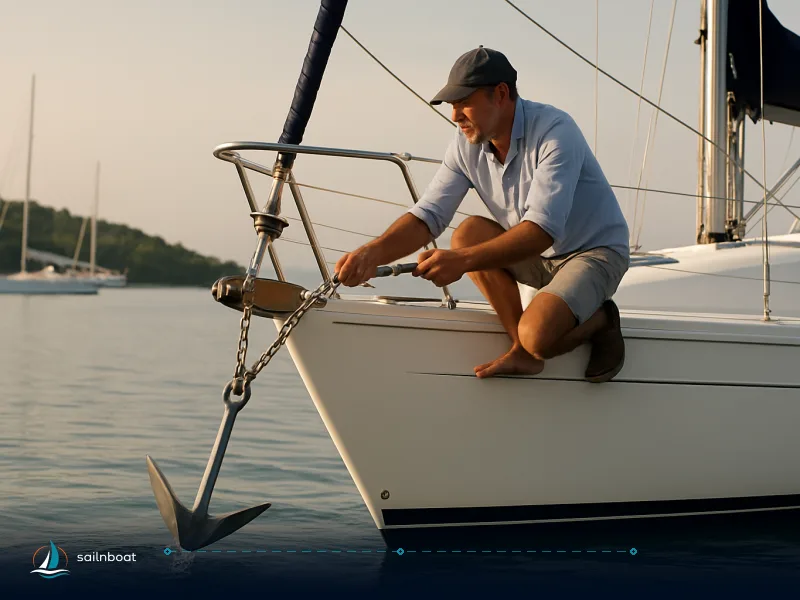
Setting the anchor (step-by-step)
- Approach with plan: choose a spot with holding appropriate to your anchor type and allowance for swing — consider tidal set and wind shifts. Use charts and depth sounder.
- Stop and lower smoothly: slowly reverse while lowering the anchor until it touches bottom; avoid dropping the anchor while moving fast (it can dig in wrong or flip).
- Pay out rode to desired scope: account for bow height and tidal range; let out chain first if you carry both.
- Back down to set: gently apply engine reverse (increasing gradually) to load the anchor and bury the fluke or plow. Hold for 1–3 minutes to bed it in; confirm no creep on GPS or by bearings. BoatUS and Lewmar instruct backing down to verify a solid set.
- Transfer load to snubber/chain stopper: secure the rode with a snubber then cleat off; do not leave the windlass as the primary load carrier.
Retrieving the anchor (step-by-step)
- Prepare: clear deck and secure loose items; check windlass and have crew briefed.
- Ease onto rode: motor slowly toward the anchor while taking in rope/chain until the rode is nearly vertical to reduce load on windlass.
- Use engine assist: use engine thrust to reduce the load on the windlass before hauling the last heavy lengths — don’t use the windlass to motor the boat to the anchor. Sail Canada and windlass manuals emphasise engine assistance and a chain stopper to take the final load.
- Fouled/snagged anchor: if the anchor is stuck, try changing the pull angle, use a trip line from the crown to pull it backward, or run a dinghy to place a buoy on the rode and pull from another angle. If unsuccessful, mark position with a buoy and retrieve later or dive if safe.
Managing strong currents
- Set while approaching into the current or have the anchor ready to lower as you drift toward the planned spot; then back down hard to bury the anchor. Keep an extra length of chain and use a snubber.
- For retrieval against current, use engine to maintain heading and retrieve slowly while keeping tension, using a trip line or changing angle if fouled.
Preventing overnight dragging
- Use adequate scope (8+:1 preferred for overnight), add extra chain if available, double check the set after 10–20 minutes and again before leaving the cockpit, and monitor wind shifts or stronger forecasts.
- Consider a second anchor (tandem or Bahamian set) only if you know the technique and have practiced it — doubling anchors complicates retrieval and catenary. BoatUS and mooring guides discuss tandem anchors as a storm option.
Windlass advantages — and limits
- Benefits: safe, fast deployment/retrieval of heavy anchors and long chain, reduces crew strain.
- Limits: windlass is not a substitute for snubber/stopper; windlass motors and gypsies have rated loads — protect them from continuous shock loads and never let crew stand over the rode while it pays out. Follow manufacturer instructions for sizing and electrical supply.
Quick reference: What to carry and check before every anchoring
- Correctly sized primary anchor (manufacturer chart) and a secondary anchor.
- Chain length adequate for your cruising area (consider tidal ranges); recommended chain size matched to anchor.
- Snubber, chain stopper, cleats, bow roller compatible with anchor shank.
- Working windlass with manual backup or unmistakable method to recover anchor without power.
- Trip line and buoy available for fouled anchors.
- Spare shackles and appropriate tools.
Review your anchoring gear and ensure you have the right anchor, chain and rode, and that your crew knows the setting and retrieval routine before your next voyage.
Frequently Asked Questions
Plow/Delta anchors are plow-shaped (CQR is hinged, Delta fixed) and work well across mixed bottoms; fluke (Danforth/Fortress) anchors have large flat flukes that excel in sand and mud but struggle in weed or rocky ground.
Galvanized chain is cost-effective, sacrificial and commonly used for primary rodes; 316 stainless resists corrosion better and looks better, but is more expensive, can gall, and may not be justified for long lengths on larger boats.
Typical manufacturer charts put a 30 ft cruising sailboat in the ~7–12 kg (15–26 lb) range depending on displacement and anchor design; consult your chosen anchor maker’s sizing table and err to the larger size for exposed anchorages.
Scope controls the force angle on the anchor: 3:1 can work for brief calm stops, ~5:1 is common for general anchoring, and 8–10:1 (or more) is recommended for overnight or storm conditions to reduce vertical pull and increase holding.
Set by approaching or lowering into the current, back down steadily under power to bury the anchor, tie off then transfer load to a snubber; retrieve by using engine thrust to ease load before using a windlass and employ a trip line or change angle if fouled.
Use adequate scope (8:1+ for overnight), heavier chain, a correctly sized anchor for your displacement and bottom, back down to confirm the set, and add a snubber and vigilance to forecast changes in wind or tide.
A windlass speeds deployment/retrieval, reduces crew strain, and makes large anchors and long lengths of chain manageable; you still need a snubber, chain stopper and correct procedure to avoid overloading the unit.
Written by
Sailnboat Editorial
The Sailnboat editorial desk covers yacht and boat chartering worldwide — routes, bases, seasons, boat types, paperwork and the practical costs that decide a trip. We are a charter marketplace, not a boat owner or a local agency: what we sell is judgement and support, so our guides are written to help you make a decision, not to sell you a specific boat. Every guide is checked against live operator and marina data before it goes out.
Fact-checked against live operator and marina data, and published under our editorial standards. Last reviewed: .