Night Sailing: Essential Safety Tips for First-Time Sailors
A concise, practical primer on night sailing safety for first-time sailors: preserve night vision, plan a hazard-free route, carry spare lights and communications, and run clear watch routines.

Night sailing safety starts with three decisions you must make before dusk: how you will preserve night vision, the exact route and arrival window, and a watch system that prevents fatigue. Get those three right — dimmed/red lighting, a hazard-aware route with paper backups, and short, written watches — and you dramatically reduce collision and grounding risk after dark.
Preserving Night Vision
Good night vision is your primary safety tool after dark; it beats any instrument when spotting small, unlit craft or debris.
-
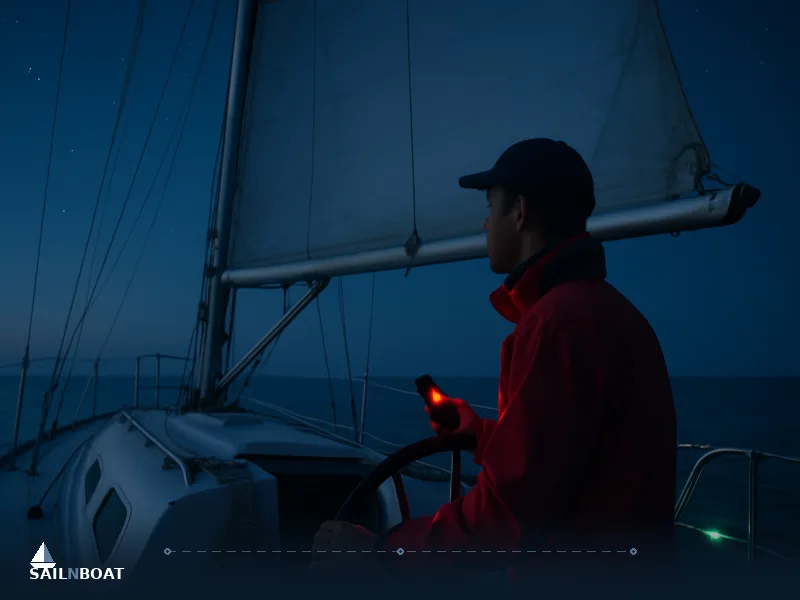
Why red and dim lighting: red or very low-intensity lighting preserves rod sensitivity in the eye because rods are far less responsive to long (red) wavelengths, so switching to red lights keeps your off-watch crew able to see outside quickly and helps the on-watch crew spot low-contrast targets.
-
Practical cockpit/chart-table setup:
-
Fit a red dome or red-filtered LED at the chart table and a dimmable red lamp in the cockpit. Keep instrument backlight levels as low as readably possible.
-
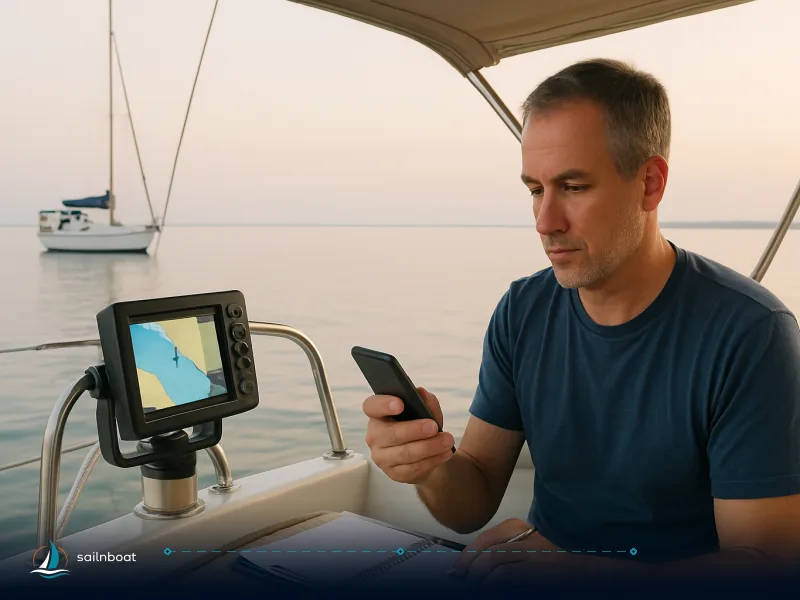
Use chartplotter “night” mode and reduce screen brightness; switch to paper charts for quick bearings or to check a position without backlight glare.
-
If someone needs to use a white light (to read a small print or handle equipment), point it down and away from other watchkeepers and switch it off immediately after use.
-
Crew prep for vision:
-
Before you set off for a night passage advise the crew to avoid bright lights for 30–60 minutes before their first night watch.
-
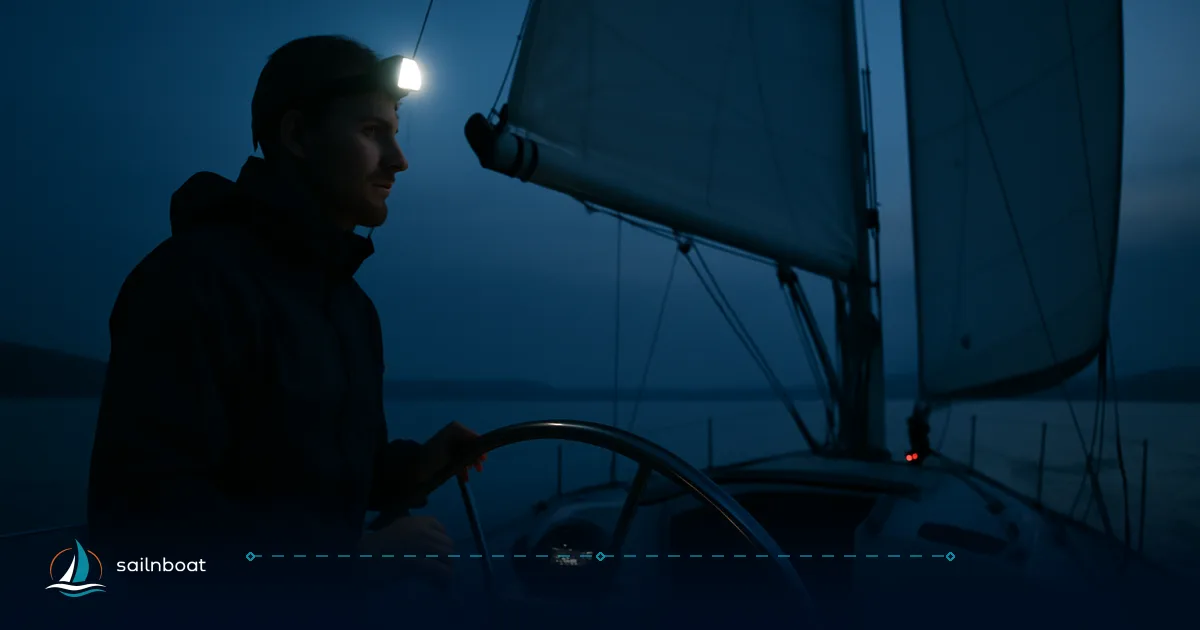
Encourage the use of small red headlamps for moving below decks and stowing gear so the helmsman’s view is not compromised.
Planning Your Night Sailing Route
Plan like you’re trading daylight for vulnerability: you have less time to react and fewer visual references.
Identifying Hazards
-
Primary checks:
-
Study electronic charts and the latest paper charts for shallow water, drying ledges, wrecks, and submarine cables. Leave a generous off-track margin where charted depths are shallow or not fully surveyed; the exact margin depends on local charts and your vessel’s draft. (Local chart data and conditions vary.)
-
Avoid or give wide berth to marked shipping lanes at night. Large commercial traffic often has limited manoeuvrability and may be operating at night with reduced visual cues.
-
Treat buoyage and lights carefully: some aids to navigation may be unlit, misaligned, or extinguished — plan alternate shelter or daylight arrival options.
-
Time-of-arrival rule:
-
Whenever possible, plan to arrive at harbours, narrow channels or unfamiliar anchorages in daylight. If you must arrive after dark, add at least one safe waypoint that allows you to slow and reassess well before the entrance.
Using Navigation Tools
- Electronic + paper: use GPS/chartplotter for continuous positioning but carry current paper charts folded and ready for quick plotting — electronics can fail or be misread at night. A portable GPS and a paper chart are simple, high-value backups.
- Radar and AIS:
- Use radar for detecting targets that lack AIS or lights, and set guard zones for intrusion alarms by range and bearing. For closest point of approach (CPA) and time to CPA (TCPA) alarms, use AIS features and/or MARPA/ARPA target tracking on the radar. Recognize radar limitations for small low-signature craft.
- AIS is invaluable for identifying large traffic and CPA (closest point of approach), but do not rely on AIS alone — many small coastal fishing vessels and pleasure craft do not transmit.
- Waypoint discipline:
- Plan intermediate, easily identifiable GPS waypoints so a single-course change is visible both on the plotter and on a quick paper-plot visual check.
- Program one ‘safe speed’ waypoint before any harbour entrance so you can stop or slow if conditions or traffic become uncertain.
Essential Equipment for Night Sailing
Treat night passages as if you were going offshore — failure modes are amplified after dark.
Safety Gear Checklist (minimum practical kit)
| Item | Why it matters |
|---|---|
| Spares for navigation lights (bulbs/fuses) and separate power feed for reserve lights | COLREGs require you to display the correct navigation lights; they do not mandate spare or reserve light systems. Offshore and many racing regulations often require independent reserve navigation lights; carrying spares is prudent seamanship. |
| Watertight hand torches (x2) + spare batteries and an approved floating torch | For search and man-overboard tasks — one should be immediately at hand on deck. |
| Searchlight (deck-mounted) with sufficient range for night pilotage and MOB search | Helps identify small targets and aids night pilotage and MOB search. |
| VHF radio (fixed) and at least one watertight handheld VHF with spare batteries | Primary short-range distress/coordination tool; handheld provides redundancy if power or antenna fail. |
| PLB/EPIRB or personal AIS/PLB units | Critical for rapid rescue notification in a true emergency; register devices as required by your SAR authority. |
| SOLAS flares or local equivalent (where required) and a floating torch for MOB | Signalling at night; check local rules and expiry dates. |
| Lifejackets with lights/strobes for night use | Lights help rescuers find a person in the water at night. |
| Paper charts, plotting tools, and a backup GPS | Electronics fail; paper charts let you confirm position and bearings. |
- Spare-navigation-lights rule: Offshore special regulations and many racing/offshore standards explicitly require reserve navigation lights and spare bulbs; for safe recreational practice carry at least one complete spare lantern/fixture or a separate, properly rated all-round white light that can be rigged quickly.
Communication Devices
- VHF practice:
- Keep Channel 16 monitored and have DSC enabled if your radio supports it. Keep a charged handheld VHF immediately accessible on deck. Avoid assuming cell coverage at night; VHF is the standard for local maritime rescue coordination.
- Redundancy:
- A charged PLB or EPIRB registered to your vessel and crew increases probability of a rapid SAR response. Additional options include satellite communicators (e.g., InReach) for text-based check-ins if you operate beyond reliable VHF range.
Organizing Crew for Night Watches
A clear, agreed watch plan is a fatigue-management and collision-avoidance tool.
Establishing Watch Systems
-
Typical watch lengths:
-
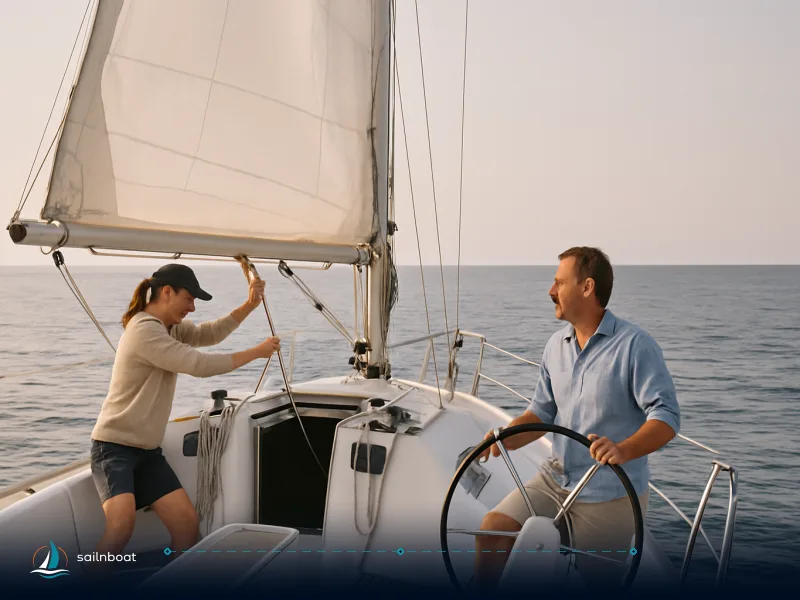
Short, defined watches in the 2–4 hour range are common for small cruising crews: two- or three-hour watches reduce fatigue-driven microsleeps, while four-hour watches give longer uninterrupted sleep blocks for off-watch crew — the right choice depends on your crew size, experience and the expected difficulty of the passage. Decide and write the schedule down before dark.
-
Watch examples table:
| Crew size | Typical night rota | Pros | Cons |
|---|---|---|---|
| 2 persons | 4 on / 4 off (or 4/4) | Longer sleep blocks; simpler rotation | On-watch person may tire during circadian low (0300–0500) |
| 3 persons | 3 on / 3 off or 2 on / 4 off | Balanced sleep and workload; flexibility | More handovers to manage |
| 4+ persons | 2–3 hour watches, overlapping handovers | Shorter fatigue windows, easier to cover busy periods | Frequent handovers to log |
- Roles and handover:
- At handover, record position, course, speed, sail configuration, engine status, notable traffic, weather changes, and any alarms set. Make the log entry quick and standardised.
- Assign a “call-the-skipper” rule: define exact triggers (e.g., any CPA < 0.5 nm, unidentified vessel on converging course, any mechanical noise, an abrupt weather change) that wake the skipper without hesitation.
Communication During Watches
- Keep on-watch communications short, standardised and calm. Use short hand signals in high noise or spray conditions and VHF for contacting other vessels or shore stations.
- Use an audible alarm (AIS, radar) and a visual checklist at each handover to reset situational awareness.
Understanding Night Sailing Regulations
Know what the rules require versus what your charter company or insurer may ask for.
Navigation Lights Requirements
-
The International Regulations for Preventing Collisions at Sea (COLREGs) require the lights prescribed for your vessel to be exhibited from sunset to sunrise and during restricted visibility; the rules also forbid lights that could be mistaken for navigation lights or impair their visibility. Small-vessel exceptions and specifics exist and depend on vessel length and type, but there is no provision for a combined masthead/sidelights unit in the COLREGs. Follow the regulations applicable to your flag/state and your vessel’s length.
-
Practical compliance:
-
Check each navigation light before departure, carry a separate power feed or battery-operated spare, and test your reserve system in daylight so you can fit it quickly if a failure occurs at night. Offshore standards explicitly require reserve lights and spare bulbs.
Local Maritime Laws
- Local rules vary: some harbours or countries require specific signals, flares or safety equipment beyond international rules. Many charter companies will list what they expect at check-in — treat their list as an operational requirement for the charter, and confirm whether missing items affect insurance cover or liability. Where rules differ between the COLREGs and national law, the local authority’s guidance applies for operations in their jurisdiction.
Final Safety Checks Before Departure
A short, scripted pre-departure routine eliminates last-minute oversights.
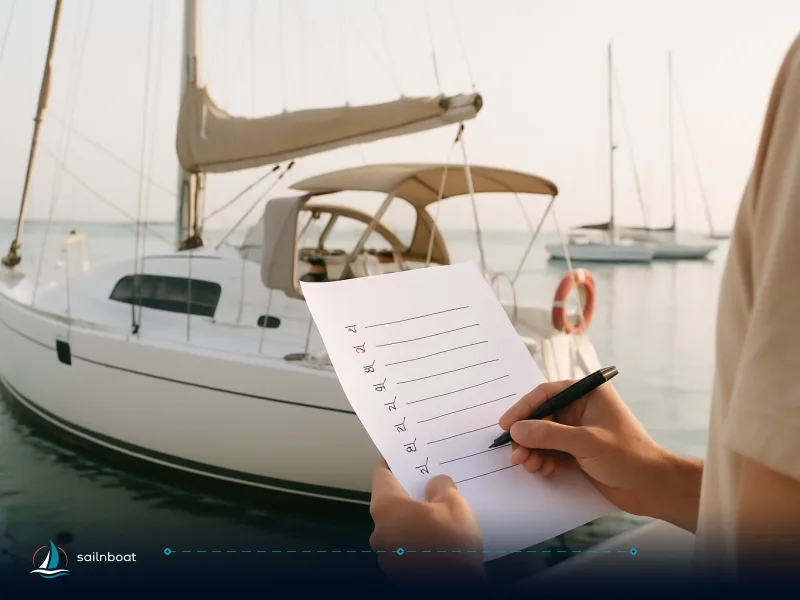
Pre-Departure Checklist (run it aloud)
- Navigation lights: test port/starboard/stern/all-round and confirm spares are accessible.
- Communications: VHF fixed power and handheld charged; DSC address registered; PLB/EPIRB charged and registered.
- Lights & spares: torches in fixed places, spare batteries and spare light bulbs/fuses in a labelled kit.
- Paper backup: current paper charts folded to the passage area, plotting tools and spare pencils available.
- Safety rigging: jacklines rigged, harnesses and PFDs located for the on-deck crew, MOB recovery gear ready.
- Watch plan: written rota posted where everyone sees it; clear handover checklist and call triggers agreed.
Emergency Preparedness
- Run a quick MOB drill before dark so everyone knows their role and the immediate procedure (helm free, throttle, man-overboard marking, MOB recovery light/torch ready, person in water observed and communicated, DSC/Mayday as needed).
- Check battery state-of-charge and alternator output; night passages can be longer—set generator or engine run plan if you expect to use instruments or searchlight regularly.
- File a float plan with shore contact or log on with a marina/harbour radio net if available; give an ETA and intended route so SAR authorities have a last-known-plan if needed.
Final thought (practical): start conservatively. If you’re new to night sailing, pick a short coastal leg for your first night run, keep an arrival in daylight as a backup, and practise the pre-departure checks, handovers and a quick MOB drill at dusk. Those practical rehearsals are what make night sailing safe — not bravado.
Frequently Asked Questions
Use red or dim lighting at the chart table and in the cockpit, dim instrument brightness and avoid bright white cabin lights; limit exposure to phone screens and bright sources just before and during your watch.
Plot a route that avoids shoals and heavy traffic, set waypoints with safe off-lying margins, check tides and lights/marks, plan to arrive in daylight where possible, and carry both electronic and paper charts.
Spare navigation lights, bulbs and fuses; watertight hand torches and a searchlight; working VHF (fixed and handheld preferred); PLB/EPIRB or registered PLBs for crew; and SOLAS-compliant flares where required.
Agree a written watch rota before dark (typical short watches are 2–4 hours), assign roles and handover checklist items, set clear 'wake-for' triggers, and log position and traffic at every change.
COLREGs require prescribed navigation lights to be exhibited from sunset to sunrise and during restricted visibility; small craft provisions and positioning vary by type and length of vessel.
Written by
Sailnboat Editorial
The Sailnboat editorial desk covers yacht and boat chartering worldwide — routes, bases, seasons, boat types, paperwork and the practical costs that decide a trip. We are a charter marketplace, not a boat owner or a local agency: what we sell is judgement and support, so our guides are written to help you make a decision, not to sell you a specific boat. Every guide is checked against live operator and marina data before it goes out.
Fact-checked against live operator and marina data, and published under our editorial standards. Last reviewed: .